How to Cost a Recipe Step by Step (With a Real Worked Example and Template)
Learn how to cost a recipe step by step: yield loss, cost per portion, food cost % and menu price, with a full worked example and a free template.

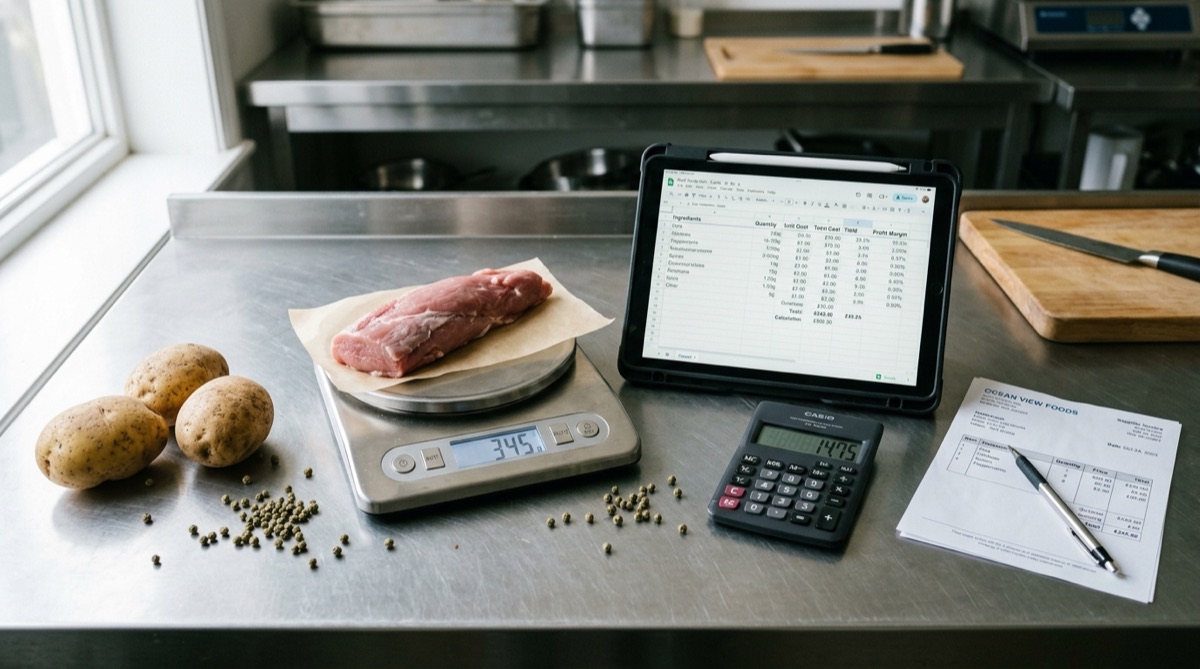
I’ve spent over fifteen years walking into other people’s kitchens with a scale, a laptop, and a promise not to judge. And every single time, the moment I ask for the recipe costing of a dish is the one that generates the most awkward silences. Some show me a napkin with four numbers scrawled on it. Others pull up a spreadsheet that became obsolete when tenderloin cost €7. And most of them just tell me they “keep it in their head.”
No business survives with costs in its head. I’ve seen bars lose €8,000 a year on a single dish because nobody subtracted the real yield loss from the vegetables. And I’ve seen entire menus sink because the selling price was set with the VAT incorrectly applied. So today I want to walk you through, step by step, how to do the recipe costing of a dish just as you would with me in an audit: no smoke and mirrors, clear formulas, and the same method that works for a tenderloin, a croquette, a cocktail, or a cake.
ChefBusiness · Real profitabilityMaximize your restaurant without losing moneyCost control and food marketing. Book your ChefBusiness consulting now.Get the consulting →What is a recipe costing for a dish and what is it for?
A recipe costing is the detailed calculation of the raw material cost of a recipe per portion. In plain terms: how much the ingredients for each dish you serve cost you. But it’s not just a sum of prices. It’s the tool that tells you whether that dish can exist on your menu without bankrupting you, and at exactly what price it must be sold for the business to breathe.
The recipe costing gives you the cost per portion, and with that figure you set the minimum selling price and verify the actual food cost. Without a recipe costing, you price by instinct. And instinct doesn’t pay wages.
Recipe costing vs kitchen spec sheet: the difference that confuses everyone
The kitchen spec sheet is the complete production document: ingredients, quantities, method, allergens, photos, yield, equipment… It includes the recipe costing, but is not limited to it. The recipe costing is the financial part of that sheet. If you want to dive deeper into the full sheet, you have the complete guide to recipe costing and also a section dedicated to the kitchen spec sheet with everything it should contain. And if this distinction still trips you up, I break down the difference between recipe costing and a spec sheet in detail, with a comparison table and a worked example.
In my audits, I usually see spec sheets that only feature the recipe, without costs. Or loose recipe costings without standardised methods. Both mistakes cost you money.
Why a poorly done recipe costing costs you thousands of euros per year
Imagine a dish you sell 40 times a day. An error of €0.30 in the real cost (because you didn’t deduct the potato yield loss or used the VAT-inclusive price) becomes €12 a day, €360 a month, over €4,000 a year for a single dish. Multiply that across a menu of 20 items. The hole is silent and constant. That’s why I insist so much on the difference between theoretical vs actual food cost: the theoretical is what you think you spend; the actual is what disappears from the walk-in.
The 7 facts you need before you start
Before you even touch the calculator, there are two concepts that fail more than a fryer without oil. Learn them because they are the foundation of everything that follows.
Gross weight vs net weight: the yield loss almost nobody subtracts correctly
Gross weight is what you buy: the whole piece, the vegetable with its skin, the fish with bones. Net weight is what actually ends up on the plate after trimming, peeling, boning, and cooking. The difference between the two is the yield loss (or trim loss), and it is expressed as a percentage.
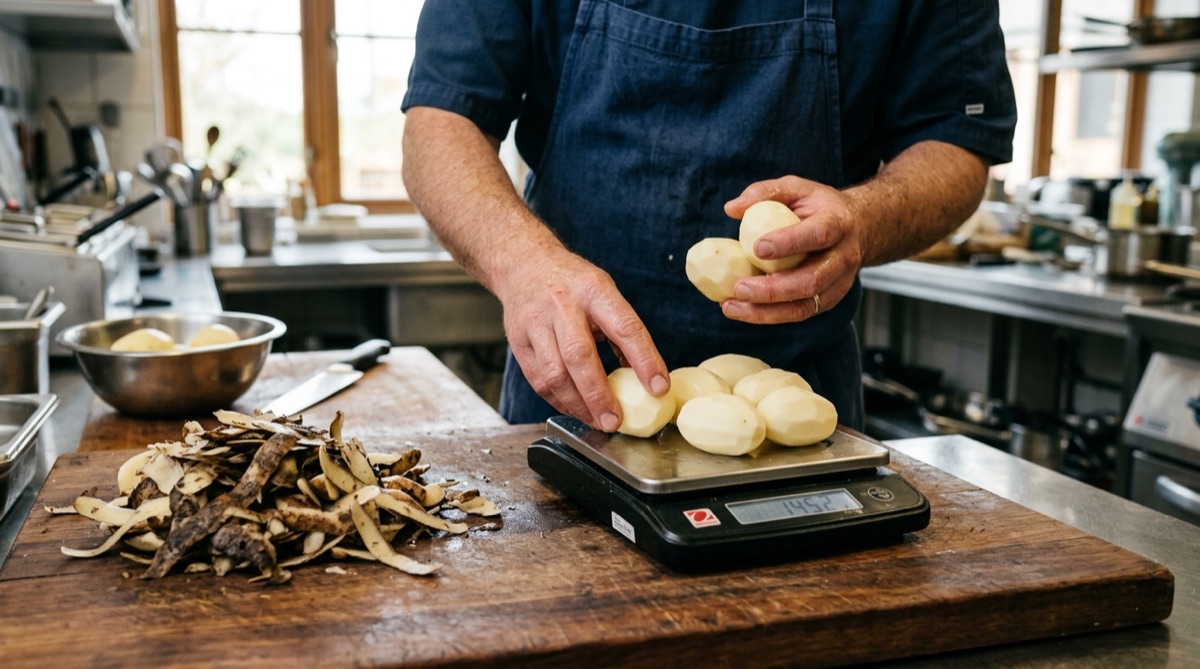
In hospitality, yield loss is not an accident: it’s a cost. If you buy 1 kg of carrots at €1.20 and you peel away 30%, the real cost is not €1.20/kg, because you only get 700 g of usable product. That 30% yield loss pushes the net kilo cost to €1.71. If you don’t reflect that in the recipe costing, you are falsifying the cost.
The correct purchase price: always WITHOUT VAT and from the invoice
The VAT rate for hospitality in Spain is 10%, but in recipe costing all purchase prices are used without VAT. You collect the VAT on sales and settle it later; it is not a cost for you. If you enter prices with VAT, you artificially inflate the cost and end up setting a selling price higher than necessary or, worse, believing a dish isn’t profitable when it actually is. Always check the supplier’s invoice and use the net price.
How to do a recipe costing of a dish step by step
Let’s get to the method. These seven steps are exactly the ones I apply when auditing a restaurant, whether it’s a ham croquette, an author cocktail, or a cheesecake. The logic doesn’t change.
Step 1. List all the ingredients and the quantity per portion
Write down every ingredient of the standardised recipe. Include oil, salt, spices, and garnishes, which tend to be the great forgotten ones. A pinch of freshly ground black pepper costs money; a splash of extra virgin olive oil to sear the meat, too. If the recipe is not standardised (meaning the cook adds “a bit” of wine depending on the day), the recipe costing will be pure fiction. Stick to the recipe, not a rough eye.
Step 2. Calculate the yield loss and net weight (yield)
Subtract both the trimming and cooking losses from the gross weight. The yield formula is:
Yield % = (Net weight / Gross weight) × 100
For example, if you need 200 g of peeled potato and the total yield loss (peeling + trimming) is 20%, the gross weight you need to buy is 200 / (1 − 0.20) = 250 g. Those 50 g extra are a cost you pay even though they never reach the plate. If there is also cooking loss (a roast that shrinks by 15%), you apply it on the clean net weight. That way you obtain the final net weight you actually serve.
Step 3. Calculate the real cost of each ingredient including yield loss
This is the trick that separates a real recipe costing from a toy one. The purchase price without VAT is applied to the gross quantity needed, not the net. The formula is:
Ingredient cost = (quantity per portion × price per unit) / (1 − %yield loss)
Sticking with the potato: you need 200 g net, yield loss is 20%, price is €1.20/kg without VAT. Cost = (0.200 kg × €1.20) / (1 − 0.20) = 0.24 / 0.80 = €0.30. Had you ignored the yield loss, you would have recorded €0.24. Those 6 cents’ difference, repeated across every ingredient, are the hole I mentioned earlier.
Step 4. Add up the total recipe cost
Total cost = sum of the cost of all the ingredients
Add the cost of each ingredient, already calculated with its yield loss. This gives you the raw material cost of the entire recipe, whether for one portion or for a preparation that yields several portions (a stock, a mother sauce, a base dough). If the recipe yields several portions, this will be the total batch cost.
Step 5. Divide by the number of portions: cost per portion
Cost per portion = Total cost / number of portions
If you’ve calculated the cost of a litre of sauce and use it across 20 dishes, divide by 20. If the recipe is already adjusted for one portion, the total cost and the cost per portion are the same. This figure is the one that rules: from here you decide whether the dish lives or dies.
Step 6. Apply the target food cost and calculate the selling price
The target food cost is the maximum percentage of revenue you want to allocate to raw materials. It depends on the type of venue (I’ll give you a table later), but for a main course in a casual restaurant it usually sits around 30%. The formula to get the minimum selling price without VAT is:
Selling price ex-VAT = Cost per portion / (1 − target food cost)
If your cost per portion is €2.80 and your target food cost is 30% (0.30), the minimum selling price ex-VAT is 2.80 / (1 − 0.30) = €4.00. Then you add the VAT (10%): 4.00 × 1.10 = €4.40. That is your price floor, not your final price. Below that, you lose money. Then you adjust based on the market, competition, and perceived value. To better understand how cost and final price relate, you can read the article on selling price and margins.
Step 7. Check the actual food cost % and margin
Once you’ve set the actual selling price you’ll use on the menu (VAT included), calculate the actual food cost and the gross margin. First, get the selling price ex-VAT: menu price / 1.10. Then:
Food cost % = (Cost per portion / Selling price ex-VAT) × 100
Gross margin = Selling price ex-VAT − Cost per portion
If the actual food cost shoots above your target or the margin doesn’t cover the rest of expenses (staff, rent, utilities), you need to adjust: reduce the recipe cost (swap an ingredient, trim the portion) or raise the price. But always with numbers, not gut feeling. To find out how many dishes you need to sell to cover all expenses, use the break-even calculator.
AI Chef Pro · AI for chefs55+ AI tools for your kitchenCreate recipes, menus and optimize costs free. Try AI Chef Pro now.Try it free →Fully worked real example: end-to-end recipe costing of a dish
Let me give you the same example I use in my training sessions: a pepper pork tenderloin with a potato side. It’s a dish that looks simple but hides yield losses and costs that many overlook.
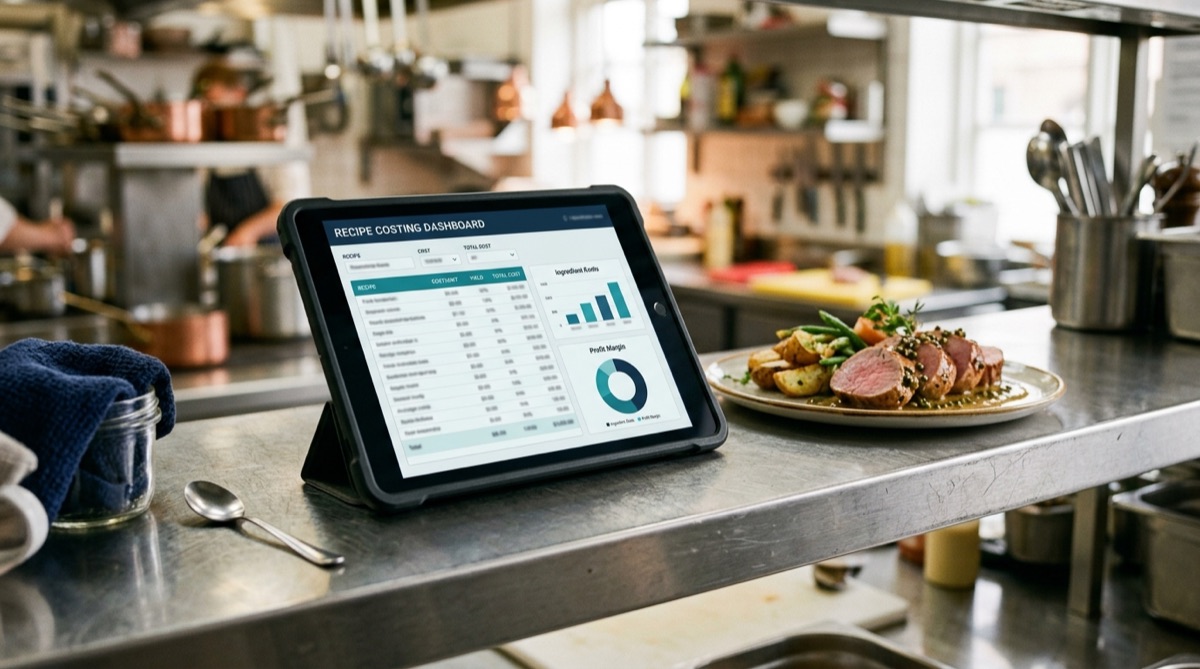
The recipe costing table filled with real numbers
| Ingredient | Gross weight | % yield loss | Net weight | Price €/kg (ex-VAT) | Cost |
|---|---|---|---|---|---|
| Pork tenderloin | 180 g | 10 % | 162 g | €9.50 | €1.90 |
| Potato | 200 g | 20 % | 160 g | €1.20 | €0.30 |
| Cooking cream | 50 ml | 0 % | 50 ml | €2.80/L | €0.14 |
| Green peppercorns | 5 g | 0 % | 5 g | €28.00 | €0.14 |
| Stock / dark base | 30 ml | 0 % | 30 ml | €3.50/L | €0.11 |
| EVOO, salt and garnish (butter/parsley) | — | — | — | — | €0.21 |
TOTAL RAW MATERIAL COST = €2.80 (it’s 1 portion, so cost per portion = €2.80).
From cost per portion to selling price with VAT and margin
With a target food cost of 30%, the minimum selling price ex-VAT would be:
2.80 / (1 − 0.30) = €4.00 (€4.40 with VAT). That is your floor, not your final price.
In the real market, a pepper pork tenderloin with a side dish moves around €13.90 (VAT included). So let’s use that menu price. The selling price ex-VAT is 13.90 / 1.10 = €12.64.
We check the actual food cost: (2.80 / 12.64) × 100 = 22.2%. The gross margin on raw material is 12.64 − 2.80 = €9.84 per portion (77.8%).
Conclusion: this dish, at €13.90, has a food cost of 22% and nearly €10 of gross margin. It’s a profitable dish… today. But as soon as the tenderloin jumps from €9.50 to €11.00/kg, your Excel recipe costing becomes obsolete. If you work with a tool that updates prices automatically, the recipe costing recalculates itself without you having to chase invoices.
What is food cost and what percentage is advisable per type of venue
Food cost is the percentage that the cost of raw materials represents against sales revenue. It’s the most watched metric in hospitality, but there is no single magic number. It depends on the type of business, the average ticket, and the expense structure. If you want a free food cost calculator to run simulations, it’s linked there.
Recommended food cost % table by type of business
| Type of venue | Recommended food cost % |
|---|---|
| Fine dining | 28-32 % |
| Casual / set menu | 30-35 % |
| Fast casual | 25-30 % |
| Café | 35-40 % |
| Artisan pizzeria | 20-26 % |
| Cocktail bar | 18-25 % |
| Pastry / bakery | 25-35 % |
These ranges are indicative. A cocktail bar can afford a lower food cost because the added value lies in the preparation and the atmosphere; a café, with lower tickets, needs tighter margins. The important thing is that you know your own figure and use it to set prices, not to justify losses.
From markup multiplier to margin: how to read your number
Many owners use the old trick of “multiply the cost by three and that’s it.” That x3 multiplier roughly equates to a food cost of 33% (1/3 = 0.33). Multiply by 4, and you aim for 25%. The relationship is:
Multiplier ≈ 1 / target food cost
So if you want a 28% food cost, your multiplier is 1/0.28 ≈ 3.57. But the multiplier is just a shortcut; it doesn’t replace the recipe costing because it doesn’t account for real yield losses or price variations. It’s better than nothing, but worse than a well-executed recipe costing.
Frequent mistakes when doing a recipe costing (and why your Excel ages)
After hundreds of audits, I have a list of mistakes that repeat like yesterday’s bread. Here are the six most expensive ones.
The 6 mistakes I see in every audit
- VAT-inclusive prices. I’ve said it, but I’ll repeat: VAT is not a cost. If you include it, you falsify the entire recipe costing.
- Not subtracting cooking loss. Meat loses weight when roasted, vegetables when blanched. That loss isn’t in the bin, but it disappears from the plate. It must be accounted for.
- Forgetting oil, salt and spices. A drizzle of EVOO, a few flakes of salt, pepper from the mill… they add up. In one dish they are cents; in a thousand dishes, a significant expense.
- Not updating supplier prices. The spreadsheet you created in January with the tenderloin at €9.50 is useless in March if the supplier has raised it to €11. The recipe costing ages with every invoice.
- Not accounting for sub-preparations. Mother sauces, stocks, base doughs, dressings… each has its own recipe costing and you must allocate its cost to the final plate. Otherwise, you’re giving away labour and raw materials.
- Confusing theoretical cost with actual cost. The theoretical is from the recipe costing; the actual is what comes out when comparing what you bought with what you sold. The difference comes from uncontrolled waste, theft, portioning errors, or recipes not being followed. That difference eats your margin. I discussed this in the article on theoretical vs actual food cost.
The underlying problem: recipe costing is not a snapshot, it’s something alive
The biggest mistake isn’t a calculation error, it’s a mindset error. Treating recipe costing as a static document that is done once and filed away. Prices fluctuate, yield losses change depending on the batch of produce, recipes evolve. A recipe costing that isn’t updated is a lovely decoration that doesn’t protect your bottom line.
Template and calculator: from Excel to a recipe costing that updates itself
Excel is a good starting point. It forces you to sit down, weigh, and calculate. But in the day-to-day of a restaurant, keeping 50 recipe costings up to date in spreadsheets is a titanic task that almost nobody does. That’s why more and more hospitality professionals are switching to tools that link recipe costing with purchase prices and recalculate costs automatically.
If you’re just getting started, you can create your first recipe costing for free and see how a system works that keeps your numbers alive. It’s not about abandoning the knowledge of recipe costing, but about freeing yourself from manual updating so you can focus on what really matters: making decisions with real data. Also, if you need inspiration, you can check solved recipe costings by type of restaurant to see how other businesses apply these same principles.
Timlup · Team on trackDaily checklists & tasks for your restoKeep your team on point with recurring tasks. Meet Timlup and simplify operations.Meet Timlup →Frequently Asked Questions About Recipe Costing
What is the formula for the recipe costing of a dish?
The full formula is: Cost per portion = Sum of (gross quantity × unit price) / (1 − %yield loss) for each ingredient. From there, the minimum selling price ex-VAT is calculated as Cost per portion / (1 − target food cost), and the actual food cost as (Cost per portion / Selling price ex-VAT) × 100. There isn’t one single formula, but a chained process we’ve detailed in the seven steps.
What is yield loss and how is it calculated in a recipe costing?
Yield loss is the loss of weight or volume of an ingredient from the moment it’s purchased until it’s served, whether due to trimming (peeling, boning) or cooking (evaporation, reduction). It is calculated as % Yield loss = (Gross weight − Net weight) / Gross weight × 100. To allocate it to the cost, you divide the gross cost by (1 − %yield loss). That way you also pay for the part you don’t use.
What is the difference between recipe costing and a kitchen spec sheet?
The recipe costing is the financial calculation of the ingredients and their cost per portion. The kitchen spec sheet is the complete document that includes, in addition to the recipe costing, the method, allergens, yield, equipment, and photos of the dish. Recipe costing is a part of the spec sheet. You can expand on this difference in the complete guide to recipe costing.
What percentage of food cost is advisable?
It depends on the type of business. In fine dining, it runs between 28-32%; in a casual restaurant or set menu, between 30-35%; in fast casual, 25-30%; in a café, 35-40%; in an artisan pizzeria, 20-26%; in a cocktail bar, 18-25%; and in a pastry shop or bakery, 25-35%. These are indicative bands that you should adjust to your own cost structure.
How do you calculate the selling price of a dish from its cost?
With the cost per portion already calculated, apply the formula Selling price ex-VAT = Cost per portion / (1 − target food cost). Then add VAT (10% for hospitality in Spain) by multiplying by 1.10. That is your minimum price. From there, adjust based on the market and round to a psychological price point. The article on selling price and margins explains it in more detail.
Is VAT included in the recipe costing?
No. All purchase prices for ingredients must be without VAT, because input VAT is deductible and does not form part of the real cost. VAT is only applied at the end, on the selling price, to obtain the menu price. Including VAT in the recipe costing inflates the cost and distorts the food cost calculation.
How do you do a recipe costing in Excel and why does it become obsolete?
You can do a recipe costing in Excel by creating a table with ingredients, quantities, yield losses and prices, and applying the formulas from the seven steps. The problem is that supplier prices change every week and yield losses vary depending on the batch. An Excel file doesn’t update on its own; it requires someone to review invoices and modify cells constantly. That’s why most recipe costing spreadsheets I see in audits are outdated and give a false sense of control.