Professional Recipe Book: What It Is & How to Create One
What a professional recipe book is, why it matters in hospitality, and how to create yours step by step. With an example, paper vs digital, and FAQ.


If you’ve ever felt your kitchen runs at two speeds — the one you set and the one the other shifts improvise — this article is going to sting a little… and you’re going to love it. I’m talking about that document many see as a heavy binder, which is actually the DNA of a profitable hospitality business: the kitchen recipe book.
As a food business consultant, I’ve set foot in enough workshops, pastry shops, bars, and hotel kitchens to know: when a team isn’t pulling together, it’s not a lack of attitude, it’s a lack of reference. And that reference doesn’t come from a chat on the pass; it comes from a well-structured professional recipe book. I’m not talking about a notebook of home recipes — I’m talking about a living system that standardizes, trains, makes profitable, and protects your concept.
Let me walk you through everything you need to know to finally build a kitchen recipe book that truly works for you.
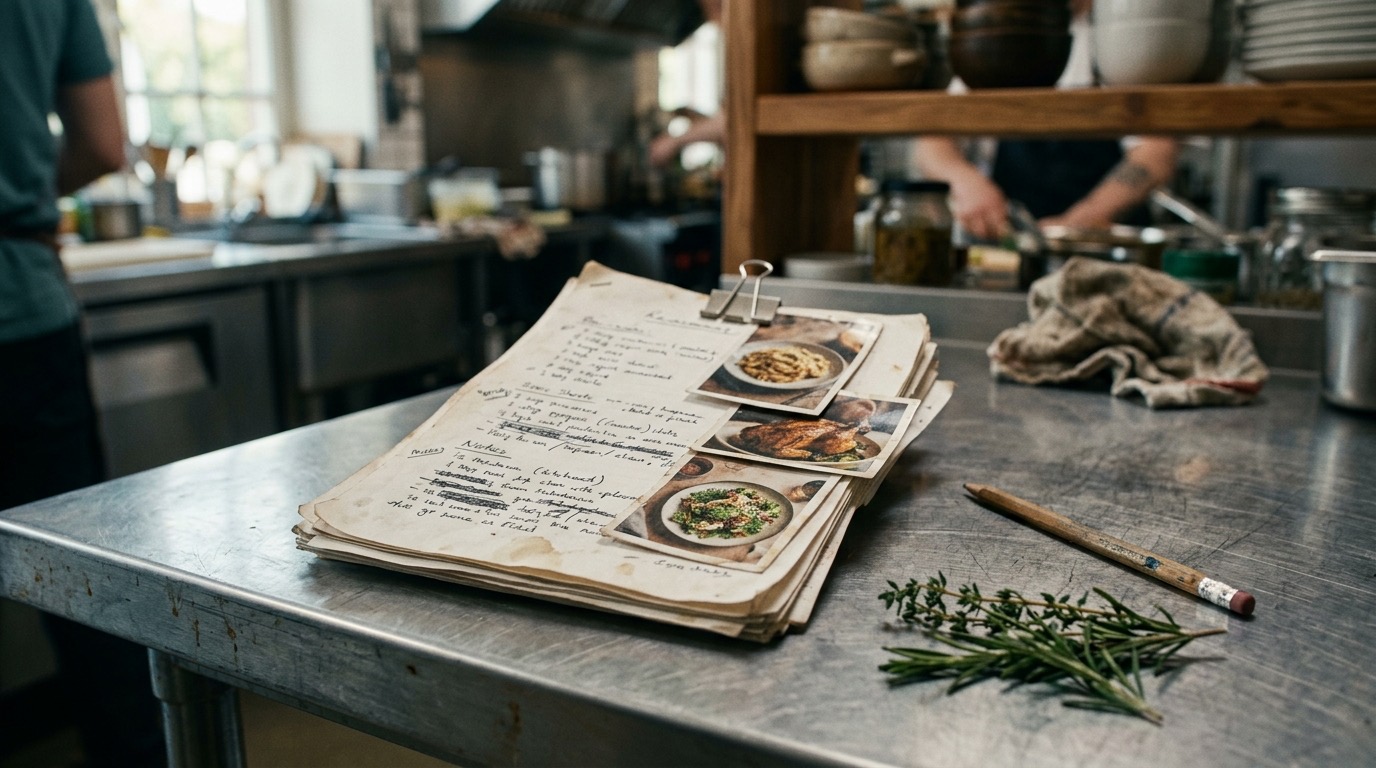
What is a kitchen recipe book?
In a professional setting, a kitchen recipe book is much more than a collection of dishes. It’s a management tool that gathers all of a venue’s preparations in a standardized, measurable, and repeatable way. Each recipe becomes a spec sheet detailing ingredients, quantities, yield loss, costs, allergens, and procedures. It leaves no room for interpretation, no space for “I do it my way.”
While at home a recipe collection tends to be emotional and flexible, in hospitality it’s a working document that directly impacts the bottom line. A professional digital recipe book also allows you to keep it alive: update prices, scale portions, or print allergen labels without redoing calculations by hand. In short, it’s the operational backbone of a food business.
Why a recipe book is crucial in a professional kitchen
I’ve seen beautiful menus that couldn’t last two months because there was no recipe book behind them. And the opposite: restaurants with zero glamour but flawless spec sheets that handle 300 covers a day without breaking a sweat. The recipe book makes that difference.
Real standardization: when every cook works from the same sheet, flavor, weight, and presentation are replicated across all shifts. The unexplainable variations and the friction between team members disappear.
Profitability starting at prep: a recipe book with built-in yield loss and cost per portion tells you the truth that the average ticket hides. If you don’t know how much each dish costs you, you’re competing blind. According to industry data, rigorous recipe-cost control can reduce raw material costs between 3% and 7% annually. For a kitchen generating €400,000 a year, that’s up to €28,000 in potential savings just by knowing what’s happening inside every cooler.
Accelerated team training: the recipe book is the onboarding manual for any new hire. Instead of weeks of “watch how I do it,” you hand over clear spec sheets, and the learning curve shrinks to days. Less dependency on individual talent, more strength as a system.
Scale without breaking: if your production kitchen today serves one location and tomorrow two, or your cocktail bar moves to bottling for distribution, you need parameterized recipes. That’s the only way to scale formats, maintain quality, and control margin.
To sum up: a professional recipe book isn’t a luxury for large restaurants; it’s the survival tool for any hospitality business that wants to stop putting out fires and start building.
What every recipe in your book must include
A recipe in a hospitality recipe book isn’t a literary description; it’s a spec sheet. If it doesn’t have these fields, it’s not operational. These are the minimum blocks I insist on for every one:
| Field | Brief description |
|---|---|
| Recipe name | Clear, unambiguous (avoid internal names only the chef understands). |
| Number of portions | Base reference for scaling (e.g., 10 portions). |
| Ingredients with net quantities | After applying yield loss; specify whether weight is gross or net. |
| Uniform unit of measure | Always in g, ml, pc… no “a pinch” or “to taste.” |
| Declared allergens | Per ingredient and for the complete recipe, with the option to indicate traces. |
| Required equipment | Pots, molds, Pacojet, thermometer, etc. Don’t let the team improvise tools. |
| Step-by-step procedure | Numbered instructions, concise, in measurable time and form. |
| Photo of the finished dish | The visual reference is part of standardization. |
| Temperatures and times | Baking, cooking, tempering… anything critical to the outcome. |
| Cost per portion | Ingredients + energy consumption and other direct costs if applicable. |
| Suggested selling price | Based on recipe costing and the defined gross margin. |
If you also use a system like Miselup, each sheet can automatically include allergen labeling, portion scaling, or the updated cost based on the latest purchase. That turns your static recipe spec sheet template into a daily profitability engine.
ChefBusiness · Real profitabilityMaximize your restaurant without losing moneyCost control and food marketing. Book your ChefBusiness consulting now.Get the consulting →How to create your kitchen recipe book step by step
Building a professional recipe book doesn’t require a master’s degree, but it does require method. This is the plan I’ve applied in dozens of kitchens, from neighborhood bakeries to 4-star hotels:
- Define the recipe book index: group your preparations by categories (starters, sourdoughs, syrups, signature cocktails…) so anyone can navigate it.
- Choose a standard template: always use the same format for every recipe. You can start with a recipe spec sheet template and adapt it to your craft (cooking, pastry, barista).
- Weigh, measure, and record live: don’t write sheets from memory. Prepare each recipe while recording actual quantities, real yield losses, and exact times.
- Calculate the cost of each ingredient: you need the updated purchase price of every product. Link the sheets with your recipe costing so that costs update automatically every time a supplier raises prices.
- Complete all sheets and verify: review with the team that each step is understood and that the final weights match what you recorded.
- Digitize the recipe book: if you use Word or Excel, you’ll soon notice limitations. A system like Miselup connects recipes, spec sheets, and costings so that costs, allergens, and portion scaling update on their own.
- Share and train: upload the recipe book to an environment the whole team can access without excuses. If it’s digital, generate a public URL so every cook can pull up the sheet from their phone mid-service.

Paper, Word, or Excel recipe book… or a digital recipe book
Handwritten sheets were the standard for decades… and also the source of many kitchen dramas. This table sums up what actually happens when you choose each format:
| Functionality | Notebook / Paper | Word / Excel | Digital recipe book (Miselup) |
|---|---|---|---|
| Cost updates | Manual and slow; sky-high error risk. | Semi-manual with formulas; files that break. | Automatic when you change the purchase price. |
| Allergen management | Scattered notes; danger of omission. | Requires intense manual maintenance. | Automatic calculation and labeling per recipe. |
| Portion scaling | Manual calculation on every order. | Possible with formulas, but fragile. | Instant and error-free. |
| Recipe search | Slow; depends on the physical index. | System search, but multiple files. | Centralized search and immediate access. |
| Sharing with the team | Photocopies or WhatsApp photos. | Emails or network files; duplicated versions. | Public URL, controlled access, and always up-to-date. |
| Common errors | Cross-outs, stains, lost notebook. | Broken links, obsolete versions, not-updated numbers. | Virtually eliminated if the input data is correct. |
A living digital recipe book removes the most dangerous friction in hospitality: misinformed teams. And if that recipe book also lets you generate complete spec sheets and functional costings, you’re safeguarding profitability without spending extra hours in Excel. If you haven’t made the switch yet, this comparison can help with moving from paper recipe books to digital.
Example of a recipe book sheet
So you can see how theory translates to paper (or screen), here’s a brief, real spec sheet for fresh pasta, designed for a prix-fixe restaurant:
- Recipe name: Egg tagliatelle (base for 4 plates)
- No. of portions: 4 portions of 150 g raw
- Ingredients (net and yield loss):
- Durum wheat semolina: 300 g
- 00 flour: 200 g
- Whole egg: 250 g (5 medium eggs, 10% shell loss)
- Fine salt: 5 g
- Extra virgin olive oil: 10 g
- Allergens: gluten, egg.
- Equipment: planetary mixer with dough hook, motorized pasta machine, floured tray.
- Procedure:
- Mix flours and salt in the mixer bowl.
- Add lightly beaten eggs and the oil. Knead on medium-low speed for 8 minutes until you get a smooth, elastic dough.
- Wrap in film and rest in the fridge for 30 minutes.
- Roll out to thickness no. 5, fold, and cut 7 mm tagliatelle.
- Flour and place on trays; keep refrigerated for a maximum of 24 h or blast chill for freezing.
- Photo: [image of the plated dish]
- Cost per portion (4 portions): approximately €0.42 (calculated with semolina at €1.20/kg, flour at €0.80/kg, eggs at €0.18/pc, and EVOO at €4.50/l).
Thanks to this sheet, the team knows exactly how many eggs they need per batch, how much each pasta dish costs, and which allergens to declare. In fact, this pasta is a good example of an intermediate preparation: a base used inside other dishes whose cost propagates to all of them. And if the price of eggs changes tomorrow, a digital recipe book updates the cost in every recipe using them without touching a single comma.
AI Chef Pro · AI for chefs55+ AI tools for your kitchenCreate recipes, menus and optimize costs free. Try AI Chef Pro now.Try it free →Frequently asked questions
What’s the difference between a recipe book, a spec sheet, and a recipe costing?
The spec sheet describes the procedure and standardized ingredients. The recipe costing is the calculation of the cost for each dish or product. And the recipe book is the organized collection of all the spec sheets. They work together, but each answers a different question: how it’s made, how much it costs, and where it’s documented.
What must a professional kitchen recipe book include as a minimum?
Every recipe must include the name, number of portions, ingredient list with net quantities and yield losses, allergens, equipment, step-by-step procedure, photo, cost per portion, and suggested selling price. These aren’t optional fields if you aim to standardize, train, and be profitable.
Is it still worth having a paper or Excel recipe book today?
For very small businesses or a sole proprietor with a menu that rarely changes, it may be enough. As soon as you have rotating teams, multiple references, or a need to scale, the digital format becomes almost mandatory. The time wasted updating costs or hunting for allergens on loose sheets translates into inefficiency and potential food-safety issues.
How do I start creating a recipe book from scratch?
I’d start by defining the categories, then pick a spec sheet template, and record each preparation as I make it (actual weights, yield losses). Next, link the ingredients with their purchase prices through costings, and digitize everything on a platform that keeps the data alive. That way, every supplier update is automatically reflected across the entire recipe book.
How often should a professional recipe book be updated?
Whenever a supplier, a raw material, or a preparation changes. If you work with live kitchen spec sheets, costs update on their own when you modify the purchase price. But I also recommend auditing the complete recipe book at least once per season to review procedures, photos, and profitability.
Do I need a different recipe book for each area of the business?
Not necessarily. A single system can house cooking, pastry, and cocktail recipes as long as each sheet is adapted to its craft (units of measure, equipment, etc.). The key is for all of them to share the same cost and allergen logic so that global reports are reliable.
Your recipe book shouldn’t be a binder you only open when the tax office calls. It should be the tool you use every day to make your kitchen profitable, predictable, and teachable. If after reading this you feel your current method is closer to chaos than to control, maybe it’s time to move to a living recipe book. As John Guerrero, I can assure you the kitchens I’ve seen take off aren’t the ones making the most creative dishes, but the ones executing the same dishes equally well every single day. And that only happens when every recipe is where it should be: documented, costed, and ready to scale.