Recipe costing for bakeries and pastry shops
Recipe costing for bakeries and pastry shops: cost per batch and per piece, baking loss and nested bases, with a croissant table and a real example.

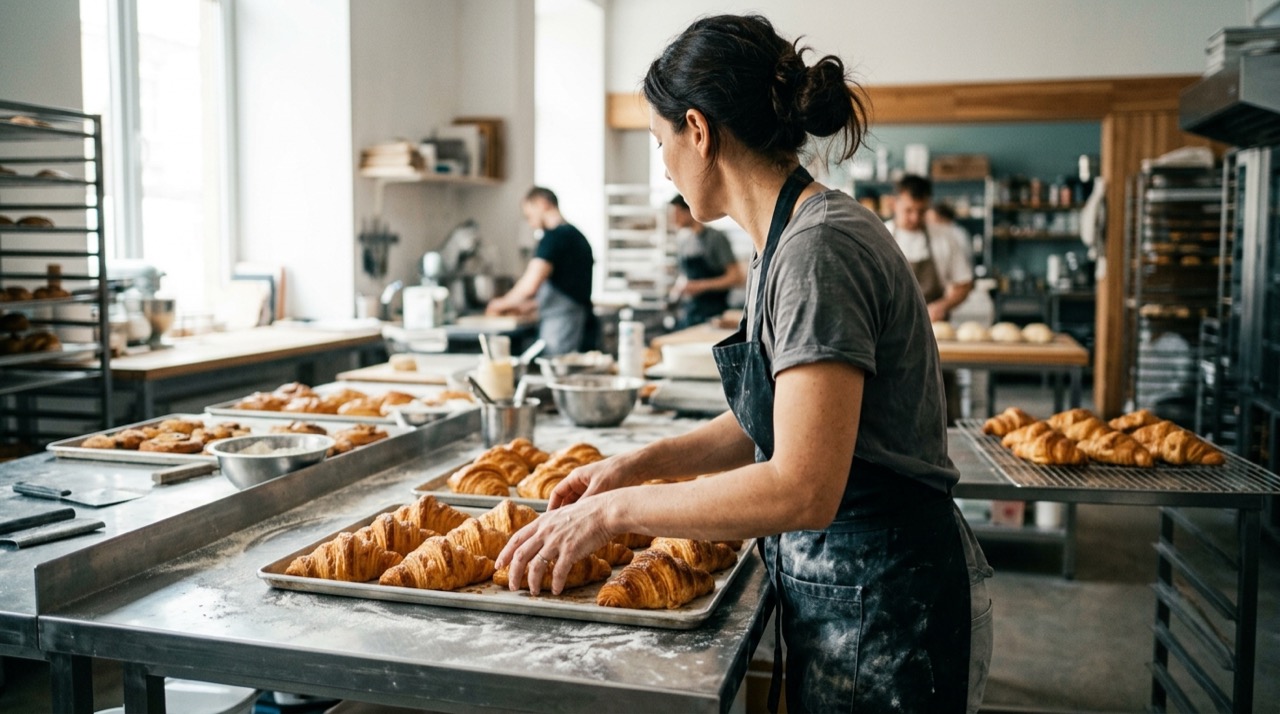
I’ve seen too many bakeries and pastry workshops lose money over a detail that seems innocent: costing as if each croissant were a restaurant plate. In a restaurant, you plate a dish per order, period. In pastry and baking, you’re dealing with batches of 30, 60, or 200 units, doughs that lose weight in the oven, and creams, ganaches, and sourdough starters used in ten different recipes. If your cost breakdowns don’t reflect that reality, every month-end you’ll wonder why profit is lower than you expected.
The good news is that recipe costing for pastry has four clear rules—once you master them, you get absolute control over recipe costs for your bakery. In this article I’ll show you how to apply them, with real examples and exact numbers, so you can bring them into your workshop today. Because costing in baking and pastry isn’t a “nice to have”; it’s the tool that tells you whether a product is making you money or taking it away.
Why costing in a bakery/pastry workshop is different
When I consult for a bakery, the first thing I review is how they’re calculating their costs. Almost always I find the same fundamental mistake: they use the logic of an individual plate—a cost breakdown designed for “one portion = one order.” But a bakery works differently. Just as recipe costing for food trucks and ghost kitchens requires adapting the method to its format, the bakery imposes its own. There are four key particularities that make all the difference and that no costing can ignore.
Batch production: not a plate, it’s a batch
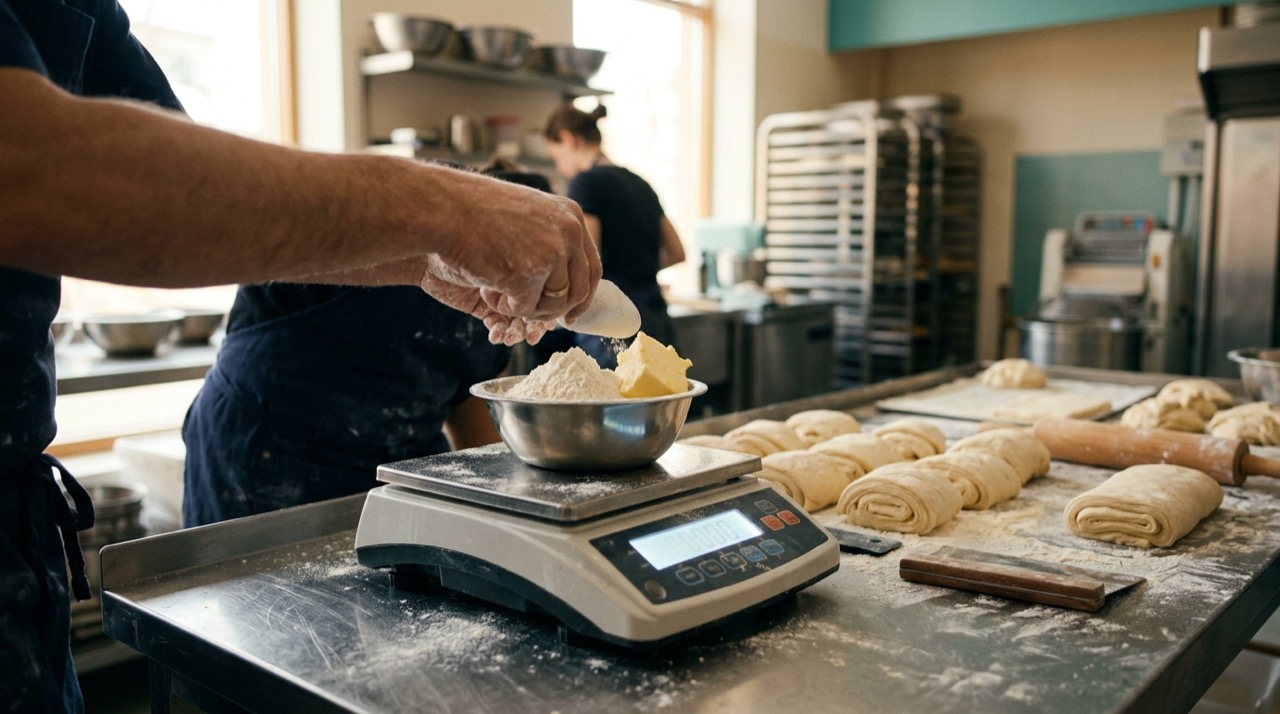
In a bakery you don’t bake a single unit; you bake an entire batch. The recipe cost is calculated for the whole batch, then divided among the units that actually go to sale. If you don’t know the real yield in pieces—because of trimmings, deformed units, or baking losses—your unit cost goes off the rails. Costing a croissant as if it were a single plate is shooting blind. Real pastry costing starts with the batch and ends with the sellable piece.
Baking and cooling losses: the weight isn’t the same
Raw dough and the baked piece don’t weigh the same. A bread dough can lose between 15% and 20% of water during baking. If you sell by weight—bread per kilo, for example—the cost per kilo of the finished product is significantly higher than that of raw dough. Many bakeries set their bread price based on raw dough cost and unknowingly bleed capital. If you sell by piece, water loss doesn’t affect the cost per piece (because you’re still selling one unit), but the final piece weight does influence the customer’s perception and your raw material yield. Either way, you have to measure baking loss.
Intermediate preparations: your daily reality
In pastry, almost everything starts from bases you prepare separately: sourdough starter, pastry cream, ganache, praliné, syrup, puff pastry, various fillings. These are preparations used in multiple recipes, each with its own raw material and time cost. If you cost each of those bases once and then nest them into the final product, you save a ton of work and gain precision. If you don’t, you end up dragging errors into every product that uses buttercream or chocolate ganache.
Volatile raw materials priced by weight
Butter, couverture chocolate, flours, nuts, and eggs are the backbone of a bakery, and their prices fluctuate constantly. When butter goes up, it doesn’t just raise the cost of the croissant; it also increases the cost of buttercream, puff pastry, brioche, and any other product that contains it. If your cost breakdown isn’t connected in real time to your purchase prices, you’ll run with outdated costs for weeks and lose margin without even noticing.
From batch cost to unit cost
The core of the method starts with how to cost a recipe step by step, but with a bakery twist: you add up the cost of all ingredients for the batch, divide by the pieces you actually put on the counter, and you get the real cost per piece. Not the theoretical pieces, not the ones that come out of the oven without counting the ones that break—only the sellable ones.
Let’s see it with a real example of a batch of butter croissants. Here’s the complete cost breakdown:
| Ingredient | Quantity | Purchase Price | Cost |
|---|---|---|---|
| Bread flour | 1.0 kg | €0.95/kg | €0.95 |
| Laminating butter | 0.55 kg | €12.50/kg | €6.88 |
| Whole milk | 0.25 L | €0.85/L | €0.21 |
| Sugar | 0.10 kg | €1.10/kg | €0.11 |
| Fresh yeast | 0.03 kg | €6.00/kg | €0.18 |
| Salt | 0.02 kg | €0.90/kg | €0.02 |
| Egg (for glazing) | 1 unit | €0.15/unit | €0.15 |
| Total raw materials | €8.50 |
With these quantities, the batch yields about 1.95 kg of raw dough. Weighing 60 g per piece, you get 32 raw croissants. But after laminating trimmings and a few pieces that open or deform in the oven, you end up selling 30. The real cost per piece is €8.50 / 30 = €0.28 per croissant.
If you ignore the loss and divide by 32 raw pieces, you get €0.27. That seems like a cent, but it undervalues the cost by 6% on every piece, every day. With a selling price of €1.40 (excluding VAT), the real food cost is 0.28 / 1.40 = 20%, and the gross margin per piece is €1.12, which means €33.60 per batch. A food cost check like this lets you decide whether the price is right or whether you need to tweak the recipe.
Baking and cooling losses: the cost you don’t see
Weight loss in the oven is one of the most common black holes in baking. A dough that enters the oven weighing 1 kg does not come out at 1 kg. Water evaporates and the bread concentrates. If you sell by piece, the cost per piece doesn’t change due to evaporation because you’re still selling one unit. But if you sell by weight, the cost per kilo of baked product is higher than the cost per kilo of raw dough, and if you don’t account for it, you’re giving away margin.
Take the example of a bread loaf. You have 1.0 kg of dough that costs you €1.20 in raw materials. After baking, the loaf weighs 0.80 kg (it lost 20% water). If you sell by weight, the cost per kilo of baked product is €1.20 / 0.80 kg = €1.50/kg, not €1.20/kg. Anyone setting the bread price based on raw weight gives away 20% every day, on every loaf. And in a bakery selling 100 kg of bread a day, that’s a hemorrhage you don’t see until you do the costing right.
To calculate correctly, weigh the piece before and after baking and after cooling (because it also loses some weight while cooling). Determine your real yield and always apply it when dividing the batch cost by the sellable kilos, not by the raw dough kilos.
Intermediate preparations: your greatest lever
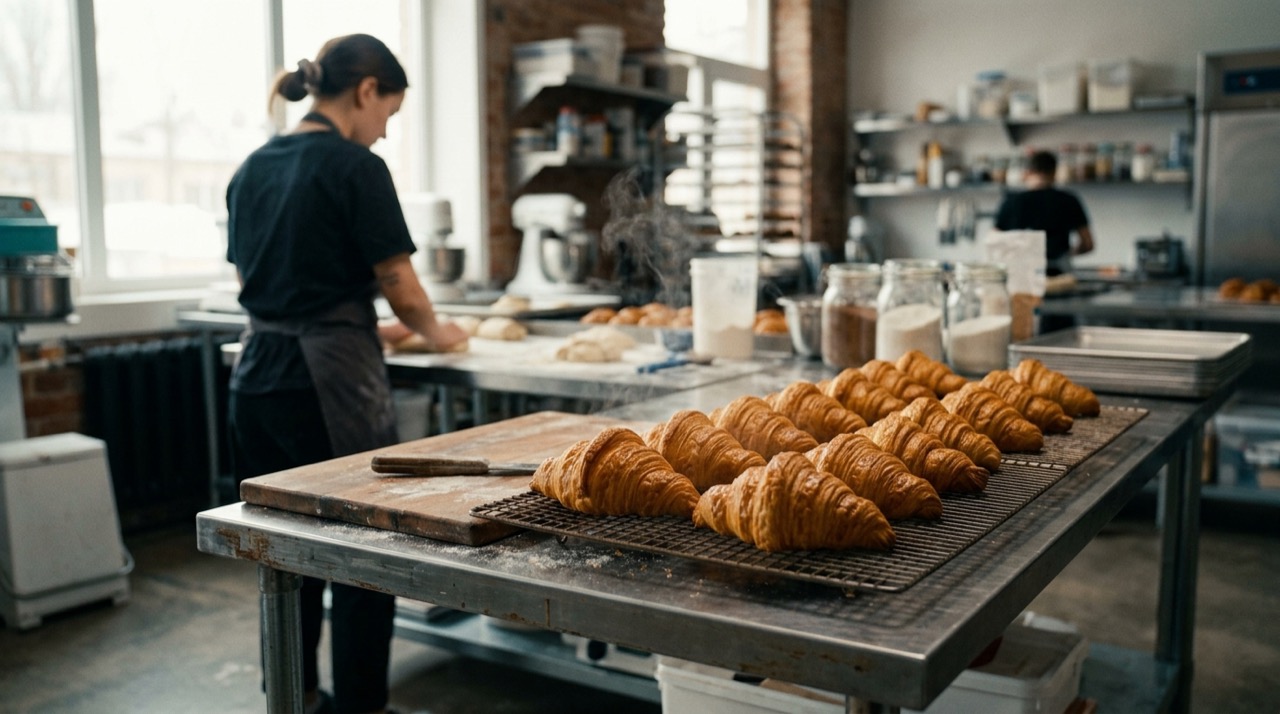
In pastry and baking, intermediate preparations are not an add-on; they’re the skeleton of your menu. You use pastry cream for filled croissants, brioches, tarts, and mille-feuille. A chocolate ganache can go into a dozen products. If you don’t cost those bases once and nest them into the final product, you’ll spend your days copying and pasting costs, and when the price of chocolate or butter goes up, you have to manually update every recipe that contains them.
I always recommend treating intermediate preparations as what they are: recipes in their own right. You calculate the total cost of the buttercream, for example, then divide it by the grams or kilos you get. That gives you a cost per gram of cream. When you build a filled croissant, you just add the grams of cream it uses, and the cost is carried over automatically. If tomorrow butter goes up, you update that ingredient’s price, and the cream, the filling, and every product that uses it recalculate themselves.
This way of working saves you hours and gives you a real financial picture of each product family. It also lets you identify which intermediate preparations are driving up your menu cost and whether it’s worth buying them in or standardizing them further.
Scaling recipes without losing cost
Scaling a recipe in a bakery is everyday business: you go from a batch of 30 croissants to one of 100, or from a large mold to individual portions. The challenge isn’t just multiplying or dividing ingredients, but keeping the cost per piece consistent and not throwing off the yield.
If you have a well-set cost breakdown, scaling is about changing the batch quantity and letting the system recalculate each ingredient’s quantity while respecting proportions. But here’s the trap: losses don’t always scale linearly. A larger batch might have proportionally fewer trimmings or, conversely, more waste if the oven doesn’t perform well. That’s why, after scaling, you verify the real yield: weigh the pieces, count how many you sell, and adjust the costing with the observed losses. That way you avoid the theoretical cost drifting away from the real one.
In Miselup, when you scale a pastry recipe, the system maintains the loss structure and the cost per piece recalculates automatically, without you having to redo the numbers. That’s one of the advantages of having a digital costing tool designed for bakeries.
Tips for controlling costs in your bakery
After more than 20 years walking into bakeries, here are the tips that have the most impact on the bottom line:
- Weigh real losses, don’t assume them. On any given day, weigh the laminating trimmings, the pieces that don’t make it to sale, and the weight difference between raw and baked dough. With that data, adjust your costing. Theory is nice, but reality rules.
- Review butter, chocolate, and flour prices every week. These are the ingredients that weigh most on your raw material cost and the ones that fluctuate most. If your costing doesn’t update automatically, at least spend 15 minutes a week updating those three prices.
- Set a target food cost per product family. The food cost of a country loaf is not the same as that of a chocolate tart with nuts. A reasonable range in pastry and baking is between 20% and 30%, but it depends on your business model. Define yours and monitor it.
- Standardize your batches. Whenever possible, bake the same number of pieces per batch so that indirect costs and oven time are spread evenly. If one day you make 30 croissants and another day 45, the energy and labor cost per piece changes.
- Cost your intermediate preparations once and use them as ingredients. Centralize the cost of pastry cream, ganache, or sourdough starter and nest them into final recipes. You’ll avoid errors and save a lot of work.
- Use software that understands how a bakery works. A spreadsheet can work to start, but when you have 20 recipes sharing buttercream and the price of butter goes up, updating it manually is risky. Tools like Miselup are designed so that costing is dynamic: you enter the ingredient once, intermediate preparations are nested, and when a purchase price changes, the entire chain recalculates in one go. Scaling a batch keeps the cost consistent without redoing numbers. It’s the difference between truly controlling costs or living with a static snapshot that goes out of date every week.
Frequently Asked Questions
How do I calculate the cost per piece for a batch?
Add up the cost of all ingredients for the full batch and divide by the number of pieces you actually sell (not the ones that come out of the oven, but the ones that reach the counter). If the batch costs €8.50 and you sell 30 croissants, the cost per piece is €0.28.
Do I need to account for baking loss in the cost breakdown?
Yes, always. If you sell by weight (bread per kilo, for example), the cost per kilo of the baked product is higher than that of raw dough because the piece loses water. If you sell by piece, the loss doesn’t affect the unit cost, but it does affect the batch yield and the uniformity of your products. It’s advisable to know your real yield and take it into account when setting the price.
What food cost is normal in pastry and baking?
It depends on the product and the type of bakery. In traditional baking, a food cost around 20‑25% is reasonable. In fine pastry, with ingredients like couverture chocolate and nuts, you can go up to 30% without issue. The important thing is that you define your target per family and monitor it week by week.
How do I cost a cream or filling used in several recipes?
Treat it as an intermediate preparation: calculate the total cost of the cream (ingredients + losses) and divide by the grams or kilos you get. Then, in each final recipe, add the grams of cream it uses, and the cost carries over automatically. If you use Miselup as an alternative to Excel, you can nest that cream inside any product, and when the price of butter or chocolate changes, the cost updates in every recipe that contains it.
Can I manage my bakery’s cost breakdowns with Excel?
Yes, but as your bakery grows and you have more SKUs and intermediate preparations, Excel becomes a source of errors. Each batch is an island, and bases are copied manually into every recipe. When butter goes up, you have to go file by file. A digital costing tool lets you keep everything connected and updated in real time—exactly what a bakery needs to avoid losing margin.
If you want to stop chasing costs and start controlling them with a costing system that works like your bakery, I invite you to check out Miselup and take a look at the plans and pricing. Because recipe costing for pastry isn’t just a calculation—it’s the tool that tells you whether you’re making money on every croissant, every loaf, and every batch.