Food Cost: What It Is and How to Calculate It (the 2 formulas you must master)
What food cost is and how to calculate it per preparation and period: formulas, worked examples, targets by business type and ways to reduce it.

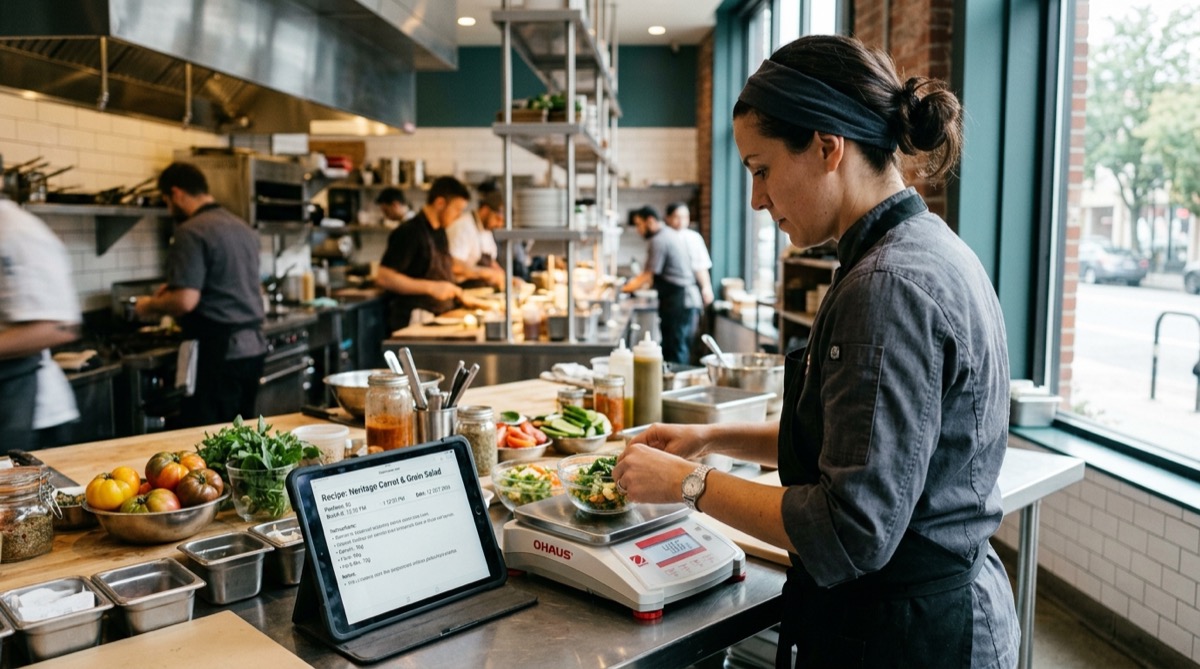
From the kitchen of a gastrobar to the bakehouse of a bakery or the counter of a cocktail bar, food cost is the figure everyone watches most closely and, paradoxically, the one most often calculated half-heartedly. I see it every week with clients who tell me “I have a food cost of 28%” and when you scratch the surface it turns out they’ve only costed three dishes and think that’s the whole picture. The reality is that there isn’t one food cost, there are two: the theoretical, which you calculate dish by dish and sets your target, and the actual, which measures what has actually happened in your business over a period. Mixing them up is the number one source of errors in hospitality — and of shocks in the profit and loss account. In this article, I’ll explain exactly what food cost is, how to calculate it with the two formulas you need to master, what percentage is reasonable depending on your type of venue, and where to start reducing it without destroying quality. All of this applies equally whether you work in the kitchen, pastry, bakery or bar, because the logic of raw material cost as a percentage of sales is universal.
AI Chef Pro · AI for chefs55+ AI tools for your kitchen55+ AI tools to create recipes and menus and optimize your costs.Take a look →What food cost is (and why there are two, not one)
Food cost is, in essence, the percentage that raw material cost represents of sales. In other words: of every euro that comes into the till, how many cents have gone on ingredients. It’s the most direct efficiency indicator any hospitality business has, because raw materials are usually the second or third largest cost after labour and rent. If your food cost gets out of hand, your gross margin evaporates and net profit disappears.
But here’s the nuance that changes everything: there’s no single food cost. There are two, and each measures something different.
The food cost per dish, also called theoretical food cost, is the one you calculate on paper: how much the raw materials of a specific dish cost in relation to its selling price. It comes from the recipe costing or spec sheet, the method our recipe costing guides break down by type of business. It’s your target, what should happen if everything is executed with millimetric precision: recipes are followed to the gram, there’s no wastage, nobody takes anything, and every portion is exactly as you’ve defined it. It’s a desk number, but essential for setting prices and designing a profitable menu.
The actual food cost for the period, also called global food cost, is the one you get when you do proper sums at the end of a week or month: how much raw material you’ve actually consumed according to your inventory and purchases, and what percentage that represents of sales for that period. This is your reality. Here all the inefficiencies show up: the waste from the fish you didn’t use, the generous portions your team dishes out during peak hours, the oil that was thrown out too early, the dessert that went wrong and ended up in the bin.
The key takeaway I want you to have is this: you need both. The theoretical food cost tells you how things should go and helps you make menu decisions and set prices sensibly. The actual food cost tells you how things are really going and warns you that something is going wrong before the hole gets too big. Anyone who only calculates one — usually the theoretical, because it’s easier — is flying half-blind and crashing without understanding why.
Formula 1: per-dish food cost (theoretical)
This is the formula every hospitality professional should know by heart before putting a price on the menu:
Food cost per dish (%) = (ingredient cost of the dish / selling price excl. VAT) × 100
Let’s go through an example with precise figures to make it clear. Imagine a dish of confit cod with ratatouille and honey aioli. You do the costing and the raw materials total €3.60 (counting all the ingredients in the exact recipe quantities, including oil, salt, garnish and decoration). You decide to sell it at €12.00 excl. VAT. The calculation is immediate:
(€3.60 / €12.00) × 100 = 30%
That 30% is your theoretical food cost for that dish. It means that of every €12.00 you earn from that cod, €3.60 goes on raw materials. The rest — €8.40 — is your gross margin to cover staff, rent, utilities and profit.
This calculation, dish by dish, is the recipe costing. And doing it properly means weighing ingredients raw and cooked, applying yields and wastage, and not forgetting the oil in the frying pan or the sprig of parsley. If you want to master the full method, I recommend reading how to cost a recipe step by step, where I explain it in full detail. And if you prefer to save the manual work and minimise errors, you can use the food cost calculator that automates the calculations and gives you the percentage instantly.
Formula 2: actual food cost for the period
If the theoretical food cost is what should happen, the actual food cost is what has happened. And to calculate it you need to do a stocktake, no ifs or buts. The formula is this:
Actual food cost (%) = ((opening inventory + purchases for the period − closing inventory) / net sales for the period) × 100
The numerator — opening inventory plus purchases minus closing inventory — is the actual raw material consumption in that period. In other words, what has actually left your storeroom and fridges heading to the kitchen, bar or bakehouse.
Let’s use exact figures. You close the month of March with these numbers:
- Opening inventory (what you had in fridges and storeroom on 1 March): €5,000
- Purchases for the period (everything you bought during March): €24,000
- Closing inventory (what you have left on 31 March after the count): €5,000
The actual raw material consumption is: €5,000 + €24,000 − €5,000 = €24,000
If the net sales for March (excl. VAT) were €75,000, the actual food cost is:
(€24,000 / €75,000) × 100 = 32%
That 32% is your reality. And if your average theoretical food cost across the menu was 30%, you have a 2-point gap between what you planned and what happened. That difference, which in hospitality usually ranges from 2 to 6 percentage points, is the symptom of uncontrolled waste, recipes not being followed to the letter, generous portions in the kitchen, theft or purchasing errors. I won’t go into all the causes of that gap here because I have a complete article devoted to analysing them: theoretical vs actual food cost: why they don’t match and how to close the gap. I encourage you to read it as soon as you finish this one, because understanding that difference is precisely what separates businesses that make money from those that don’t know why they’re losing it.
What is a “good” food cost: ranges by business type
If you’re expecting me to give you a magic number, I’m sorry to disappoint you. It doesn’t exist. Throughout my career I’ve seen obsessions with hitting 28% that have ruined the customer experience, and I’ve also seen businesses running beautifully with a controlled 35%. A “good” food cost isn’t a universal figure; it’s the one that fits your business model, your average ticket, and your cost structure.
Think about this: a fast-food outlet can live with a 28% food cost because its average ticket is low, but it makes up for it with massive volume and a lean workforce. At the other extreme, a fine dining restaurant can operate at 35% or even higher, because what it’s charging for isn’t just the cost of the sirloin, but the technique, the creativity, and the entire experience. Both can be profitable if they know their game.
The golden rule I apply with my clients is this: don’t look at food cost in isolation; look at it alongside your gross margin and your sales volume. There’s no point boasting about a 20% food cost if, to achieve it, you’re serving ridiculously small portions and your customers aren’t coming back. Or if your venue is half empty.
That said, I know you need a reference point to guide you. This table shows the ranges I typically work with in the Spanish market, though I insist: these are indicative, not a verdict.
| Type of business | Indicative target food cost |
|---|---|
| Fast food / fast casual | 25-30% |
| À la carte restaurant | 28-33% |
| Haute cuisine / fine dining | 30-38% |
| Pizzeria | 22-28% |
| Café and bar (beverages) | 18-24% |
| Bakery and pastry shop | 25-35% |
The important thing isn’t to copy a number from the internet, but to set your own target based on your proposition and, above all, to monitor the deviation between what you should be consuming and what you actually consume. That’s where the key lies.
How to lower food cost without losing quality
Reducing food cost doesn’t mean buying cheaper at the expense of quality. That’s a shortcut that ends up costing you dearly. The levers that truly work are these, ranked from highest to lowest impact:
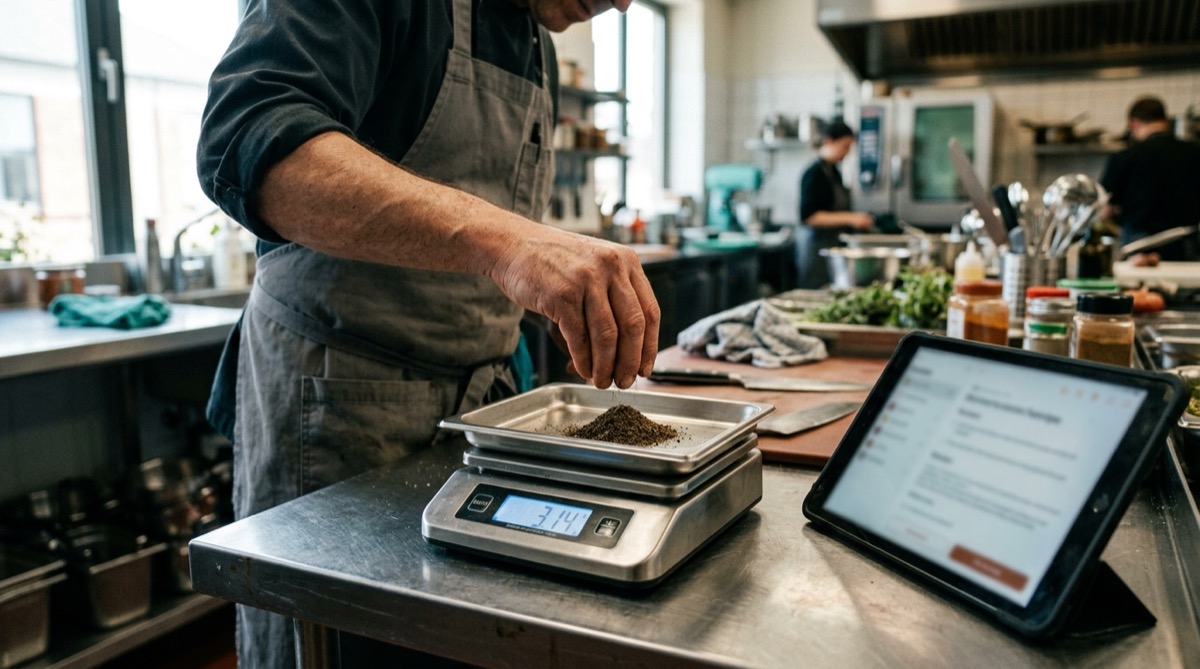
Standardise portions and recipes. This is, by far, the biggest money leak in hospitality. Portions served “by eye” are the number one enemy of your food cost. You need spec sheets with exact gram weights and a scale at every station. Controlling over-portioning and waste can save you between 2 and 5 percentage points without the customer noticing a thing. It’s money that’s currently flying from your kitchen straight into the bin.
Control waste and utilise trimmings. Every vegetable offcut you throw away is a euro you lose. Trimmings go into stocks and soups, fish bones into fumet, meat bones into broths. And apply the FIFO system (first in, first out) rigorously: never open a new container if there’s an opened one behind it. Anything that expires due to poor stock rotation is a direct loss that sends your actual food cost soaring.
Negotiate and review purchasing. Review your supplier contracts at least twice a year, compare prices, and adjust order formats to your actual consumption. A saving of 20 cents per kilo might seem ridiculous, but multiply it by the thousands of kilos you buy each year and you’ll see how it turns into significant money. It’s not about switching suppliers every week, but about negotiating with data.
Increase the average ticket through menu engineering. If you can get each customer to spend a little more without the raw material cost growing in the same proportion, your food cost automatically drops as a percentage. This is where the strategy of pricing dishes correctly comes fully into play, something I develop in depth in how to price a dish.
Lowering food cost isn’t a one-off action you do in January and forget about. It’s continuous work: measure, adjust, and measure again. Consistency is what separates businesses that control their profitability from those that fly blind.
A low food cost doesn’t guarantee you’ll make money
I’ve seen too many restaurateurs obsessed with a textbook food cost percentage while their business was sinking. And I’ve also seen the opposite: businesses with an apparently high food cost that were cash-generating machines. Why does this happen? Because food cost only measures raw materials, and profitability is played out across the entire P&L.
Your profit and loss statement also includes staff, rent, utilities, taxes, insurance, maintenance, and, above all, whether or not you reach your break-even point. You can have an impeccable food cost of 28% and still lose money because your cost structure is too heavy for the volume you’re billing, or because your average ticket is too low to cover the rest of the costs.
That’s why food cost is a starting point, not the finish line. You need to connect it with P&L control that monitors the entire business, and that’s where Miselup fits in naturally, linking recipe costing and food cost with the daily P&L so you know exactly where you’re making money and where you’re losing it. If you’ve ever thought “my recipe costing adds up but I’m losing money”, I recommend you read this article where I explain exactly why it happens and how to fix it. And if you want to understand the full picture of your business, I’ve broken down the cost structure of a restaurant.
Food cost tells you how much the food costs; the P&L tells you if you have a business.
ChefBusiness · Real profitabilityMaximize your restaurant without losing moneyCost control and food marketing. Book your ChefBusiness consulting now.Get the consulting →Frequently asked questions
What is the food cost formula?
The basic formula is to divide the raw material cost of a dish by its selling price excluding VAT, and multiply by 100. For example, if a dish costs you €3.60 in ingredients and you sell it for €12.00 excluding VAT, your food cost is 30%. For periodic calculation, you divide total consumption by total sales excluding VAT.
What is the difference between theoretical and actual food cost?
Theoretical food cost is what you should consume according to your spec sheets and what was sold. Actual food cost is what you really consumed according to inventory and purchases. The difference between the two reveals waste, theft, weighing errors, or poorly executed recipes. That deviation is the thermometer of your kitchen control.
What percentage of food cost is good?
There is no single number that works for everyone. It depends on the type of business: a pizzeria can aim for 22-28%, while a fine dining restaurant can operate at 30-38%. The important thing is to set your target according to your proposition and control the deviation between theoretical and actual.
How often should I calculate food cost?
Ideally, you should calculate it weekly. Doing it only at the end of the month gives you a snapshot too late to react. With weekly control, you detect deviations in time and can correct on the fly. Some high-volume businesses even monitor it daily.
How can I lower food cost without losing quality?
By standardising portions with spec sheets and scales, controlling waste through utilisation and the FIFO system, reviewing purchasing and negotiating with suppliers, and working on menu engineering to increase the average ticket. The key lies in constant measurement, not in buying cheaper raw materials.
Does a low food cost mean my restaurant is profitable?
Not necessarily. Food cost only measures the cost of raw materials, but profitability also depends on staff, rent, utilities, and sales volume. I’ve seen businesses with an impeccable food cost losing money because their cost structure was too heavy for their turnover.