How Much a Restaurant Really Makes in Spain (2026): Average Revenue vs. What the Owner Takes Home
How much a restaurant in Spain really earns: average revenue by type, what the owner actually takes home (3-8%) and why revenue is not profit.


Every week I sit down with a restaurant owner who tells me, with a mix of pride and relief: “John, the restaurant is doing great, we’re bringing in strong revenue.” And I always answer the same thing: “Strong revenue or strong profit? Because they’re not the same thing.” I’ve seen neighbourhood bars billing €20,000 a month where the owner takes home a decent salary, and I’ve audited trendy restaurants billing €120,000 a month that were two payrolls away from closing. Revenue is not profit. And if you only look at the till, you’re running your business blindfolded.
In this article, I’m going to lay out the real numbers —the ones you see when you audit hundreds of accounts— so you finally know how much a restaurant in Spain really makes in 2026. No smoke, no half-measures, and focused on the only thing that matters: what you actually take home after paying everything.
ChefBusiness · Real profitabilityMaximize your restaurant without losing moneyCost control and food marketing. Book your ChefBusiness consulting now.Get the consulting →How Much a Restaurant Makes in Spain: The Short (and Honest) Answer
I’ll be direct: an average restaurant in Spain can post solid revenue, but the owner is left with only a 3-8% net profit. That’s the typical estimated range we consultants in the sector work with, and believe me, it’s rare to exceed 8% in a full-service restaurant. But before you throw your hands up in horror, let’s clarify something fundamental that most people confuse.
When we talk about what a restaurant “makes”, there are three distinct figures you can’t mix up:
- Revenue: everything that comes through the till. The big number, the one that makes headlines. But it’s only the starting line.
- Net profit: what’s left after paying absolutely everything — raw materials, staff, rent, utilities, taxes, financing. This is the real profitability figure.
- What the owner takes home: here’s the nuance. The owner may draw a salary (which is just another business expense) and, on top of that, the net profit if there is any. Adding both together without distinguishing them is a classic mistake that inflates the perception of what’s really being earned.
The thesis is clear: revenue is not profit. I’ve seen too many businesses break down from below while the kitchen ran like clockwork. Because the real risk isn’t in the food cost; it’s in not knowing, every single day, whether sales are covering your break-even point.
And to put some hard context on the table: according to the Anuario de la Hostelería de España 2025, the restaurant sector in Spain billed €116.193 billion in 2024, representing 4.7% of GDP. We’re talking about a sector with 266,837 establishments and 1.39 million employees. Giant figures that hide a much more modest reality for the everyday business.
Average Restaurant Revenue by Type and Size
This is where everyone wants a magic number, and I’m sorry to say it doesn’t exist. There’s no official data on average revenue by establishment type, so what I’m presenting below are indicative sector ranges, based on my experience auditing all kinds of businesses. They’re not official statistics, but they are a reliable compass.
| Type of Establishment | Monthly Revenue (indicative) | Annual Revenue (indicative) |
|---|---|---|
| Neighbourhood bar / café | €15,000 - €35,000 | €180,000 - €420,000 |
| Full-service restaurant (traditional) | €40,000 - €80,000 | €480,000 - €960,000 |
| Pizzeria / casual dining | €25,000 - €55,000 | €300,000 - €660,000 |
| Fast food / QSR | €40,000 - €120,000 | €480,000 - €1,440,000 |
| Fine dining / haute cuisine restaurant | €60,000 - €150,000 | €720,000 - €1,800,000 |
Indicative sector figures, not official data. If we took the raw average (€116.193 Bn among 266,837 establishments), we’d get around €435,000 per establishment, but that figure is heavily skewed by large operators and doesn’t reflect a typical establishment at all.
The important thing here isn’t the number itself, but understanding why the ranges are so wide. Location, average ticket, table turnover, and opening days can mean two restaurants of the same type bill double or half. And, above all, the business model matters more than the gross volume. A neighbourhood bar billing €20,000 a month can generate more net profit for its owner than a trendy restaurant billing three times that. Revenue is the headline; profitability is the reality.
And this applies across the whole sector: bakeries, pastry shops, cocktail bars, and dark kitchens play with other averages, but the logic is the same. Don’t compare yourself to the sector’s raw figure; compare your cost structure to your actual sales.
What the Owner Earns: Revenue vs. Net Profit
This is the table you should frame. Because this is where the illusion of a full till is separated from what you truly take home.
| Type of Establishment | Estimated Net Margin | What the owner takes home per month (approx.) |
|---|---|---|
| Neighbourhood bar / café | 10-20% | €1,500 - €7,000/month |
| Full-service restaurant | 3-8% | €1,200 - €6,400/month |
| Pizzeria / casual dining | 15-20% | €3,750 - €11,000/month |
| Fast food / QSR | 2-9% | €800 - €10,800/month |
| Fine dining / haute cuisine restaurant | 3-10% | €1,800 - €15,000/month |
| Real case (Pistacho Gros) | NEGATIVE | −€2,459/month despite a healthy food cost |
Net margin on the indicative revenue from Table 1; management estimates, not official data. Note the paradox: a neighbourhood bar billing much less can take home more than a fine dining restaurant billing three times as much.

Before you get excited by the high end of each bracket, there’s a crucial nuance we repeat endlessly in consulting: is the owner’s salary included within the costs, or does it come out of the profit? Because if the owner doesn’t assign themselves a market salary and account for it as a staff expense, the net profit is artificially inflated. You’re looking at a number that isn’t real, because part of that money should have gone to paying for your work. When you adjust for that, the realistic net margin in hospitality is in that 3-8% range. Consistent, by the way, with the international benchmark for full-service restaurants, which sits at 3-5%.
If you want to understand why costs structurally eat up that margin —which items weigh the most and what the target percentages are— we’ve broken it down in our analysis of the cost structure of a restaurant and its target percentages. I’m not going to repeat it here; I want you to take away the final picture: high revenue doesn’t guarantee high profit.
AI Chef Pro · AI for chefs55+ AI tools for your kitchen55+ AI tools to create recipes and menus and optimize your costs.Take a look →The Mirage: Why a Restaurant Can Bring In a Lot and Still Earn Little (or Lose Money)
The most dangerous mental error I see in hospitality is confusing a full till with a healthy business. Full is not the same as profitable. You can have a waiting list every weekend, an impeccable food cost of 30%, and still be losing money each month. How? Because the rent eats you alive, because the team is overstaffed on weekdays, because the average ticket doesn’t cover the break-even point. The till rings, but the P&L statement bleeds.
And the risk of closing is real. According to business demography data from the INE published in 2025, 41.9% of Spanish companies born in 2018 were still alive after five years. That is, almost 58% had disappeared. In the first year, the survival rate is 76.9%: around one in four companies doesn’t make it to the second year. Mind you, that’s data for the whole economy, not broken down for hospitality. The famous myth that “60% of restaurants close in the first year” is exactly that, a myth of foreign origin with no methodological backing in Spain. Don’t use it.
That said, the recent pulse of the sector is not calm. According to data from Delectatech, around 37.5 bars and restaurants closed per day in Spain in 2024, 3.1% fewer than in 2023. And in 2025, although restaurant sector revenue kept growing by around 3%, its profitability fell by 0.9% compared to 2024, in an environment of higher costs and around 180,000 unfilled vacancies, according to the Anuario de la Hostelería de España 2025. Beware: that −0.9% is the drop in profitability, not a margin of 0.9%. They are very different things.
In my audits, the pattern repeats: controlled food cost, efficient kitchen, full house… and red numbers. The real case of Pistacho Gros is the best example I can give you without revealing names: a restaurant that lost €2,459 in a month while having a healthy food cost. The kitchen wasn’t the problem. The problem was that nobody knew how much they had to sell each day just to avoid losing money. And that is precisely what separates a business that survives from one that closes.
How Much You Should Bill to Make Money (and Not Just to Break Even)
There’s a sales figure below which you lose money no matter what. It’s called the break-even point, and if you don’t know it, you’re flying blind. It’s not a complex financial concept: it’s simply the revenue volume where your income equals all your costs. Above it, you profit; below it, you lose.
And here’s the key that changes management: the break-even point is calculated by day, not by month. Because profitability isn’t decided at the end of the month with the spreadsheet closed, but every night when you cash up. If you wait until the 30th to find out whether you made or lost money, you can no longer correct anything. Daily control is what separates restaurant owners who sleep soundly from those who live with the anxiety of not knowing.
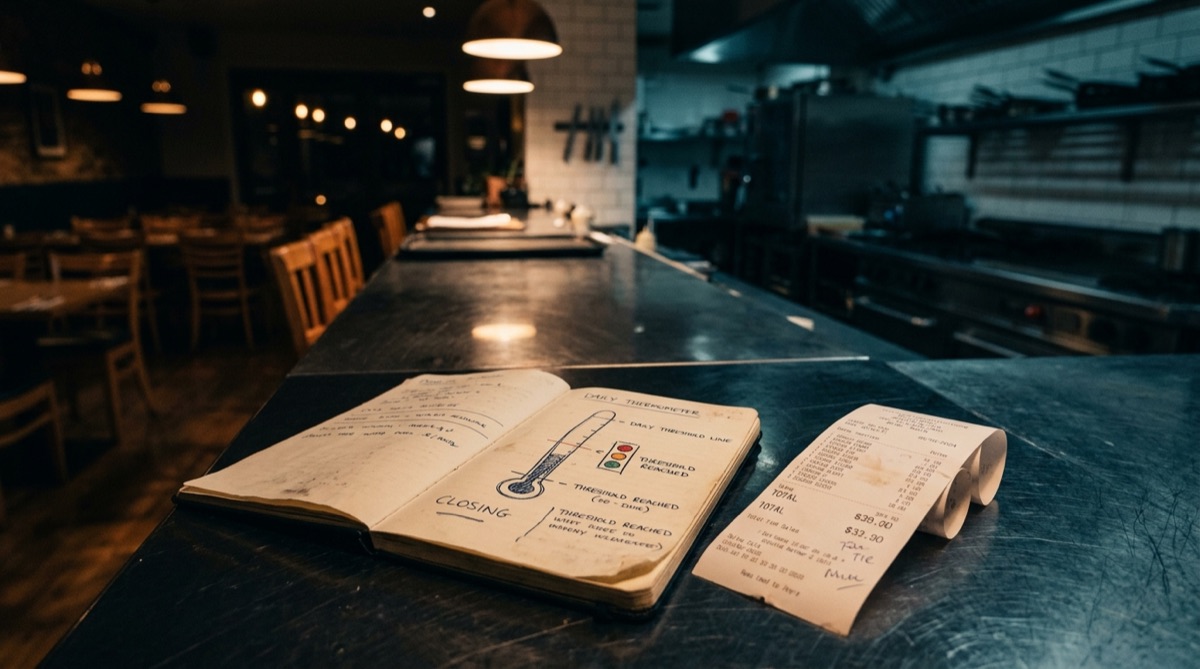
If you want to see exactly how it’s calculated and what variables you need, I explain it step by step in how to calculate the break-even point of a restaurant. But if you’d rather go straight to the number, I have a free tool for you: the «Are You Making or Losing Money?» calculator gives you your daily sales floor in under two minutes. Try it; you’ll be surprised to see how much you need to bill each day just to break even.
From Curiosity to Control: Stop Guessing How Much You Make
Let’s summarise the essentials: revenue is the headline, net profit is the reality, and daily control is what separates restaurant owners who survive from those who close. You can bill the sector average, have an impeccable food cost, and still lose money. Pistacho Gros is the proof. Profitability isn’t just decided in the kitchen; it’s decided every night at the intersection of your sales and your break-even point.
That’s why we built Miselup. So you don’t have to be a financier and yet still know, every night, whether you’re ahead of or behind your floor. The system connects three pieces that usually live in separate spreadsheets: the recipe costing of your dishes (so you know the real food cost of your dishes step by step), the daily break-even point, and an automatic daily P&L that tells you, with no dressing up, how much you’ve made or lost today.
If you want to control your menu’s selling price and margins without errors, know which dishes really make you money with menu engineering, or simply stop guessing, get started with Miselup and first check out the free food cost calculator. It works for chefs, bakers, pastry chefs, bartenders, and baristas. Because no matter what you serve: if you don’t know how much you earn each day, you’re leaving your profitability to chance.
Timlup · Team on trackDaily checklists & tasks for your restoKeep your team on point with recurring tasks. Meet Timlup and simplify operations.Meet Timlup →Frequently Asked Questions
How much does a restaurant earn per month in Spain?
It depends on the type of establishment, but in a full-service restaurant the estimated monthly net profit ranges between €1,200 and €6,400, representing a net margin of 3-8% on sales. This is an indicative industry range, not an official figure. A neighbourhood bar may earn less in volume but more in percentage terms (10-20% margin).
How much revenue does a restaurant generate on average?
No official data on average turnover by type of establishment exists. Indicative industry ranges place a traditional full-service restaurant between €40,000 and €80,000 per month (€480,000-€960,000 per year). The gross industry average —around €435,000 per outlet— is heavily skewed by large operators and does not reflect the reality of an independent business.
How much does the restaurant owner earn?
What the owner takes home is the sum of their salary (if correctly accounted for as an expense) plus net profit. In a full-service restaurant, estimated net profit ranges between €1,200 and €6,400 per month. If the owner does not allocate a market-rate salary, that figure becomes inflated and does not reflect the true profitability of the business.
How much does a small restaurant earn per month?
A neighbourhood bar or café can generate an estimated monthly net profit of between €1,500 and €7,000, with a net margin of 10-20%. The key is that, even though it brings in less than a large restaurant, its lighter cost structure allows it to retain a higher percentage of every euro coming in.
What is the profit margin of a restaurant?
As a management estimate, the typical net margin for a full-service restaurant is 3-8% on sales. In bars and cafés it can reach 10-20%, in pizzerias 15-20%, and in fast food it ranges between 2-9%. These are indicative ranges, not official figures.
Why can a restaurant bring in a lot of revenue and still earn little or lose money?
Because revenue is not profit. A restaurant with high turnover may have disproportionate fixed costs (rent, overstaffing) that push its break-even point above its actual sales. I have audited businesses with flawless food cost that were losing money every month because no one was monitoring the daily cross-check between sales and break-even point.
How much revenue do you need for a restaurant to be profitable?
It depends on your cost structure. There is a daily sales figure —the break-even point— below which you lose money no matter what. That figure is different for each business and is calculated by cross-referencing fixed costs, variable costs and contribution margin. You can obtain it in minutes with the «Are You Making or Losing Money?» calculator.
How many restaurants close in their first year in Spain?
There is no official INE data broken down for hospitality. The data that does exist is for all Spanish companies: first-year survival is 76.9%, meaning around one in four companies does not make it to the second year. The myth that ‘60% of restaurants close in the first year’ lacks methodological support in Spain.
How much does a restaurant earn per year?
Applying the estimated net margins to the indicative annual turnover, a full-service restaurant can generate an annual net profit of between €14,400 and €76,800. A neighbourhood bar would be between €18,000 and €84,000 per year. I stress: these are management estimates based on the turnover and margin ranges we use in consultancy work, not official figures. If you want to truly control what your business earns, start by tracking your restaurant KPIs month by month.