How to Cost a Cocktail: Work Out Your Cost Per Drink
How to work out the real cost per drink of your cocktails step by step: a gin and tonic example, ideal pour cost and menu price. What bar costing forgets.

I’ve spent more than a decade neck-deep in bars, cocktail menus, and hospitality spreadsheets, and there’s one pattern I keep seeing — and it genuinely hurts: bars and cocktail spots with prices that on paper should leave bags of margin —a gin and tonic at €12, a signature cocktail at €11, a glass of wine at €7— yet at the end of the month they’re still barely keeping their heads above water. The reason is almost never low sales; it’s that they don’t really know how much every drink they serve actually costs. And beverage costing, particularly for cocktails, is packed with traps you don’t get on the food side: waste from spillage, ice that dilutes and costs money to produce, garnish that seems trivial, house-made syrups nobody bothers to calculate… It all adds up, and when you’re not measuring it, you’re giving margin away without even noticing. Today I’m going to explain what a proper cocktail costing truly includes, how to calculate cost per drink step by step with a real-world example, and why settling for a theoretical “pour cost” is a trap. This matters whether your bar leans towards classic cocktails, specialty coffee, wines by the glass, or mocktails: the logic is exactly the same. In fact, if you run a café or coffee shop, I break the cost per drink down in detail —coffee dose, milk, and take-away packaging— in recipe costing for cafés.
ChefBusiness · Real profitabilityMaximize your restaurant without losing moneyCost control and food marketing. Book your ChefBusiness consulting now.Get the consulting →What is cocktail costing (and what it includes that almost everyone misses)
A cocktail costing is the calculation of the real raw material cost of serving ONE drink, breaking down every single element in the recipe down to the last detail. It’s not a rough number or a mental estimate; it’s an exact figure built ingredient by ingredient, with the same discipline you’d use when costing a dish in a kitchen. The difference is that behind the bar there are line items almost everyone overlooks until they do the maths properly — and that’s where the margin leaks away.
What a cocktail costing must absolutely capture:
- The base spirit or liqueur. This is the one thing practically everyone counts, which is why it’s rarely a problem. We know what the bottle costs, we divide by its millilitres, and multiply by the recipe quantity. So far, so simple.
- The mixers: tonic, soft drinks, soda, ginger ale, coconut water… Any liquid that isn’t the main spirit. A single bottle of premium tonic can cost €0.85, and if your menu features three cocktails that use it, that figure multiplies fast.
- Juices and syrups. Here’s the first big trap: if they’re house-made, they have their own costing. A sugar syrup isn’t free — it involves sugar, water, and preparation time — and a fresh fruit purée carries waste, the cost of the fruit, and labour. If you don’t cost your pineapple syrup and you’re adding 15 ml to each cocktail, you’re eyeballing the cost, and that isn’t costing at all.
- The garnish: dehydrated or fresh citrus, herbs like rosemary or basil, olives, salt and sugar for rimming glasses, edible flowers… Everything adds up. A single dehydrated grapefruit slice can cost between 0.10 and €0.20, and if you use it in ten cocktails a day, that’s between €30 and €60 a month on one decorative element alone.
- Ice. It costs money — water, electricity, machine amortisation, maintenance — and it also has another effect that impacts cost: it dilutes. When a bartender works with lots of ice and shakes or stirs longer than needed, the recipe stretches, the guest’s perception shifts, and the real waste increases. It’s not just a direct cost; it’s an indirect waste factor.
- Waste. In cocktail bars, waste is the silent enemy. It includes evaporation from opened bottles, accidental spills, the remnants left in the shaker when you pour, and above all, over-pouring when working free pour without a jigger. If your recipe calls for 50 ml of gin and the bartender averages 55 ml because they aren’t using a jigger, you’re giving away 10% of the spirit in every glass. Multiply that across hundreds of serves, and it’s a bloodbath.
In the bar world, the percentage that represents the cost of the drink versus its selling price is called pour cost, and it’s the direct equivalent of food cost in the kitchen. But just as with food cost, there’s a world of difference between theoretical pour cost — what you calculate using the ideal recipe — and actual pour cost, which is what you see when you match real purchases against real sales. If you want to dig deeper into that gap, which is exactly the same as I explain for kitchen operations, I’ve written about theoretical vs actual food cost.
How to calculate cost per drink step by step
Figuring out the real cost of a cocktail isn’t complicated, but it does demand method. Skip a step or round numbers too aggressively, and the figure you end up with won’t help you price with confidence. Let’s go step by step, with a concrete example.
Step 1: calculate the unit cost of each ingredient. The basic formula is straightforward: purchase price divided by the pack size content. If you buy a 700 ml bottle of gin for €17.50, the cost per millilitre is €17.50 / 700 ml = €0.025 per ml. Do the same for all liquid ingredients: bottles, small bottles, juice cartons — anything with a measurable volume. For garnishes and other solid items, you’ll need to work out the unit cost (what each slice, sprig, or olive costs you) by dividing the cost of the container by the actual usable units, after stripping out the waste specific to that ingredient.
Step 2: multiply by the actual recipe quantity. Take the exact millilitres — or units, for garnishes — set out in your spec sheet. If your cocktail uses 50 ml of gin: 50 ml x €0.025 = €1.25. If the tonic comes in an individual 200 ml bottle and you use the whole thing, the cost is simply the purchase price, €0.85.
Step 3: add up all ingredients, including garnish and ice. Leave nothing out. The total of these components is your ingredient cost before waste.
Step 4: add the waste percentage. In a well-run cocktail bar — using jiggers, trained bartenders — you can apply a 5% on the ingredient subtotal. If you’re high-volume, working free pour, or relying heavily on casual staff, push it to 10%. Waste isn’t optional: it exists, and if you don’t bake it into your costing, you’re falsifying your real cost.
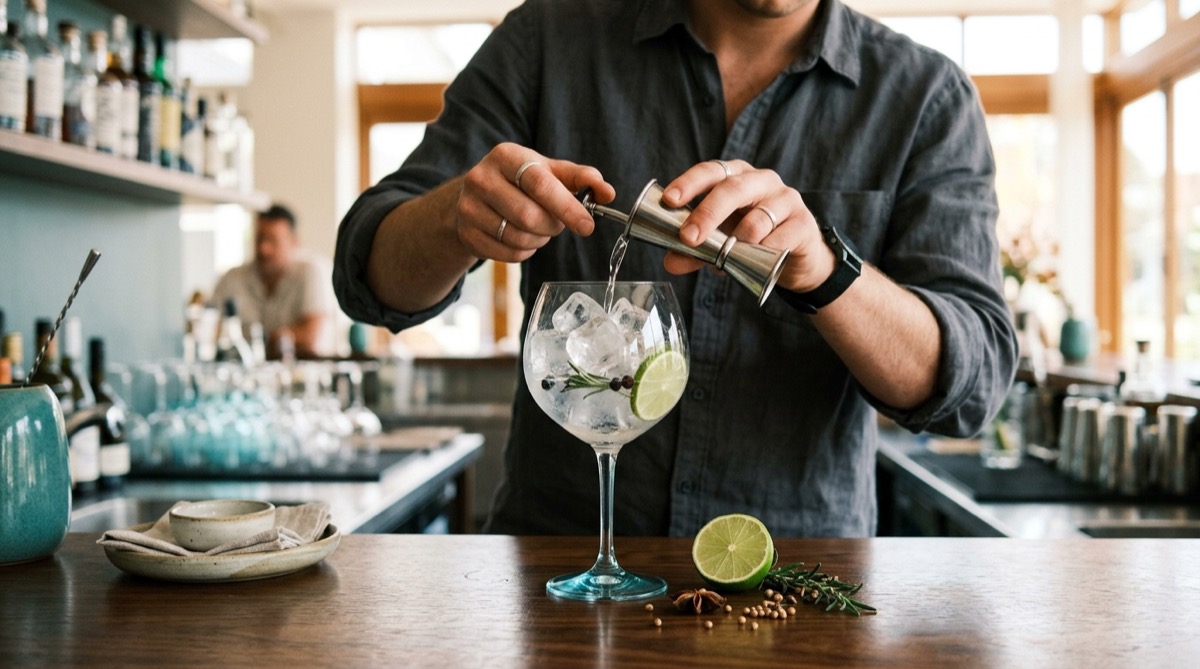
Let me walk you through a worked example with exact figures, a premium Gin and Tonic:
| Component | Purchase format | Purchase price | Quantity per drink | Cost |
|---|---|---|---|---|
| Premium gin | 700 ml bottle | €17.50 | 50 ml | €1.25 |
| Premium tonic | 200 ml bottle | €0.85 | 1 unit | €0.85 |
| Garnish (lime + botanicals) | — | — | — | €0.25 |
| Ice | — | — | — | €0.10 |
| Ingredient subtotal | €2.45 | |||
| Waste 5% (spillage/evaporation) | €0.12 | |||
| Cost per drink | €2.57 |
Notice what this number tells us: the real cost per drink is €2.57. The spirit — the only thing many bar owners mentally count — is just €1.25, half the total. The rest is the tonic, the garnish, the ice, and the waste. If you set your selling price thinking that drink costs you €1.25, your theoretical pour cost will be 10.4% against a selling price of €12, and you’ll think you’re laughing. The reality is a pour cost of 21.4%, and that changes the picture completely.
Automating this calculation for your entire drinks menu is what allows you to make decisions based on data, not gut feel. If you’d rather not do it by hand, you can use the cost per drink calculator I’ve put together. And if your business also has a kitchen, the base method is exactly the same one I describe for how to cost a recipe step by step: swapping solid ingredients for liquids doesn’t change the logic, only the line items you need to watch closely.
From cost per drink to selling price: pour cost and multiplier
Once you’re clear that your premium gin and tonic costs €2.57, the inevitable question is: what do I sell it for? This is where two tools I use daily with my clients come into play: the quick multiplier and pour cost.
The multiplier is a mental shortcut: you multiply the cost by a factor to arrive at the selling price. In cocktail bars, many start with ×4 or ×5. If you take your €2.57 and multiply it by 4.7, you get a selling price of around €12.00, a nice round commercial figure. That’s fine for a quick snapshot, but the real fine-tuning comes from pour cost.
Pour cost is the percentage that the drink cost represents of the selling price. It’s calculated like this: cost per drink divided by selling price, multiplied by 100. In cocktails, an ideal pour cost hovers between 18% and 24%. It’s lower than a typical kitchen food cost, and that makes sense: at the bar, the customer is mainly paying for the brand, the technique, the experience and the atmosphere, not just the liquid in the glass. A pour cost of 30% on a signature cocktail is usually a red flag; one of 15% may mean you’re leaving money on the bar or that your price is scaring customers away.
Back to our example. With a cost of €2.57 and a menu selling price of €12.00, the pour cost is 21.4%, a comfortable figure that leaves you room to manoeuvre. But I want you to see how the picture changes when you adjust the price:
| Menu selling price | Pour cost |
|---|---|
| €10.00 | 25.7% |
| €12.00 | 21.4% |
| €14.00 | 18.4% |
At €10.00 you’re brushing the upper limit; at €14.00 you get a very attractive pour cost, but the price must be backed by the customer’s perception of value. Selling a gin and tonic with a well-served premium gin isn’t the same as one with a well gin; market price and your bar’s positioning dictate the final call.
An important note, especially for those of you working in Spain: the menu selling price includes 10% VAT. If you want to fine-tune your profitability analysis, it’s worth calculating the pour cost on the ex-VAT price, too. For the €12.00 case, the net price is roughly €10.91, and the real pour cost rises to 23.6%. Both figures are valid; the critical thing is to pick one and use it consistently when comparing your cocktails, your weeks and your venues. If you switch the base, you’re playing tricks on yourself. At heart, the logic is the same as when you price a dish: you need a cost floor that protects you and a market price that keeps you competitive. If you want to dive deeper into that philosophy, I’ve written a guide on how to price a dish and there’s also a practical tool for calculating selling price and margins that I continually adapt to the bar world.
Theoretical pour cost isn’t the real one: where the margin disappears at the bar
The pour cost you calculate sitting down with a recipe is the theoretical one. The real one appears when you cross-check your purchases with your sales, and they rarely match. At the bar, the gap between the two is treacherous because it seeps in through many cracks.
Free pouring without a jigger is the silent enemy: that bartender who pours by eye and overshoots by two centilitres on every cocktail. Multiply that by 100 drinks in a night and you’ve given away several bottles. Then there are opened bottles that evaporate or oxidise before their time, spillages during service, house rounds and freebies that go unrecorded, pilferage, and batched or pre-mixed cocktails measured imprecisely. Any of these leaks can turn a theoretical pour cost of 21% into a real pour cost of 28% without you realising, and that 7% difference is net margin that vanishes.
The solution isn’t glamorous, but it’s the only one that works: regular bar inventory and cross-checking against sales. Just like in the kitchen, you need to count what comes in, what goes out and what should have gone out according to your standardised recipes. If you don’t measure, you’re flying blind. And, of course, keep your recipes written down, with exact weights and millilitres, and train your team to follow them. At the bar, precision and creativity aren’t enemies; in fact, precision makes creativity sustainable.
A good pour cost doesn’t guarantee the bar makes money
Pour cost tells you how much each drink costs, but the profitability of your business is decided in the P&L. I’ve seen more than one bar with spotless pour cost on its cocktails that still lost money. Why? Because the unit margin is one thing, and the full profit and loss account is quite another.
In the P&L, the heavyweights are bartenders’ wages, the rent, your licence, music rights, utilities, overall waste and, above all, the break-even point: the number of drinks you need to sell each day to cover all your fixed costs. If your cost structure is so heavy that even with a 20% pour cost you don’t reach break-even, the business is taking on water. That’s why costing the drink is the starting point, not the finishing line. You need to connect it to P&L control that watches the whole business, from the first spirit to the last cent of electricity.
That’s how I work with Miselup: every cocktail costing is automatically hooked into the bar’s daily P&L, so I can see in real time whether the bar margin is sustaining the business or whether sales volume is falling short. If you only focus on the drink, you risk perfecting recipes while the bar bleeds from the bottom. If you want me to tell you more about this gap, here’s an article I wrote reflecting precisely on why my costing works out but I’m still losing money. Costing tells you how much the drink costs; the P&L tells you whether you have a bar.
Timlup · Team on trackDaily checklists & tasks for your restoKeep your team on point with recurring tasks. Meet Timlup and simplify operations.Meet Timlup →Frequently asked questions
How do you cost a cocktail?
You add up the costs of all the ingredients in the recipe (spirits, mixers, syrups, garnish and even ice and waste), dividing the purchase price of each bottle or product by the quantity used in the drink. The result is the cost per drink in euros.
What is pour cost and what’s the ideal percentage in a cocktail bar?
It’s the percentage that the drink cost represents of the selling price. In cocktails, a healthy pour cost usually sits between 18% and 24%. Below that you may be leaving sales margin on the table; above it your margin suffers and the business becomes vulnerable.
Does cocktail costing include ice and garnish?
Yes, and it’s a common mistake to leave them out. Ice has a production and logistics cost, and garnishes (citrus, herbs, olives) also add up. Include everything, no matter how small it seems, because over 500 drinks those cents turn into euros you hadn’t accounted for.
How much should a gin and tonic cost in a bar?
It depends on the gin, the premium tonic and the experience you offer. With a cost of €2.50 and a target pour cost of 20–22%, a selling price between €11.00 and €13.00 is reasonable. If you add impeccable service, quality glassware and solid storytelling, you can justify higher prices.
How do you set the selling price of a cocktail?
The most direct method is to apply a multiplier of 4 to 5 times the cost per drink. Then you adjust according to your desired pour cost and your bar’s positioning. Always check that the final price is consistent with your market and the customer’s perception of value.
Why isn’t my bar profitable if my cocktails have a good margin?
Because the drink margin doesn’t pay the fixed bills. If sales volume doesn’t reach the break-even point, or if your overheads (rent, staff, utilities) eat up the margin, the bar loses money even if each cocktail is profitable on its own. You need overall P&L control.