How Much Does It Cost to Make a Pizza? Real Breakdown (2026)
How much does it cost to make a pizza? Compare a Margherita at home and in a pizzeria, with an ingredient breakdown, food cost and menu pricing.

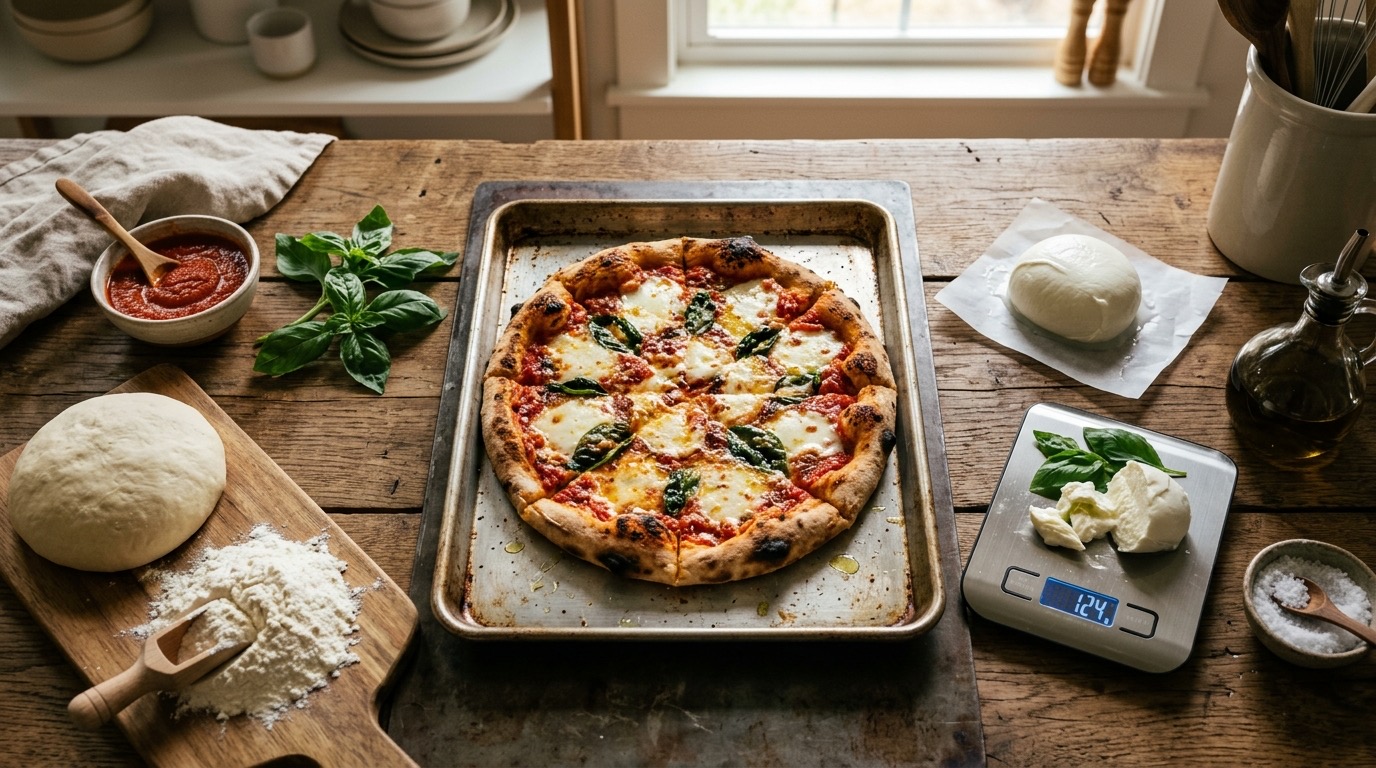
How much does it cost to make a pizza? The short answer
A Margherita costs about $2.40 in ingredients at a pizzeria and roughly $3.25 to make at home. Yet pizzerias sell that same pizza for $8–16 because ingredients are just one line on the P&L—labor, rent, and overhead swallow most of the menu price.
| Scenario | Typical cost |
|---|---|
| Made at home (retail ingredients) | ~$3.25 |
| Pizzeria ingredient cost (wholesale) | ~$2.40 |
| Delivery / takeout (menu price) | $14–18 |
Homemade pizza cost: the itemized ingredient breakdown
Let me show you the math on a 12‑inch Margherita made with standard retail ingredients bought at a supermarket. These prices reflect what a home cook pays for enough product to make one pizza—not bulk quantities.
| Ingredient | Cost (retail, 1 pizza) |
|---|---|
| Flour (for the dough) | $0.40 |
| Yeast + salt + olive oil | $0.30 |
| Canned tomato (portion) | $0.55 |
| Fresh mozzarella (125 g) | $1.50 |
| EVOO drizzle + fresh basil | $0.50 |
| Total ingredient cost | $3.25 |
Mozzarella is the heavyweight—at $1.50, it accounts for nearly half of that $3.25. With dairy prices trending higher, cheese remains the single biggest line item, whether you’re baking at home or running a shop. Cut the pie into 8 slices, and you’re looking at roughly $0.41 per slice in raw ingredients. Add a few cents for the electricity or gas to run your oven, and you’re still under $0.50 a slice.
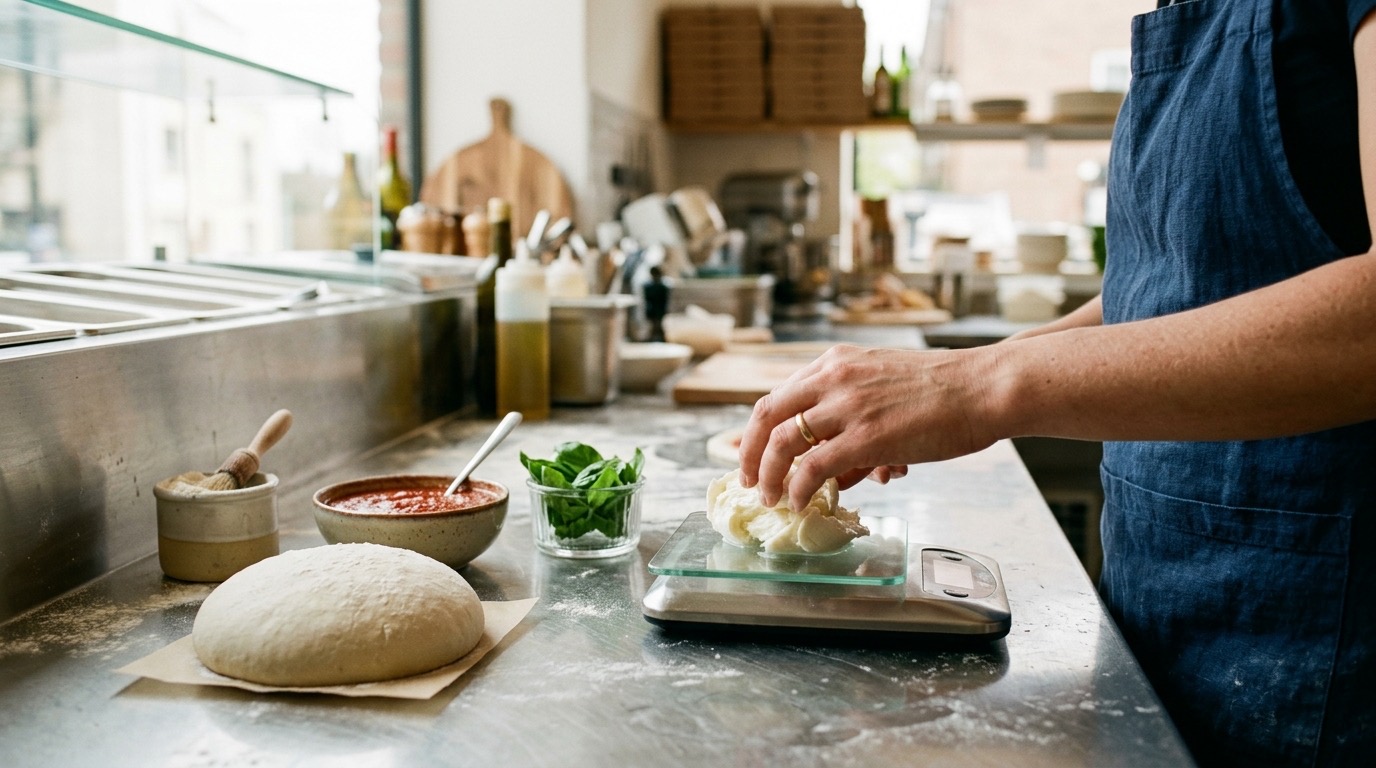
Is homemade pizza cheaper than takeout or delivery?
The short answer is an unqualified yes. Here’s how the numbers stack up side by side.
| Option | Typical cost (Margherita) |
|---|---|
| Homemade (retail ingredients) | $3.25 |
| Frozen supermarket pizza | $5–7 |
| Delivery / takeout | $14–18 |
If you make pizza once a week instead of ordering delivery at $16 a pop, you pocket roughly $11–15 every week—that’s $600 or more a year that stays in your bank account. Multiply that by a family of four, and the savings get serious fast.
The trade‑off is real, though. You need time (dough fermentation doesn’t happen in 10 minutes), a hot oven, preferably with a baking stone or steel, and a few reps to get the stretch and bake right. But once the process clicks, the gap between a $3.25 homemade Margherita and a $16 delivery pie starts to feel a lot like pure leverage—especially when you control exactly what goes into the dough and onto the top.
How much does it cost a pizzeria to make a pizza?
At pizzeria scale, buying wholesale changes everything. The dough ball that costs you $0.40 in flour (plus the other bits) turns into a pre‑portioned ball bought by the case. Let me show you the math on what a pizzeria actually spends for the same Margherita.
| Ingredient (wholesale) | Cost per pizza |
|---|---|
| Dough ball | $0.45 |
| Tomato sauce (80 g) | $0.40 |
| Fior di latte mozzarella (120 g) | $1.35 |
| EVOO + fresh basil | $0.20 |
| Total pizzeria ingredient cost | $2.40 |
Mozzarella alone is $1.35 of the $2.40—about 56% of the entire ingredient cost. Cheese is the line that keeps operators up at night; a few cents’ swing in dairy markets flows straight to the bottom line.
Now, stretch that ingredient cost into menu pricing. Most pizzerias target a 30% food cost, meaning the ingredient spend should be about 30% of what the customer pays. That gives you menu prices that look like this:
| Pizza type | Ingredient cost | Menu price (at 30% food cost) |
|---|---|---|
| Margherita | $2.40 | $8.00 |
| Pepperoni | $2.95 | $9.85 |
| Four cheese | $3.20 | $10.65 |
| Hawaiian | $3.05 | $10.15 |
Notice the pizzeria’s $2.40 Margherita rings up at $8.00 on the menu, not $16. That’s because a lean, high‑volume slice joint can run at a tighter food cost than a full‑service restaurant. The $14–18 you see for delivery often layers in commission fees, packaging, and the fact that third‑party platforms take a 15-30% cut.
Why the cost difference versus homemade? Three reasons: wholesale volume pricing drives down unit costs; yield and trim are baked into the spec (a 120 g portion of mozzarella might start from a block that sheds brine and minor waste); and net vs. gross weight—pizzerias buy by the kilo or case, not the retail pack. The dough ball jumps from your $0.70 all‑in (if you priced your homemade one) to $0.45 because flour, yeast, and labor are amortized over hundreds of balls a day.
Why does a pizza that costs $4 to make sell for $16?
This is the trust equation. When a guest sees a $16 pizza and hears “the ingredients are only about four bucks,” the instinct is to feel a little swindled. Let me lay out where that $16 actually goes, using a representative 15‑inch pizza sold in a typical independent pizzeria. This isn’t pulled from a single operator’s books—it’s an illustrative breakdown that mirrors the numbers I work with day in, day out.
| Cost category | Amount |
|---|---|
| Ingredients | ~$3.90 (≈24% food cost) |
| Pizza box | $0.45 |
| Labor (hourly + payroll taxes) | $3.85 (≈24%) |
| Rent, utilities, insurance, other overhead | $5.80 (≈36%) |
| Profit (before tax) | $2.00 (≈12% margin) |
| Total menu price | $16.00 |
Everything adds up. The ingredients—dough, sauce, cheese, and toppings—account for barely a quarter of the price. The box that keeps the pizza hot isn’t free. Labor, even at an efficient shop, runs around a quarter of the menu price once you add taxes, workers’ comp, and a real hourly wage. Then rent, gas, electric, liability insurance, and the dozen other overhead buckets eat another third or more of the ticket.
The ~$2.00 that looks like “profit” is what pays the owner’s mortgage and funds the next oven, the next hire, the emergency repair when the walk‑in dies on a Saturday night. After taxes, that margin shrinks again. Ingredients may be the most visible cost, but they are only about a quarter of the menu price—the rest is the infrastructure that lets you walk in, pick up a hot pizza, and walk out.
I’ll break down food‑cost percentages in detail in the next section, but hold onto this picture: a pizza’s menu price isn’t set by its ingredients alone. It’s set by the real estate, the team, and the thin cushion of profit that keeps the doors open.
Timlup · Team on trackDaily checklists & tasks for your restoKeep your team on point with recurring tasks. Meet Timlup and simplify operations.Meet Timlup →Pizza food cost percentage: what’s a healthy number?
A well-run pizzeria typically lands between 25% and 35% food cost.
Most operators I work with treat ~30% as a practical target, and shops that consistently hit 18–22% are in lean, highly profitable territory.
Pizza often tolerates a slightly higher food-cost percentage than other dishes—and that’s not a flaw, it’s volume math. Unlike a high-labor tasting menu where every plate demands intricate prep, pizza throughput is enormous. A single oven deck can fire 30–40 pizzas an hour with one or two skilled hands. So the incremental labor cost per pie is low, and gross profit dollars pile up fast even when ingredient costs sit at 28–30%. You’re not chasing a 20% food cost on a $16 entrée; you’re running a high-volume operation where each $8-$12 pizza throws off $5-$8 of gross profit per pie — before labor, rent and overhead take their share.
Here’s the formula you need to memorize:
COGS (Cost of Goods Sold) = Opening Inventory + Purchases − Closing Inventory
Food Cost % = (COGS ÷ Food Sales) × 100
That top-line COGS captures everything you used during the period—dough balls, cheese, sauce, toppings, flour on the bench, even the olive oil in the can. Until you run that calculation against actual sales, your “recipe cost” is just a target. The P&L number is your real food cost percentage.
Notice I didn’t say “theoretical” or “ideal” food cost. Those are useful for line-level diagnostics, but the bank cares about the period-end COGS %. If you’re pricing at 30% and the P&L reads 34%, you’ve got a usage gap to close—waste, theft, over-portioning, or a supplier price hike you haven’t priced into the menu.
How to calculate the food cost of your pizza (worked example)
Let’s walk it with the Margherita we’ve been using. I’ll keep the method tight; you can expand this into your full menu with the step-by-step guide.
-
List and weigh every ingredient
Dough ball (250g), tomato sauce (80g), fresh mozzarella (120g), fresh basil (a few leaves), extra-virgin olive oil (5g), salt. Use your actual build spec—no guessing. -
Cost each ingredient per gram from its purchase price
Take the landed cost of the ingredient (including delivery) and divide by its usable weight. For example, a 5 lb block of fresh mozzarella at $25.50 gives you 2,268g; your cost per gram is about $0.0112. A 25 lb bag of high-gluten flour at $18.00 yields 11,340g; $0.0016/g. Never cost per unit—always cost per gram or ounce, because that’s how you build a plate. -
Sum the lines
Dough ball ≈ $0.45
Tomato sauce (80g) ≈ $0.40
Fresh mozzarella (120g) ≈ $1.35
Olive oil + basil ≈ $0.20Plate cost = $2.40
-
Divide by the menu price
$2.40 ÷ $8.00 = 0.30 → 30% food cost.
That’s the margin snapshot. For the full, repeatable method—from invoice to costing sheet—head over to how to cost a recipe step by step. It’s the same engine I use to cost every new pizza before it hits the menu.
How to price a pizza on your menu
The cleanest starting point is factor pricing:
Menu price = Ingredient cost ÷ Target food cost %
Flip the percentage into a pricing factor: 1 ÷ 0.30 = 3.33. Multiply your plate cost by that factor.
Here’s how that looks across a few common pizzas, assuming a 30% target:
| Pizza | Ingredient cost | Menu price (× 3.33) |
|---|---|---|
| Margherita | $2.40 | $8.00 |
| Pepperoni | $2.95 | $9.85 |
| Four cheese | $3.20 | $10.65 |
| Hawaiian | $3.05 | $10.15 |
Those prices are factor-pricing math, rounded to the nearest nickel — not a finished menu. You then adjust for your market, your competition, and your perceived value. A Neapolitan spot in a high-rent neighborhood might push a Margherita to $14–$16 and still hold a 20% food cost. Factor pricing gives you a floor; your brand gives you the ceiling.
A quick taxation note: in the US, menu prices are pre-tax—sales tax is added at checkout. If you operate in a VAT-inclusive market like Spain, the math changes because the displayed price includes the tax. Our Spanish-language guide covers that adjustment in detail.
You can model different scenarios instantly with the menu price calculator. Plug in your cost, set your target, and it builds the price table for you.
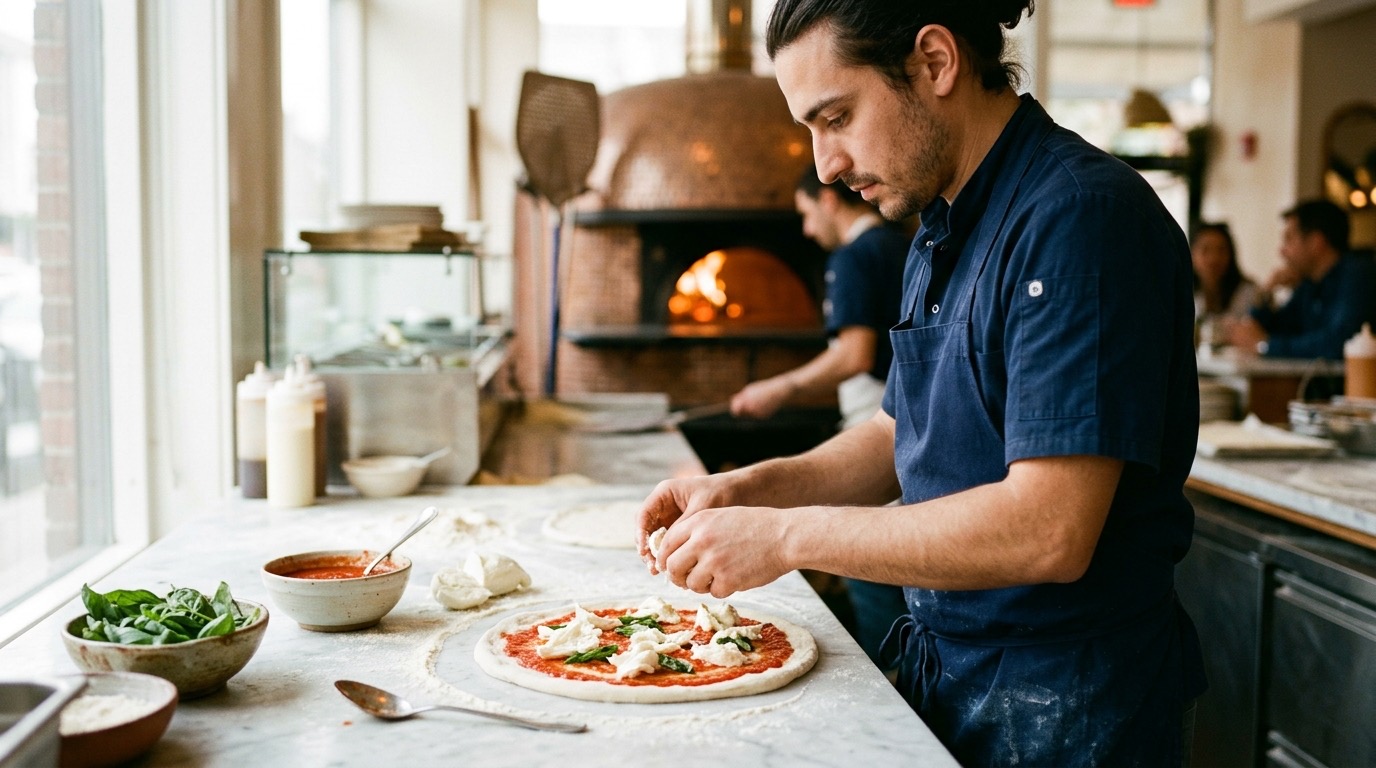
The catch: mozzarella and flour prices change every week
Here’s the wedge that catches most pizzerias: mozzarella alone accounts for roughly 55–60% of a Margherita’s ingredient cost. Flour forms the backbone of the dough. Together, dairy and flour prices have trended up over the last few years, and they move every week—sometimes more than once a week in volatile markets. The $2.40 Margherita plate cost I just showed you is already out of date the moment a supplier email lands with a new cheese price.
A static spreadsheet goes stale. A living spec sheet doesn’t. When you build a recipe inside recipe costing software, you tie every ingredient line to a purchase price. Change that price once—say, mozzarella jumps from $5.00/lb to $5.40/lb—and every pizza on your menu that uses it recalculates its food cost automatically. That number then flows into your daily P&L, so you spot margin erosion before the week ends, not after the month-end inventory count.
This isn’t about software; it’s about protecting your margin in real time. I’ve walked through the anatomy of a recipe spec sheet and how each line feeds the business, and the restaurant cost structure piece shows how plate costs connect to your overall P&L. If you’re still pricing with a spreadsheet you update quarterly, you’re flying blind on the two ingredients that swing your profit most.
Free pizza food cost calculator
Get an instant number for your own prices with the pizza food cost calculator. It’s built for the operator who wants to see the math fast. To see the same approach applied across a full menu, visit the recipe costing hub for pizzerias. And if you’re ready for the living version that updates with every price change, Miselup pricing has you covered.
ChefBusiness · Real profitabilityMaximize your restaurant without losing moneyCost control and food marketing. Book your ChefBusiness consulting now.Get the consulting →Frequently asked questions
How much does it cost to make a pizza at home?
A classic homemade Margherita—with supermarket flour, mozzarella, tomatoes, basil, and olive oil—runs about $3.25 for a roughly 12-inch pie. That figure assumes you’re buying ingredients in standard grocery sizes and already have pantry staples like salt and oil. It doesn’t include energy or your time, but it’s the honest ingredient cost.
Is homemade pizza cheaper than takeout or delivery?
Yes, by a wide margin. A $3.25 homemade pizza would cost $14–$18 delivered, and the ingredients are the same quality or better. The savings come from eliminating labor, overhead, delivery fees, and the pizzeria’s profit margin. Over a month of weekly pizza nights, the difference adds up fast.
How much does it cost a pizzeria to make a pizza?
It varies by style, but a Margherita built from standard pizzeria ingredients—dough, crushed tomatoes, fresh mozzarella, olive oil, and basil—costs around $2.40 in raw materials. Topping-heavy pies like four cheese or pepperoni push that toward $3.00–$3.20. These are ingredient costs only; they don’t include labor, rent, or utilities.
What is a good food cost percentage for a pizza?
A healthy range is 25–35%, with ~30% as a common target. Pizzas that run 18–22% are considered lean and very profitable. Pizza can tolerate a slightly higher percentage than many dishes because throughput is high—a busy oven produces dozens of pies per hour, keeping gross profit dollars strong even at 30% food cost.
How do you calculate the food cost of a pizza?
List every ingredient with its exact weight, then cost each ingredient per gram from its purchase price (including delivery). Sum the lines to get the plate cost. Divide that by the menu price: (plate cost ÷ menu price) × 100. Using the Margherita example, $2.40 ÷ $8.00 = 30% food cost.
How much should I charge for a pizza on my menu?
Start with factor pricing: menu price = ingredient cost ÷ target food cost %. At 30% target, the factor is 3.33. A $2.40 Margherita would price at $8.00. Then adjust for your market, competition, and perceived value. This formula gives you a floor; your brand sets the ceiling.
Why does a pizza that costs $4 to make sell for $16?
The $4 covers only the ingredients. The $16 menu price has to absorb labor, rent, insurance, utilities, marketing, credit card fees, and still leave a profit. A food cost of about 24% on a $16 pizza means the other three-quarters — roughly $12 — goes toward everything else. No pizzeria survives on ingredient markup alone.
What is the most expensive ingredient on a pizza?
Mozzarella consistently claims the top spot. On a Margherita, it can account for 55–60% of the total ingredient cost. For cheese-heavy pies, that percentage climbs even higher. That’s why a small change in the wholesale price of mozzarella can swing your food cost percentage by a full point or more.