Kitchen yield test: Cut costs with accurate food costing
Master the kitchen yield test to reduce waste and boost profits: how accurate yield percentages transform your recipe costing, step by step.

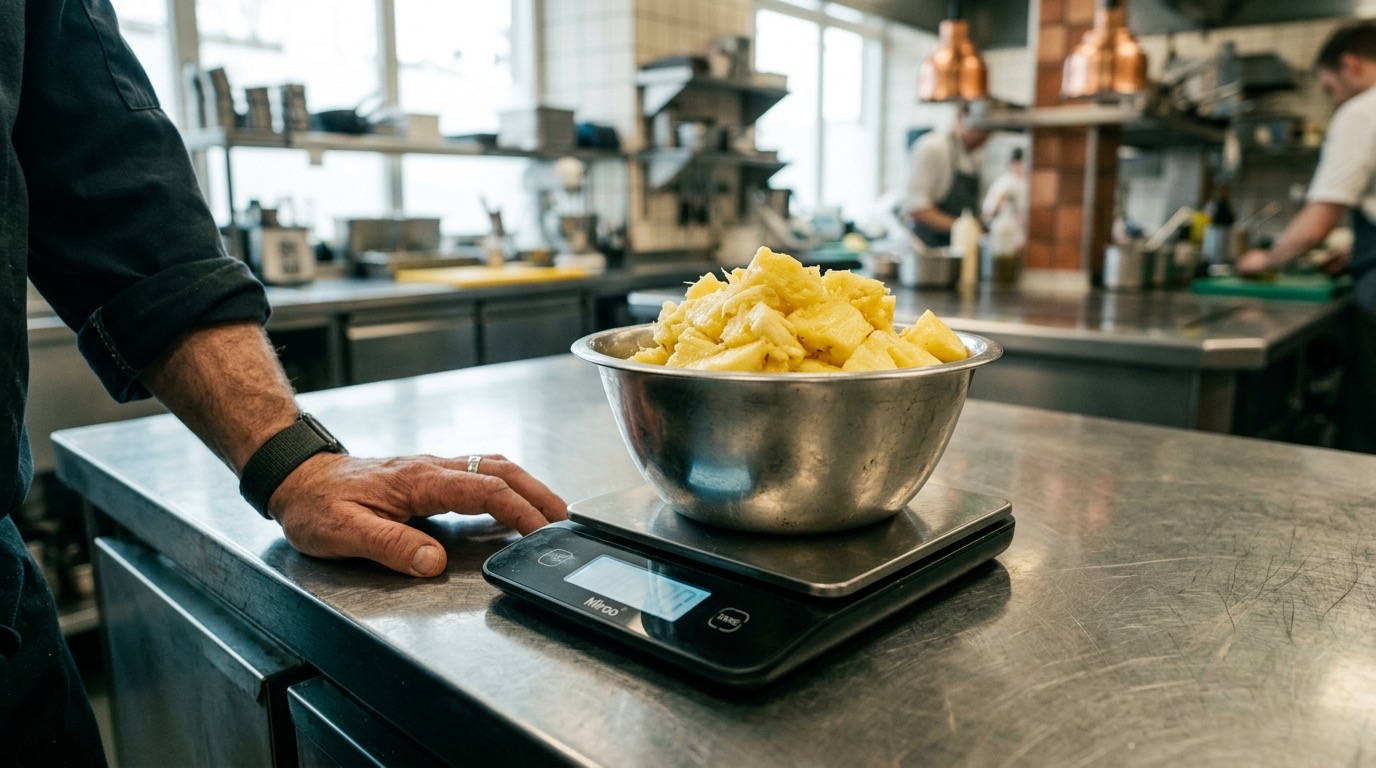
If you’ve been in hospitality for any length of time, you’ve definitely lived this scene: you receive a delivery, glance at the supplier invoice, and jot down the price per kilo on your recipe cost card as if every single kilo ends up on the plate. But between the box that comes through the door and the portion that goes out the pass, there’s a whole series of actions — peeling, deboning, cleaning, portioning — that leave a part of the weight you paid for in the bin (or in a usable by-product). Ignoring that loss is giving away margin. That’s why, when I consult for a pastry workshop or a cocktail bar, the first thing I put on the table is the scale: we’re going to run a real yield test — yours, the one that turns the purchase price into the real ingredient cost.
Don’t get me wrong: generic tables and supplier data help, but they’re just a rough snapshot. The yield of a product in the kitchen changes with size, season, the skill of the person breaking it down, and even the dish you’re going to plate. A pineapple in July doesn’t yield the same as one in December, and the commis doesn’t peel it the same way as the chef de partie. Measuring it in your own kitchen, with your team and your recipe, is what gives you the data to calculate the cost per clean kg and, from there, the cost card that saves your P&L.
What is product yield in the kitchen
Yield is the percentage of product you actually use after cleaning, breaking down, and portioning it, relative to the gross weight you bought. In short: if from 1 kg gross you get 700 g of pulp ready to serve, your usable yield is 70%. It’s the exact opposite of waste — if you want to dig deeper into that duality, check out the detailed food waste yield table by product — but here we’re not talking about what’s lost, but how to measure what you actually have left to sell.
A reliable figure doesn’t come from a generic Excel sheet; it comes from your own yield test. That number tells you how much the usable kilo really costs you, lets you assign the correct cost to each portion, and, if one day you need to push back on a supplier, gives you the arguments to do it. Because buying at €3 per kilo gross is not the same as buying at €6 per kilo clean, and you only see that jump when you weigh.
The yield factor formula (and the correction factor)
The calculation is simple, but it’s worth being clear from the start:
Yield (%) = (usable net weight ÷ gross weight) × 100
Usable net weight is what reaches the plate, after the whole process: cleaning, breaking down, and portioning. If you stop at cleaning, you get a partial figure; for the cost card you need the final usable yield, which includes portioning trimmings.
With that percentage you move to the correction factor, which is the multiplier you apply to the purchase price to get the real cost per clean kg:
Correction factor = 1 ÷ (yield as a decimal)
For example, a yield of 55% equals 0.55 as a decimal; the correction factor is 1 ÷ 0.55 ≈ 1.82. If the gross kilo cost you €2.80, the clean kilo works out to €2.80 × 1.82 = €5.10. That’s the figure that should go into your cost card, not the €2.80.
How to run a yield test step by step
The protocol is pure kitchen discipline: weigh, record, and don’t skip any step. Always do it cold, when the shift is calm, and repeat it every time something relevant changes (supplier, size, season, staff). Here’s how I structure it:
- Weigh the gross product as it arrives. Take a representative batch — not just one piece — and put it on a tared scale, with the original packaging if necessary. Record the total gross purchase weight.
- Clean and break down, then weigh the clean product. Perform the mandatory waste: peel, debone, gut, trim sinew. Anything that doesn’t go on the plate stays out. Weigh the result and you’ll get the net weight after cleaning. For fine detail on handling weighing at this stage, I suggest the guide on gross weight vs net weight in the kitchen.
- Portion and weigh what’s actually servable. Here’s the key many forget: cutting into regular portions creates trimmings, ends, crumbs. Weigh only what ends up on the plate, in the cocktail glass, or on the counter tray. That’s your usable net weight, which gives you the definitive yield.
- Record usable trimmings. The pineapple you peel isn’t just waste: the skin and core can go into a syrup or a ferment. They don’t count as usable yield of the main ingredient, but they do count as a by-product with economic value. Set them aside and, if you find an outlet for them, deduct their value from the cost in the cost card.
- Calculate the percentage and the correction factor. With the three weights (gross, clean, and portioned), work out the usable yield: (portioned weight ÷ gross weight) × 100. Then the correction factor = 1 ÷ (yield as a decimal). Save these data by date, supplier, and batch.
Repeat the test as often as you can. The yield of cuts and butchery varies with the product, but also with technique; if you change your knife or your cut, the number shifts. That’s why I recommend checking out the guide on butchery yields and cost per cut, where I break down how each type of cut affects utilisation.
From yield to real cost per clean kg
The formula in euros is straightforward:
Real cost €/kg clean = purchase price €/kg gross ÷ yield (as a decimal)
If the pineapple costs you €2.80/kg gross and the usable yield is 0.50 (50%), the servable kilo works out to €2.80 ÷ 0.50 = €5.60. In other words, double. That’s why I insist that the purchase price is only half the story.
This formula works for any purchase unit: if you buy by the piece, convert the total cost of the piece to euros and divide by the clean kilos obtained. The result is the real cost per clean kg, the one you must carry through to all your recipe cards.

Worked example: from purchase to plate
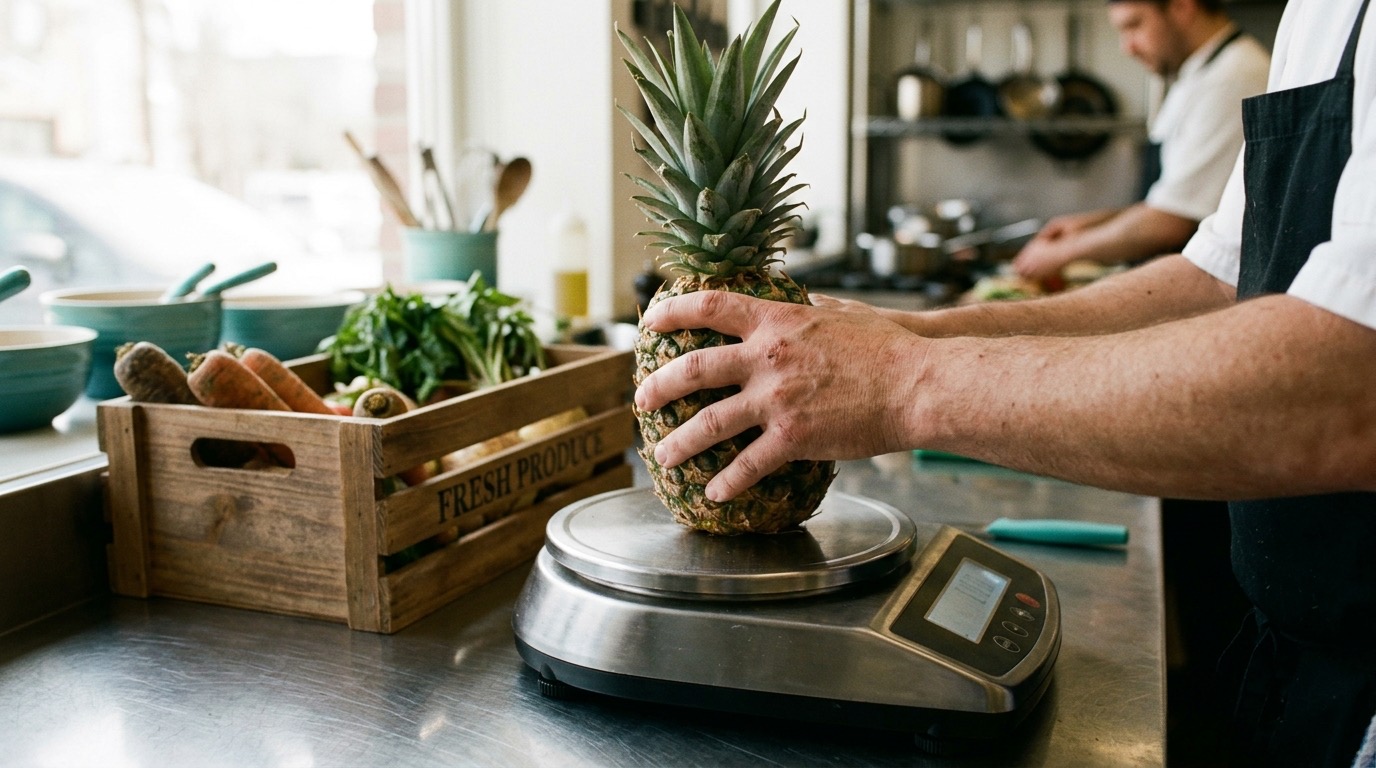
I’ll follow a single product so you can see the full journey: a whole tropical pineapple, perfect for pastry, cocktails, or a kitchen garnish.
Purchase: 1 pineapple weighing 1.4 kg at €2.80/kg. Total gross cost: 1.4 × €2.80 = €3.92.
Yield test:
- Gross weight: 1.400 kg
- After peeling and coring (cleaning): I get 0.770 kg of clean pulp. Cleaning yield: (0.770 ÷ 1.400) × 100 = 55%.
- When portioning into regular 2 cm dice for a dessert, I discard irregular trimmings and ends. Final servable weight: 0.700 kg. Usable yield: (0.700 ÷ 1.400) × 100 = 50%.
Real cost per kg of servable pulp: €3.92 (total gross cost) ÷ 0.700 kg = €5.60/kg. Compared to the €2.80/kg purchase price, the cost has doubled. Correction factor: 1 ÷ 0.50 = 2.0.
Applied to a portion: a dessert uses 90 g of pulp (0.090 kg). Raw material cost for the pineapple alone: 0.090 × €5.60 = €0.504, which we round to €0.50. If the total ingredient cost of the dessert were, say, €1.40 and you work with a target food cost of 28%, the selling price excluding VAT would be: €1.40 ÷ 0.28 = €5.00. Without the test, you would have calculated 0.090 × €2.80 = €0.25, and your cost card would have been off by 100%.
I’ve summarised the three weighings in a table so you can visualise it:
| Phase | Weight (kg) | % of gross | Cumulative cost (€/kg) |
|---|---|---|---|
| Gross (purchase) | 1.400 | 100% | €2.80 |
| Clean (peeled and cored) | 0.770 | 55% | €5.09 |
| Portioned (servable dice) | 0.700 | 50% | €5.60 |
The cost per kg jumps when you include portioning. Stopping at clean weight would have given you €5.09/kg, still an optimistic figure. Only the portioned data gives you the real ingredient cost.
Reference yields by product type
Every kitchen is different, but to give you a starting point, here are six products that don’t usually appear in generic waste tables, with their approximate usable yields (cleaning + portioning) and indicative correction factor:
| Product | Approx. usable yield (%) | Correction factor | Brief note |
|---|---|---|---|
| Tropical pineapple | 50% | 2.00 | Varies with size and cut type (dice, medallions). |
| Melon (piel de sapo type) | 45% | 2.22 | Without skin or seeds, in regular portions. |
| Mango | 55% | 1.82 | Highly dependent on ripeness and pit size. |
| Aged cheese in wedge | 85% | 1.18 | After removing rind and trimmings for uniform portions. |
| Cured ham on the bone (sliced) | 60% | 1.67 | Includes bone, rind, and slicing trimmings. |
| Pumpkin (butternut type) | 55% | 1.82 | Peeled, deseeded, and portioned into cubes. |
These numbers are just a reference to give you an idea. The data that really matters is from your own test, repeated with your product and your way of working. For a comprehensive product waste table, you can check the dedicated article on the food waste yield table, where I break down the gross loss for each family.
How to bring yield into your cost card (and why doing it by hand is a trap)
Entering the gross purchase price on your cost card — or even a fake “clean” price the supplier sells you — is the fast track to distorting your food cost. The cost card must work with the real cost per clean kg, which comes from multiplying the purchase price by the correction factor. If your recipe calls for 150 g of mango pulp, the cost of that line is 0.150 × (gross price × correction factor). Without that factor, you’re assuming the mango reaches the plate without pit or skin, and that doesn’t happen.
At a menu scale, with dozens of ingredients, keeping correction factors up to date in Excel becomes a nightmare: the supplier changes, the season changes, the yield changes, and you have to review every single formula one by one. That’s where a recipe costing software like Miselup saves the day: you store the yield per ingredient, the system recalculates the real cost and the food cost of each dish in real time, and you only have to worry about running the test and entering the data. If you want to play with numbers without commitment, you can use the waste and yield calculator to simulate scenarios, and then the food cost calculator to see how it impacts the final price.
Common mistakes when running a yield test
I’ve seen these errors repeat in workshops, bars, and kitchens of all kinds. Take note to avoid them:
- Weighing a single piece instead of a batch. One pineapple doesn’t represent the whole case. Take at least three or four pieces from the same batch and average them.
- Not taring the containers. Weighing the pulp inside a bowl without deducting the bowl’s weight inflates the yield and gives you a false sense of success. Always zero the scale.
- Forgetting the weight lost during portioning. Many stop at clean weight and don’t reach servable weight. Plating trimmings exist and must be measured.
- Using the supplier’s percentage without verifying. The data on the delivery note is indicative, but it doesn’t include your way of working or the finish of your dish.
- Not repeating the test when the season, size, or supplier changes. A mango from Brazil in January doesn’t yield the same as one from Málaga in September. The test expires; schedule it as a recurring task.
Frequently asked questions
What is product yield in the kitchen?
It’s the percentage of product you actually use after the entire process of cleaning, breaking down, and portioning, relative to the gross weight you bought. It tells you how much of every kilo you pay for ends up on the plate. Without that data, your cost card works on a fiction.
How is the yield factor calculated?
The yield factor is obtained by dividing the usable net weight by the gross weight and multiplying by 100. From there, the correction factor is 1 divided by the yield as a decimal. That factor lets you multiply the purchase price to get the real cost per clean kilo.
How often should I repeat the yield test?
Whenever the supplier, size, season, or the staff handling the product changes. At a minimum, review high-cost, high-waste products once per season. In kitchens with high staff turnover, every change of shift may justify a new test.
What’s the difference between clean weight and portioned weight?
Clean weight is what you get after peeling, deboning, or gutting, but before cutting into service portions. Portioned weight is what remains after shaping the portions: dice, medallions, slices. Portioned weight is always smaller because it generates trimmings; for the cost card you need the portioned weight, which reflects what you actually sell.
How does yield affect the real cost of a dish?
Directly: a low yield drives up the cost per clean kilo, and that extra cost is passed on to each portion. If you don’t measure it, you’re underestimating your raw material cost and your actual food cost will be higher than the theoretical one. Measuring yield lets you adjust the selling price or rethink the recipe before the margin disappears.