Butchery yields: how to calculate the cost per cut
Learn to calculate a breakdown's yield and allocate the whole-piece cost across cuts of different value, with a worked salmon example in euros.

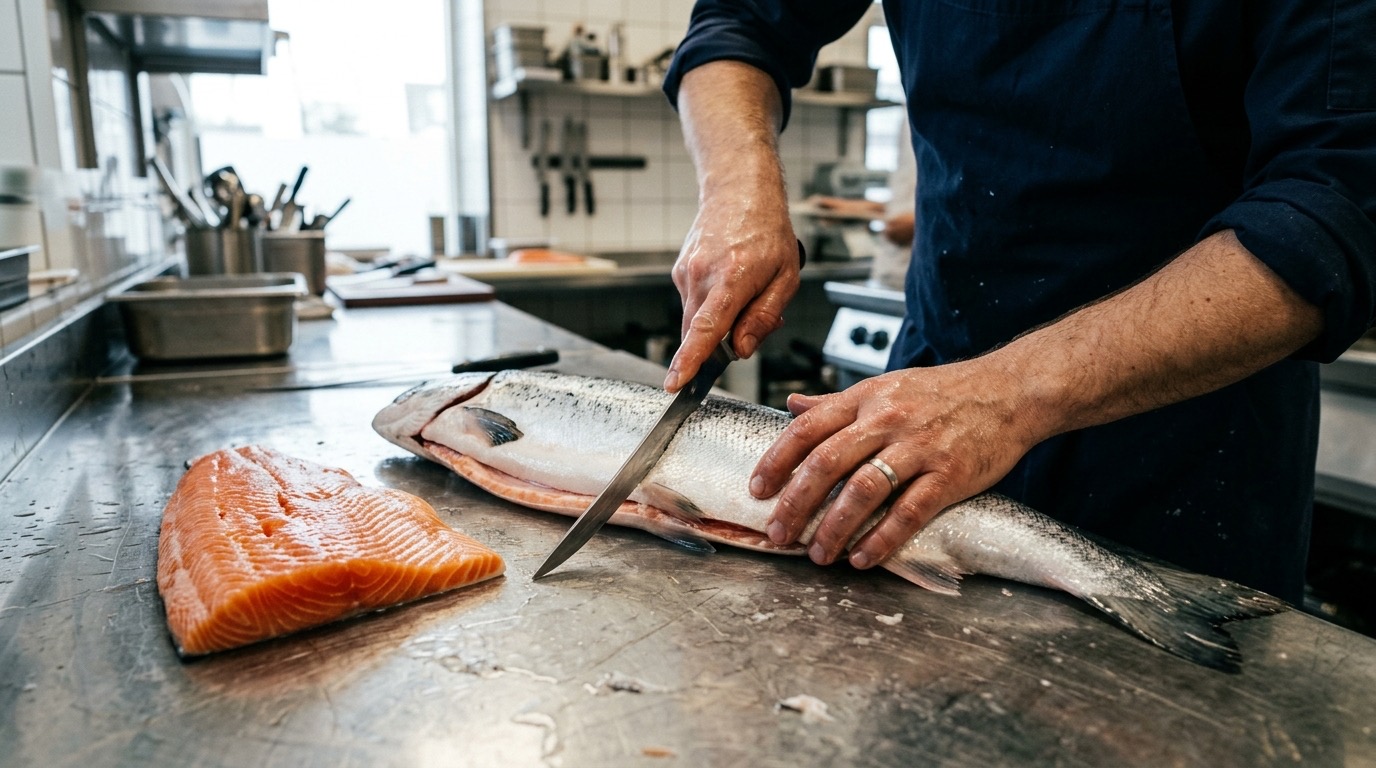
I’ve been walking into other people’s kitchens for over fifteen years to review recipe costing, and when I get to the fish, meat, or poultry, I’m usually told the same thing: “John, I buy the whole piece and break it down myself, so the cost per portion is just the purchase price divided by the net kilos.” That sentence hides a silent leak through which hundreds of euros escape every week. Because breaking down a primal cut doesn’t yield a single “net weight”: it produces cuts of different commercial value, and if you don’t allocate the cost based on that value, you’re making decisions blind. Today, I’ll walk you through, cut by cut and euro by euro, how to do it right.
What is the yield of a cut or breakdown (and how it differs from waste)
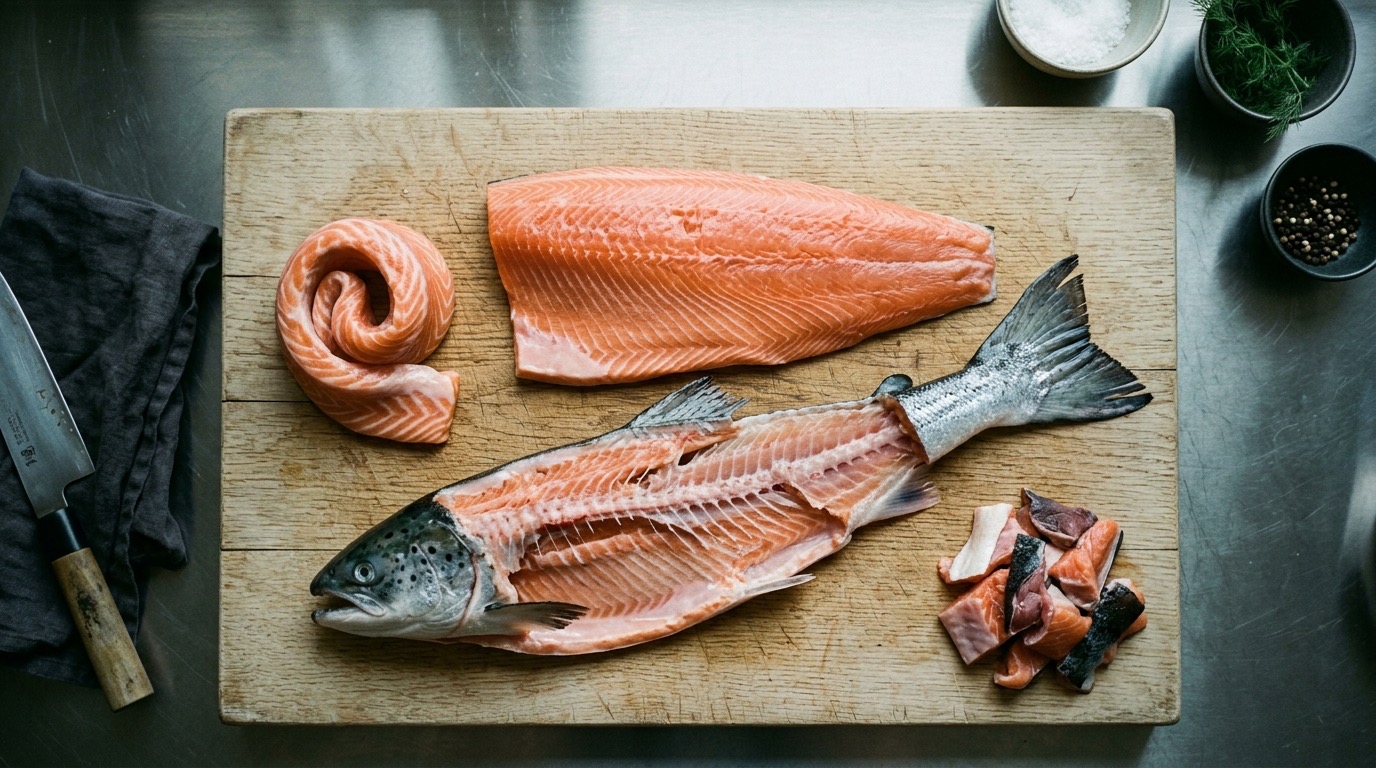
The yield of a breakdown is the percentage of the original piece that turns into useful, sellable cuts or portions — the ones that will actually generate revenue. If you buy a whole 4 kg salmon and after cleaning and breaking it down you get 2.5 kg of loins, belly, tail, and usable trimmings, your sellable yield is 62.5%. The remaining 37.5% is heads, bones, skin, scales, and small losses from evaporation or bleeding.
Waste, on the other hand, is simply the weight lost during cleaning and breakdown. With that same salmon, the gross waste would be 1.4 kg. But be careful: part of that waste can become a valuable by-product (bones and head for stock, crispy skin for garnish). That’s why the yield of a breakdown isn’t just a number: it’s the gateway to smart valorisation of every gram. If you want to dive deeper into how to measure waste for each ingredient, here’s the waste and yield table by product I use in my consulting work, and to understand how to run real product-by-product tests, take a look at this guide on yield of a product in the kitchen.
How to calculate the yield of a breakdown, step by step
Calculating yield isn’t complicated, but it requires method. I always recommend following these steps:
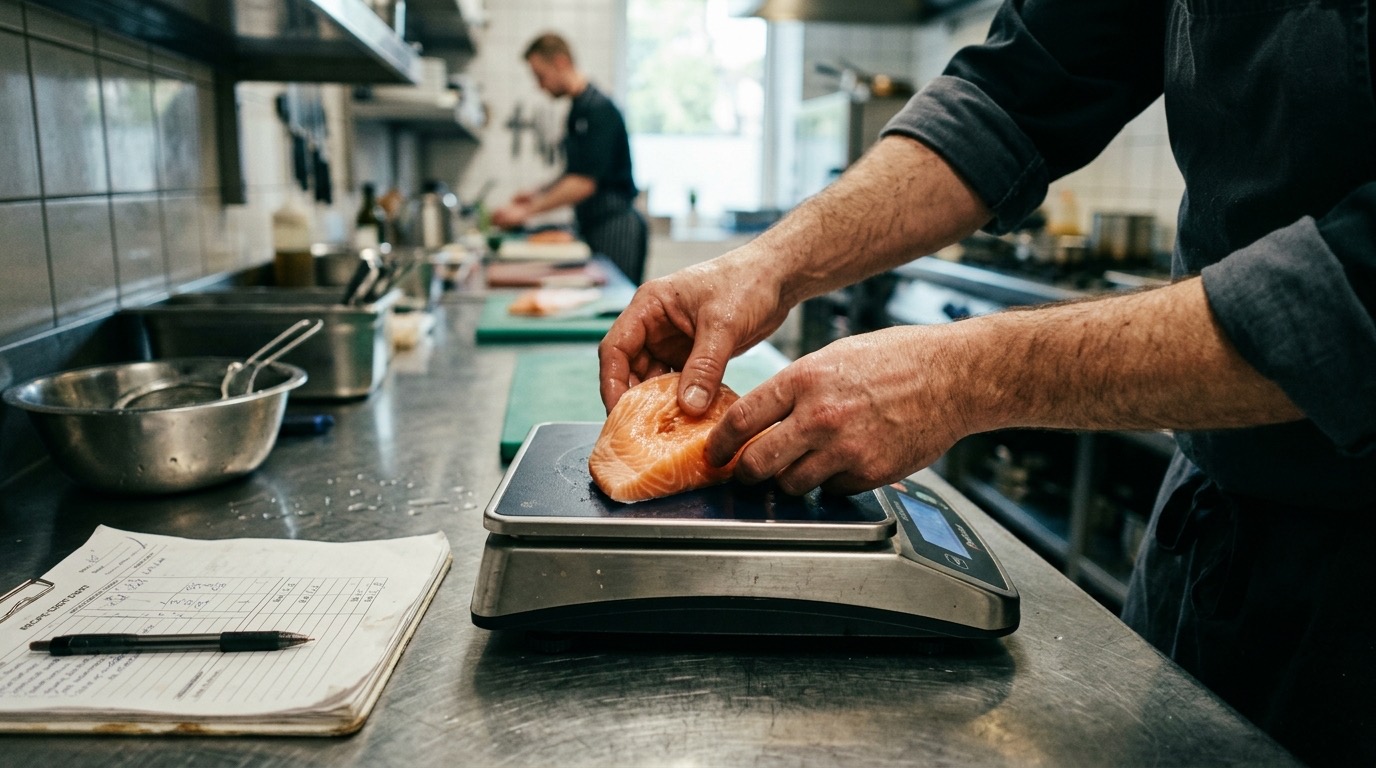
- Weigh the whole piece on a calibrated scale, just before you start working on it. Note the gross weight (GW).
- Perform the breakdown exactly as you would on a daily basis: separate the prime cuts, trimmings, bones, skin, glands — everything. Don’t cheat by trimming more just because you’re measuring; be realistic.
- Weigh each fraction separately: loins, belly, tail, trimmings, bones, skin, etc. Add up all the weights to check there are no unexplained losses (the sum should roughly match the GW; differences of 1-2% are normal due to evaporation).
- Identify which fractions are sellable as-is or after further processing (for example, skin can be sellable if you turn it into a crispy garnish). Add those weights: that’s your net sellable weight (NSW).
- Calculate the yield: (NSW / GW) × 100. That percentage is what you’ll use to plan purchases and recipe costing.
Repeat this test at least three times with pieces from different suppliers or batches and calculate the average. In hospitality, a poorly measured yield means a food cost that’s inflated from minute one.
Yield table by cut type: meat, fish, and poultry
So you have a quick reference, I’ve put together this table with realistic average yields in current Spanish hospitality. They’re not dogma, but they are a starting point to compare against your own tests.
| Piece / Cut | Sellable yield (%) | Typical use | Note |
|---|---|---|---|
| Suckling lamb carcass (whole, without offal) | 50 – 55% | Shoulder, leg, chops, neck for stew | The rest is bones, head, and hard trimmings. |
| Beef sirloin (striploin, trimmed of external fat, portioned) | 85 – 90% | Steaks, medallions, carpaccio | Prime cut with little waste if breakdown is precise. |
| Bone-in pork leg (fresh ham) | 70 – 75% | Steaks, stew cubes, part for mince | Bone and rind account for most of the waste. |
| Whole fresh salmon (4-5 kg) into loins | 62 – 68% | Loins, belly, tail, trimmings | Head, backbone, and skin make up 32-38% of the weight. |
| Wild sea bass (1-1.5 kg) into portions | 48 – 55% | Clean loins with skin | Head and backbone are proportionally large. |
| Bluefin tuna (fresh loin 3-5 kg) into portions | 75 – 82% | Loins, belly, trimmings | High yield if blood meat is cleaned well. |
| Whole chicken (1.8-2.2 kg) cut into eighths | 65 – 70% | Breasts, thighs, drumsticks, wings, carcass | Carcass and loose skin account for 30-35%. |
| Bone-in, skin-on chicken breast into clean fillet | 55 – 60% | Clean fillet without skin or bone | Skin and bone represent almost half the weight. |
| Boneless, skinless chicken thighs and drumsticks | 60 – 65% | Meat for skewers, stews, stuffings | Bone and skin are the main waste. |
This data helps you predict how much truly usable product you’ll get, but remember that yield varies by supplier, seasonality, and the skill of the person breaking it down.
Worked example: breaking down a whole salmon, cut by cut and in euros
Let’s ground all this with a real case I see every week. We buy a whole 4.000 kg salmon at €12.90/kg. Total cost of the piece: €51.60.
After breaking it down, we get the following cuts and weights:
| Cut | Weight obtained (kg) | % of the piece | Indicative market value (€/kg) |
|---|---|---|---|
| Loins (clean, skinless, boneless) | 1.600 | 40.0% | €22.00 |
| Belly (fatty strip, very flavourful) | 0.400 | 10.0% | €28.00 |
| Tail (rear part, ideal for tartare) | 0.300 | 7.5% | €14.00 |
| Trimmings (small strips, meat attached to the bone) | 0.200 | 5.0% | €8.00 |
| Skin and backbone (for stock) | 1.500 | 37.5% | €2.00 |
| Total | 4.000 | 100% |
Now, how do we allocate that €51.60 among the cuts? There are two paths.
Allocation by weight (incorrect for valorisation): We divide the total cost by the total weight (€51.60 / 4.000 kg = €12.90/kg) and assign that price to each cut based on its weight. So, the loins would cost €20.64 (1.600 kg × €12.90), the belly €5.16, the tail €3.87, the trimmings €2.58, and the skin and bone €19.35. The problem is that the belly, which is worth €28/kg on the market, is being valued the same as the trimmings at €8/kg. You’re subsidising the trimmings with the margin the belly should generate. Your recipe costing will tell you the trimmings are expensive (and you might stop using them) and that the loins are dirt cheap (and you’ll lower the selling price unnecessarily, losing profitability).
Allocation by market value (correct): We calculate the total market value of all cuts: (1.600 × 22) + (0.400 × 28) + (0.300 × 14) + (0.200 × 8) + (1.500 × 2) = €35.20 + €11.20 + €4.20 + €1.60 + €3.00 = €55.20. Then we calculate an allocation factor: actual cost of the piece / total market value = €51.60 / €55.20 = 0.9348. We multiply the market value of each cut by that factor to get the assigned cost:
| Cut | Assigned cost (€) | Real cost per kg (€) |
|---|---|---|
| Loins | €35.20 × 0.9348 = €32.90 | €20.56/kg |
| Belly | €11.20 × 0.9348 = €10.47 | €26.17/kg |
| Tail | €4.20 × 0.9348 = €3.93 | €13.10/kg |
| Trimmings | €1.60 × 0.9348 = €1.50 | €7.50/kg |
| Skin and bone | €3.00 × 0.9348 = €2.80 | €1.87/kg |
| Total | €51.60 |
Now each cut carries a cost proportional to what it’s actually worth on the market. If you serve a 150 g portion of loin, the cost of that portion is 150 g × €20.56/kg = €3.08. With a target food cost of 30%, the suggested selling price would be €3.08 / 0.30 = €10.27 (round up to €10.50 or €10.90). The belly, at €26.17/kg, is a premium bite you can make even more profitable with a good sales pitch. This allocation lets you set prices with logic, not “by eye.”
Timlup · Team on trackDaily checklists & tasks for your restoKeep your team on point with recurring tasks. Meet Timlup and simplify operations.Meet Timlup →How to allocate the cost of the piece among cuts: by weight vs. by market value
The example above already shows the difference, but I want the general method for any breakdown to be clear. Allocation by weight is simple but misleading: it assigns the same cost per kilo to all cuts, ignoring that some are worth much more than others. If you use this system, prime cuts will seem more profitable than they are, and humble cuts will seem ruinous, which can lead to wrong decisions (eliminating trimmings that are actually very profitable if used well, or giving away margin on star dishes).
Allocation by market value, on the other hand, weights the cost based on the price at which you could buy that cut already cleaned. The formula is:
- Calculate the total market value (TMV) of all cuts: sum of (weight of each cut × market price of that cut).
- Calculate the allocation factor: cost of the whole piece ÷ TMV.
- Assign to each cut: weight of the cut × market price × factor.
This method respects commercial reality and gives you a much more accurate costing. If you’re not sure about the market price of each cut, check invoices from suppliers who sell those pieces already cleaned or use wholesale market references. In my consulting work, this simple adjustment often uncovers hidden margins and justified selling price increases.
Factors that make the yield of a breakdown vary
Yield isn’t a static figure; it fluctuates for multiple reasons you need to control:
- Origin and quality of the piece: A Norwegian farmed salmon usually has more intramuscular fat and a slightly higher yield than a wild Alaskan one. Suckling lamb gives a higher yield than an older lamb because it has less external fat.
- Seasonality: At certain times, fish accumulate more fat or are leaner. Wild sea bass in winter has a lower yield than in summer.
- Skill of the cook or butcher: A bad cut can leave valuable meat attached to the bone or skin. Investing in butchery training is highly profitable.
- Size of the piece: Very small pieces (a 1.2 kg chicken) have proportionally more bone and skin than a 2 kg one. The same goes for fish: a 2 kg salmon yields less than a 5 kg one.
- Equipment: A good boning knife, a well-maintained steel, and, for meats, a precise bandsaw, can make a difference of up to 5% in yield.
Common mistakes when valuing a breakdown
These are the errors I see over and over in restaurants of all kinds:
- Not doing a real yield test and using generic percentages that don’t match your supplier or your way of working. Your kitchen’s yield is unique.
- Allocating cost only by weight, as if all cuts were worth the same. This is the mistake that loses the most money without you realising it.
- Ignoring the value of by-products. That salmon backbone and skin aren’t trash: with them, you produce a stock that saves you from buying industrial broth. That recovered value should offset the cost assigned to prime cuts, not be lost in the bin.
- Not updating yields with every change of supplier or batch. A new supplier might bring fattier pieces or ones with more bone, and your costing becomes obsolete in a week.
- Not differentiating between first, second, and third category cuts when designing the menu. The same loin can go to carpaccio (first category) and the trimmings to meatballs (third). If you don’t separate costs, you won’t know which dish is giving you the most real margin.
How to automate cost allocation with digital recipe costing
Doing this allocation by hand for every piece is a titanic task. Luckily, today there are tools that do it automatically and without errors. A good recipe costing software like Miselup lets you create a “composite item”: you enter the weight and cost of the whole piece, the resulting cuts with their weights and market values, and the system automatically allocates the cost under the criterion you choose (by weight or by value). Plus, it updates all your recipe costings in real time if the purchase price changes.
If you’re still not sure about your real yield, I invite you to use this free waste and yield calculator I’ve prepared. In a few clicks, you’ll get the exact percentage of your breakdown and can start making decisions with data, not gut feelings.
ChefBusiness · Real profitabilityMaximize your restaurant without losing moneyCost control and food marketing. Book your ChefBusiness consulting now.Get the consulting →Frequently asked questions
How do you calculate the yield of a meat cut?
You weigh the whole piece (for example, a 3.200 kg beef sirloin), clean and cut it into portions, weigh the usable portions (let’s say 2.880 kg), and divide this weight by the initial one: (2.880 / 3.200) × 100 = 90% yield. The waste (0.320 kg) is fat trimmings and purge. Always do the test with at least three pieces to get a reliable average.
What is the average yield of a beef carcass or a whole salmon?
A beef carcass (half carcass) can have a sellable yield of around 65-70% if fully broken down, though it depends on the breed and finish. A whole 4-5 kg salmon usually yields between 62% and 68% of loins, belly, and usable trimmings. These are indicative figures: in your kitchen, they can vary by up to 5 points either way.
How do I allocate the cost of a piece among cuts of different value?
The fairest method is allocation by market value: assign each cut a cost proportional to the price at which you could buy it already cleaned. For example, if a salmon loin is worth €22/kg on the market and trimmings €8/kg, the loin will absorb a larger share of the whole piece’s cost. The formula is (total cost ÷ total market value) × value of each cut.
How does breakdown yield affect recipe costing and food cost?
Directly. If you overestimate the yield (you think you get more portions than you actually do), your cost per portion will be lower than the real one, and your food cost will skyrocket without you detecting it in time. An error of just 3% in the yield of a salmon can mean an extra €0.40 per portion, which in 100 weekly covers is €40 of lost margin. Precision in breakdown is pure profitability.
What do I do with breakdown by-products (bones, trimmings)?
Always valorise them. Fish bones and heads turn into fish stock (each litre saves you between €3 and €5 compared to bought broth). Meat bones give brown stocks, sauces, and glazes. Meat or fish trimmings are perfect for stuffings, meatballs, rillettes, or tartares. In the salmon example, the skin and bone cost €2.80 and generated about 3 litres of stock valued at over €12. Don’t give away value by throwing away by-products.