Cooking Loss vs Trimming Waste: Kitchen Costing Example
Cooking loss vs trimming waste: how they differ, how each enters your recipe costing, and a worked euro example with the two yields chained.

Every time I audit a recipe costing sheet, I run into the same blind spot: mixing up trimming waste with cooking loss as if they were the same thing. The result is a cost per portion that looks right on paper but bleeds money plate by plate in the kitchen. And the worst part is that the error doesn’t jump out at you, because you see trimming waste every day on the butchering table, while cooking loss stays invisible until you weigh the piece again after the heat. If you don’t clearly separate these two moments, you’re giving away margin with every service without even knowing it.
In the following lines, I’m going to walk you through—using real scale numbers and the data I handle every week with production kitchens, restaurants, and bars—how to tackle these two types of waste independently. Because yes, they are measured in different phases, they enter the spec sheet differently, and—pay attention—when an ingredient goes through both, the yields multiply, not add up. Mastering that nuance is what separates a costing sheet that protects you from one that leaves you stranded at the end of the month.
Trimming Waste vs. Cooking Loss: Two Phases, Two Moments
Waste is simple to define: it’s everything you buy but don’t end up serving on the plate. The standard formula, (gross weight - net weight) / gross weight, is broken down in detail in the article on theoretical vs actual food cost. But the important nuance isn’t the arithmetic; it’s when and where each type of waste appears and how you record it.
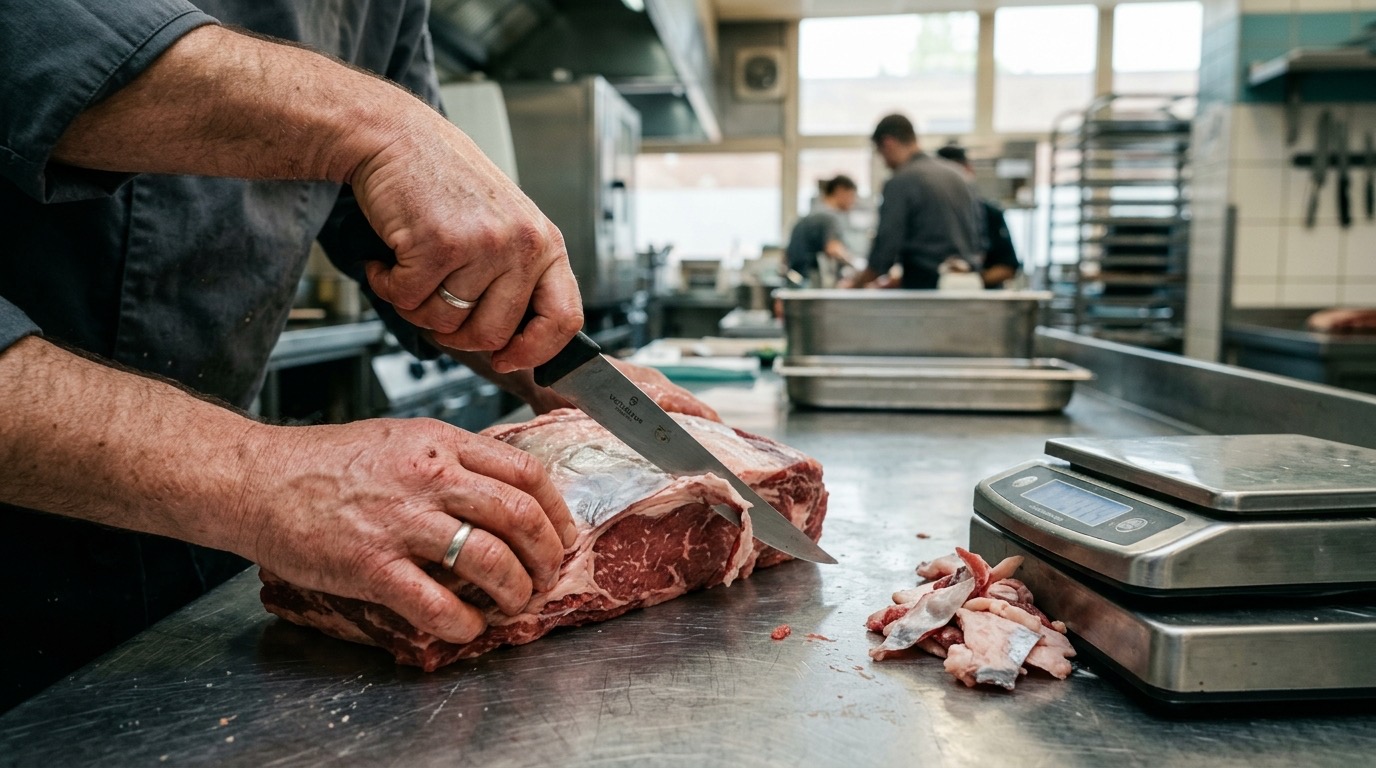
Trimming waste happens raw, on the butchering table. You see it and touch it: bones, skins, tails, fats, sinews, peels, tough stems… everything you remove before the ingredient reaches the cooking station or the pass. It’s physical, predictable waste that depends on the supplier, the peeling, or the butchering. To know exactly when to weigh the gross and net in this phase, I recommend you review the steps I detail in the article on gross weight vs net weight in the kitchen.
Cooking loss, on the other hand, you don’t see during the cut. You only discover it when you weigh the piece after applying heat. Water evaporates, proteins contract, fat renders, and fibers lose volume. It’s waste you couldn’t measure until that moment, and it depends directly on the technique, temperature, time, and even the exact doneness you request for the meat.
The classic error comes when you apply only one of the two in the spec sheet, or you simply add them together. I’ll tell you now: if your recipe goes through both phases, the trimming and cooking yields chain together with a multiplication, and the actual cost you end up with is significantly higher than you guessed.
Cooking Loss by Technique: Why a Roast Doesn’t Lose the Same as Sous-Vide
If there’s one thing I repeat in every training session, it’s that you can’t take cooking loss data from someone else’s table without measuring it in your own ovens, with your own pieces and your exact service doneness. But it is useful to have some indicative ranges to understand the impact of technique on yield, especially when comparing options for the same preparation.
This table will serve as a starting reference:
| Cooking Technique | Typical Cooking Loss (%) | Yield After Cooking (%) | Notes |
|---|---|---|---|
| Griddle or Grill | 20-25% | 75-80% | High surface evaporation; marks and quick texture, but loses juice. |
| Oven Roasting | 25-30% | 70-75% | Dry air dries the exterior; loss depends on final doneness and resting. |
| Braising or Long Stew | 30-35% | 65-70% | Collagen turns into gelatin, but there’s loss from prolonged evaporation and liquid reduction. |
| Boiling or Poaching | 30-40% | 60-70% | Most of the loss goes into the cooking water; lean pieces shrink intensely. |
| Frying | 15-20% | 80-85% | Loses water, but part of the weight is recovered by fat absorption; the net result is a bit kinder. |
| Steaming | 10-15% | 85-90% | Gentle cooking, no immersion; maintains volume and moisture. |
| Low-Temperature Sous-Vide | 5-15% | 85-95% | No evaporation: almost all loss is juice inside the bag, which is often reused. |
These percentages don’t replace your scale; they are the clue that helps you decide if that pork shoulder is more profitable braised than roasted, and above all, not to assume that “meat always loses 30%” without measuring with your specific technique.
For trimming waste percentages by product (loins, fish, specific vegetables), I won’t duplicate a long table here: go directly to the waste and yield table by product that I keep updated. There you’ll find, for example, how much a whole monkfish actually yields after cleaning or what a bell pepper loses when you roast and peel it.
Trimming Waste vs. Cooking Loss: Comparison Table
So you can see it at a glance, I’ve summarized the differences in this side-by-side table:
| Aspect | Trimming Waste | Cooking Loss |
|---|---|---|
| When it happens | Before cooking, raw. | During and after heat. |
| Where it’s seen | On the butchering table (skins, bones, trimmings). | On the scale after cooking (final servable weight). |
| What causes it | Deboning, trimming fat, peeling, cleaning vegetables. | Water evaporation, fat rendering, protein contraction. |
| How it’s measured | Comparing purchase gross weight with clean weight before cooking. | Comparing weight before cooking (clean) with weight after cooking. |
| How it enters the costing | Applied to the raw ingredient to get the “recipe net weight.” | Applied to the preparation when the portion is defined by cooked weight. |
| Examples | Removing the chain and fat from a beef striploin; filleting a hake. | Roasting the clean loin to medium-rare; steaming a hake and weighing the resulting fillet. |
I insist: you see and weigh the first one before the fire; you only discover the second one after. Keeping them separate in your workflow is the first step to making your costing sheet stop lying to you.
The Real Cost When the Two Wastes Chain Together: A Step-by-Step Example in Euros
Let me show you with real numbers, the kind clients bring me when a dish doesn’t add up. Imagine you buy a 3 kg beef striploin at €18.00/kg. Your total purchase cost is €54.00.
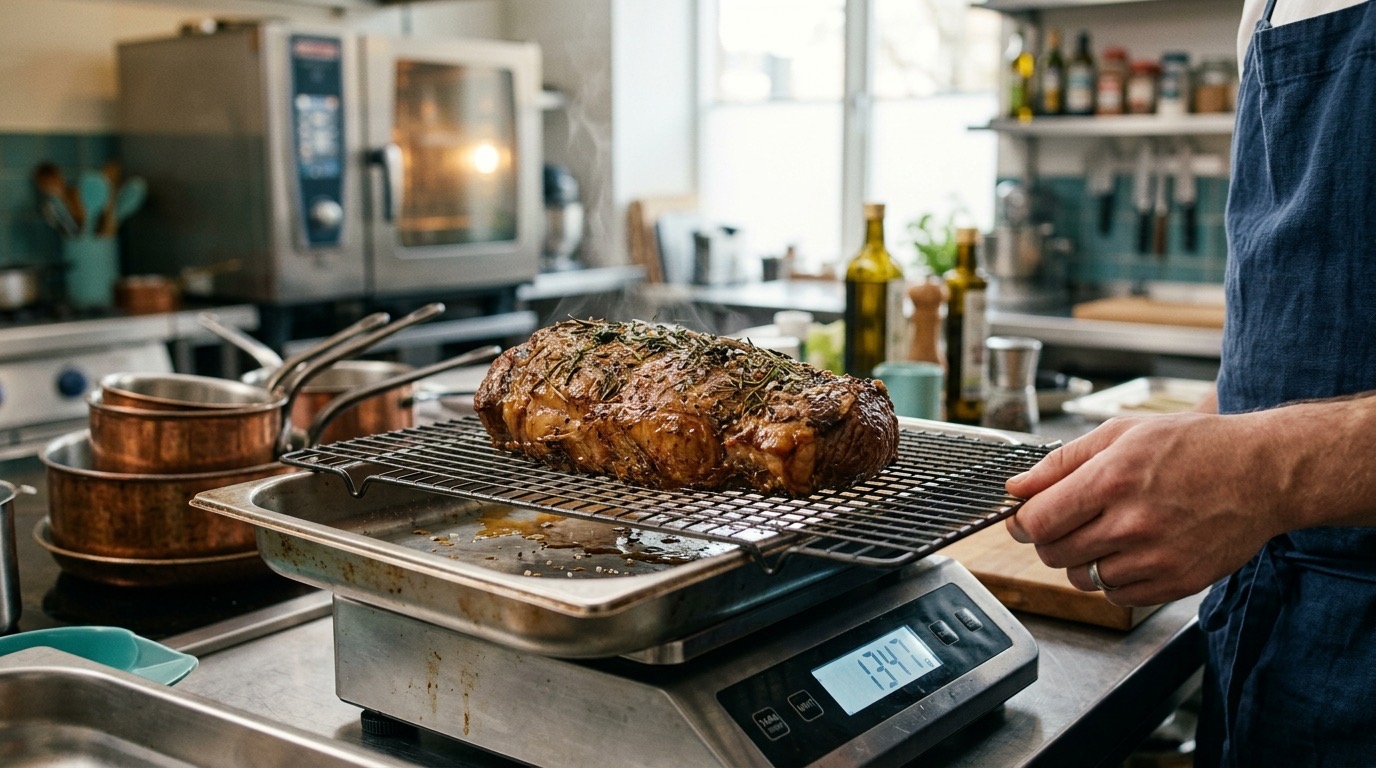
When you clean it raw, you remove fat, sinews, and the chain. After butchering, you weigh the clean meat: 2.55 kg. The trimming yield was 85% (2.55 / 3.00). That’s your first filter.
Then you roast that clean piece in the oven to medium-rare. You weigh it again hot, after a brief rest: 1.9125 kg. The cooking loss has given you a yield of 75% on the clean piece (1.9125 / 2.55).
Here comes the key point that underpins this whole article: the total yield is not the sum of the waste percentages, but the product of the two yields. I multiply 0.85 × 0.75 = 0.6375. That is, 63.75% of those initial 3 kg ends up on the plate. The real cost per kilogram served skyrockets:
€54.00 / 1.9125 kg = €28.24/kg.
To read this smoothly on a spec sheet, this table shows the step from raw to cooked with the cost per kilo at each phase:
| Phase | Weight (kg) | Cumulative Yield | Total Cost (€) | Cost per kg (€/kg) |
|---|---|---|---|---|
| Purchase (gross) | 3.000 | – | €54.00 | €18.00 |
| Clean (after butchering) | 2.550 | 85.00% (trimming) | €54.00 | €21.18 |
| Cooked (servable) | 1.9125 | 63.75% (0.85 × 0.75) | €54.00 | €28.24 |
With that cost per kilo served of €28.24/kg, a 180 g portion of roast loin comes to €5.08 in raw material.
Now notice the silent error: if you only apply the trimming waste and forget the cooking loss, your costing would calculate €54.00 / 2.55 kg = €21.18/kg, and the 180 g portion would cost you €3.81. You’d be losing €1.27 for every plate you serve, convinced your numbers are correct. Multiply that by 50 services a week, and you’ll see how the profit and loss statement starts to limp without anyone understanding why. This is the exact point where many “correct” costing sheets let margin slip away.
How Each Waste Enters the Costing Sheet (and When They Multiply)
In the standard spec sheet, you start with the gross weight of the ingredient, apply the trimming yield, and get the recipe net weight that appears on the production line. Up to that point, the trimming waste is already absorbed into the unit cost of the ingredient.
Cooking loss, on the other hand, you apply later, on the finished preparation, especially when the portion is defined by cooked weight. This is the typical case for carved roasts, stewed meats you weigh on the plate for banquets, or oven-baked fish you serve by final grammage.
What you should never do is subtract the waste percentages: a 15% trimming loss plus a 25% cooking loss is not a 40% total loss, because the second percentage is applied to what’s left after the first. The only correct way is to multiply the yields: Total yield = (1 - % trimming/100) × (1 - % cooking/100). Or, in decimals, Total_yield = Trimming_yield × Cooking_yield. This simple operation gives you the real cost per kilo served, the one that lets you set a selling price that actually leaves a profit.
Common Mistakes When Separating Trimming Waste and Cooking Loss
After reviewing hundreds of costing sheets, these are the most frequent errors when handling the two types of waste:
- Adding the percentages instead of multiplying the yields. As I’ve shown you, 15% and 25% don’t add up to a 40% loss; chained together, they leave you with a real yield of 63.75%, far from that 60% you would mistakenly assume.
- Not re-weighing the piece after heat. If you decide the costing with book data instead of your kitchen’s data, you’re flying blind. Sous-vide in your oven can yield more or less than the table, and only the scale after the pass gives you reliable data.
- Defining the portion raw and serving it cooked without adjusting for loss. I’ve seen sheets where the cost per portion is calculated on 200 g of clean raw meat, but the waiter serves 180 g of cooked meat. If you don’t reflect that loss, the real cost of the dish goes up and the margin shrinks.
- Forgetting cooking loss in catering and banquets where you quote by served weight. When you invoice by the kilo of meat served, every point of yield you don’t measure is a gamble. An unaccounted cooking loss can turn a profitable event into a hole.
- Not re-testing the yield when changing technique or supplier. The same piece from a different source can have more fat cover, increasing trimming waste; and if you switch from roasting to braising, the cooking loss changes. The yields you measure today must be updated when you touch any of these variables.
Automate the Calculation of Both Wastes in Your Costing Sheet
Having the concept clear is fundamental, but in the day-to-day of a production kitchen or professional kitchen, you need the numbers to flow automatically without a slip-up throwing off your food cost. That’s why I always incorporate a tool like Miselup, a costing software that lets you assign a waste percentage to each ingredient and each phase, and automatically recalculates the real cost when you modify the trimming or cooking yield. This way, the spec sheet always reflects what’s happening on your butchering table and in your oven, not what you think is happening.
If you want to try the yield chaining yourself with your own numbers, head over to the waste and yield calculator. Enter the two weights, and it gives you the real cost instantly, using the same criteria I just explained.
Timlup · Team on trackDaily checklists & tasks for your restoKeep your team on point with recurring tasks. Meet Timlup and simplify operations.Meet Timlup →Frequently Asked Questions
What is the difference between trimming waste and cooking loss?
Trimming waste is the loss that occurs raw, when removing inedible parts or parts not used in the recipe (bones, skins, fats). Cooking loss is the weight loss the food suffers after applying heat, mainly from water evaporation and muscle contraction. You see the first one when butchering; you only discover the second one by weighing after the process.
Do you add trimming waste and cooking loss together?
No, because cooking loss is applied to what’s left after trimming. To get the total loss, you must multiply the yields of each phase: Total yield = (1 - % trimming/100) × (1 - % cooking/100). Adding the percentages gives you a lower number and a cost that doesn’t match reality.
How much does meat or fish lose when cooked?
It depends entirely on the technique and the type of piece. For meats, a roast can lose between 25% and 30%, while a low-temperature sous-vide barely loses 5-15%. For fish, steaming usually hovers around 10-15%. The only reliable way is to weigh the piece right after cooking and before plating.
How does cooking loss affect cost and selling price?
If you don’t include it, your costing will underestimate the real cost per kilo served, leading you to set a selling price that’s too low and lose margin. As I showed you in the striploin example, forgetting cooking loss can mean more than one euro per portion; that money never reaches the bottom line.
When should I apply each waste in the costing sheet?
You apply trimming waste to the raw ingredient to get the recipe net weight used in production. You apply cooking loss later, when you define the portion by cooked weight, which is common for roasts, stews, and catering services. If your dish is served raw (like a tartare), you’ll only have the first one. If it goes through heat, you must chain the two by multiplying their yields.