Recipe Costing for Catering and Events: A Practical Guide
Master recipe costing for catering and events with a per-guest approach, scaling, and event costs. Wedding example and dynamic costing tool included.

I know what it’s like to spend an entire Sunday in front of a spreadsheet, poring over line items and convincing yourself the margin on that event you just served was higher than it really was. And I also know how much it stings when the bank tells a different story. In catering and events, the danger isn’t the plate that goes wrong; it’s the costs you never saw coming. I’ve been in restaurant kitchens, production workshops, and catering companies for over twenty years, and everywhere I’ve found the same trap: working with a cost structure designed for a restaurant à la carte menu, when what you’re selling is a per-guest menu with everything that entails.
The good news is that getting out of that trap isn’t about magic—it’s about method. Because when you understand that costing a catering job means thinking about the dish, the logistics, the extra staff, and the waste generated by a service for 200 people, you stop walking blind and start budgeting with a real margin. And that’s what this article is about: how to do a recipe costing for catering and events that puts every euro in its place, so the price you give the client isn’t a hunch but an informed decision.
Why costing a catering job isn’t the same as costing a menu
If you come from the restaurant world and make the leap to events, there’s a lesson you learn fast—and often the hard way: the recipe costing for an à la carte dish looks very different from the costing for a wedding menu or a corporate cocktail. In a restaurant, the guest orders individual dishes, and you can calculate the cost of each recipe, set a price with a margin, and trust that the sales mix will do its job. In catering, the client buys a fixed experience: a wedding menu at X euros per person, finger food for 80 attendees, a corporate brunch. The sales unit isn’t the dish; it’s the guest.
That changes everything. First, the cost of raw materials has to be read from the full menu, not from the isolated dish. But also, costs appear that don’t exist in a restaurant—or at least not with the same intensity—like extra staff hired for that one day, transport of the production to the venue, rental of tableware or linens, one-off insurance, or setup and teardown. If your costing only looks at the recipe spec sheet, you’re leaving out a big part of the real cost. And that cost eats into your margin without you noticing.
That’s why the first step in doing a recipe costing for catering and events that actually works is accepting that you need a different mental structure. It’s not about making a good cost breakdown for a single dish and that’s it; it’s about building a cost per guest that captures everything it costs to serve that menu at that specific event. A living costing that lets you scale recipes without throwing off the numbers and that serves as the basis for sending out quotes that won’t leave you in the red.
Cost per guest and cost per menu: the unit you’re really selling
When I started advising catering companies, one of the first things we did was flip the mindset: stop asking “how much does this dish cost me?” and start asking “how much does this menu cost me per person?” The client isn’t buying a risotto; they’re buying a wedding menu that includes appetizer, starter, main, dessert, wine, coffee, and petit fours. So the cost you want to control is the cost per guest of the full menu.
To calculate it, the mechanics are simple to state but demanding to execute: you add up the raw material cost of all the preparations that make up the menu—including bread, butter, oil, drinks, and even welcome details—and divide by the number of guests. But careful: that guest count isn’t the one the client confirmed; it’s the number of guests you actually produce for, which is usually higher. We’ll talk about safety overproduction in a moment, because it’s one of the key factors that most distorts cost when you don’t account for it.
Once you have the raw material cost per guest, you add all the other event costs, also divided per person. The result is the total cost per guest. From there, you decide the selling price per guest and calculate the real margin. If you do this manually or with a spreadsheet, every change in a supplier or recipe forces you to recheck chains of formulas that break easily. That’s why many professionals end up using tools that calculate the cost per guest automatically and keep the data consistent when a purchase price changes or the number of guests changes.
Scaling recipes without throwing off the cost
This is one of the points where I see the most stumbling. A recipe designed for 8 portions doesn’t just get multiplied by 25 to give 200 without consequences. The rule of three works in theory, but in a real kitchen it runs into yield losses that change when scaling, production capacities that force batch cooking, and seasoning adjustments that aren’t linear. If you scale poorly, the cost your costing reflects isn’t the cost you actually had, and the margin vanishes again.
Yield losses when scaling
When you go from a test recipe to a production run of 200 portions, some yield losses multiply more than proportionally. For example, in a starter that involves marinating or manual deboning, waste on small pieces can be higher than on a large piece that yields more cleanly. If your costing doesn’t capture that real yield loss, you’ll be buying more raw material than you planned, and the cost per portion shoots up.
Production capacity and batches
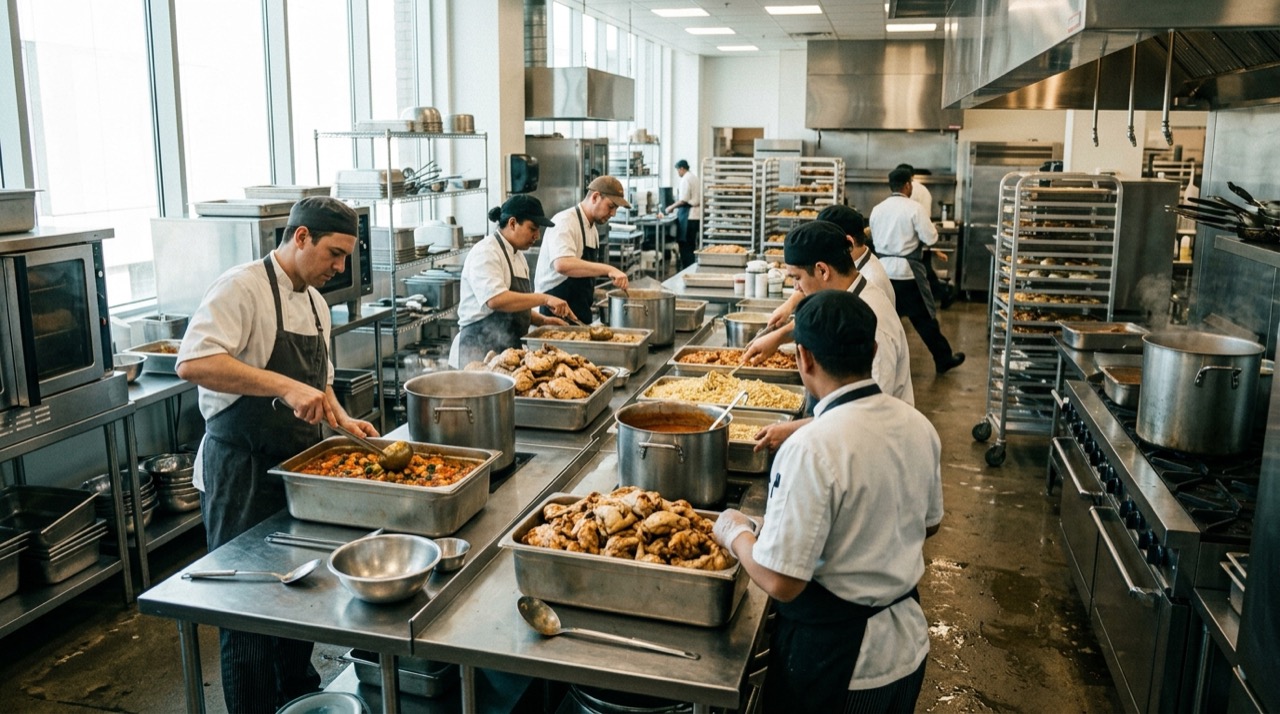
Another classic trap: the original recipe is designed for a domestic oven or a hob, but the event requires production in an industrial kitchen with convection ovens, blast chillers, and cold rooms. If your team can’t handle the whole production in one pass, you’ll have to work in batches, which can stretch times, increase energy consumption, and above all, create performance differences between the first batch and the last. That impacts the real cost.
Safety overproduction
At a buffet or cocktail reception, you never produce exactly for the number of guests. You always make extra, because running short is the worst-case scenario. That safety overproduction—which can range from 5% to 15% depending on the type of service and client profile—is cost that comes out of your pocket. If you don’t include it in your costing, you are distorting the real cost. My recommendation: always scale your recipes to the number of guests plus that safety buffer, and have the costing reflect the cost of producing for that quantity, not the contracted quantity.
ChefBusiness · Real profitabilityMaximize your restaurant without losing moneyCost control and food marketing. Book your ChefBusiness consulting now.Get the consulting →Event costs that need to be allocated
This is where I separate the wheat from the chaff. Many event kitchen professionals feel comfortable when they have raw material costs under control, but forget that an event is a logistics operation that goes far beyond the stoves. If you don’t distribute those costs among the guests, the profit you think you have is an illusion.
In the table below I list the line items you should consider in any medium-sized event. The figures are indicative for a service of 120 guests, but the concept is what matters:
| Cost line item | Total amount (€) | Cost per guest (€) |
|---|---|---|
| Raw materials (incl. overproduction) | 4,200 | 35.00 |
| Extra front-of-house and kitchen staff | 1,440 | 12.00 |
| Transport, logistics and travel | 360 | 3.00 |
| Rental of tableware, linens and furniture | 540 | 4.50 |
| Insurance, permits and miscellaneous | 180 | 1.50 |
| Total event cost | 6,720 | 56.00 |
Extra staff is one of the big forgotten items. When you work on an event, you often reinforce the service and kitchen team with staff hired by the hour or by the day. That’s a direct event cost and should be split per guest. The same goes for transport: moving production, equipment, and staff to the venue has a cost—fuel, tolls, per diems—that isn’t raw material, but without that expense you couldn’t serve.
Rental of tableware, linens, and even auxiliary furniture is another line item that varies greatly by event type, but is almost never zero. And don’t forget specific insurance costs or one-off permits that might be needed. If you don’t include them in your per-guest costing, the margin you calculate is fictional. To really understand how all these costs are distributed in a general business structure, I recommend reviewing the structure and percentages of restaurant costs, which, though designed for dine-in restaurants, gives you a solid foundation for understanding the allocation logic.
Practical example: a wedding menu costed per guest
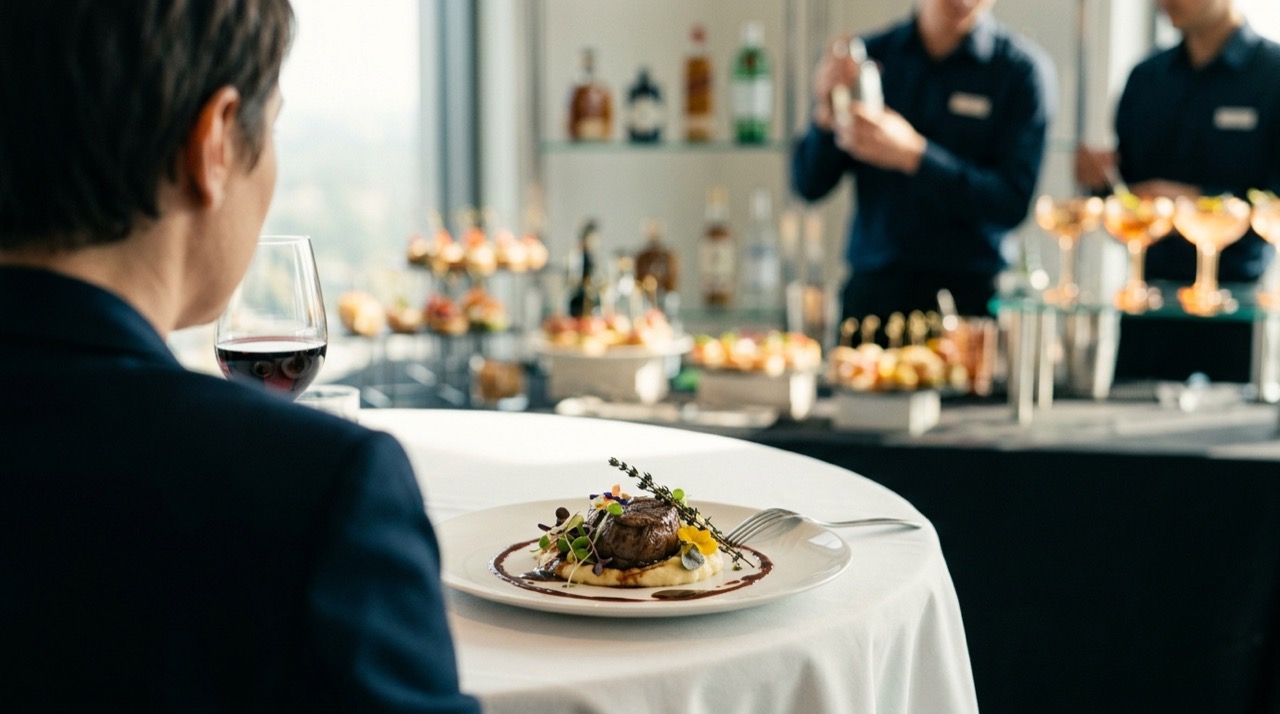
Let’s get down to earth with a concrete example. Suppose a wedding for 120 guests at a venue on the outskirts of Madrid. The contracted menu includes: a welcome appetizer with two cold bites and a glass of cava, a warm salad starter with foie gras and nuts, a main course to choose between oven-baked sea bass and beef sirloin with garnish, wedding cake dessert and coffee/tea bar, plus a wine pairing (white, red, and cava) and bread.
Production is planned for 132 guests (120 + 10% safety overproduction). The raw material cost, including drinks and bread, totals €4,200, giving a raw material cost per guest of €35.00 based on the 120 contracted guests.
Extra staff for the event includes one head chef, two additional cooks, one head waiter, and six servers, all hired for the event day, at a total cost of €1,440. Transport of equipment, production, and tableware is done with two vans, costing €360 in fuel, tolls, and per diems. Rental of tableware, linens, glassware, and auxiliary furniture comes to €540. One-off insurance and permits add up to €180.
The total event cost, as we saw in the table, is €6,720. Divided by 120 guests, the total cost per guest is €56.00. If the selling price agreed with the couple is €95.00 per person, the gross margin per guest is €39.00, which represents a 41% margin on the selling price. A reasonable margin for a wedding, where the ticket is high but so are the demands and the risk.
This example makes it clear that if you had only costed the recipe, you would have stopped at €35.00 cost and thought you were making €60.00 per guest. But the reality is that the real margin, once you allocate all event costs, is very different. And that difference is what separates a healthy business from one that wonders why it works so hard and sees no results.
How to budget with sound judgment
The quote you send to the client can’t be a number you pull out of thin air. It must come from the per-guest costing you just built, and then be adjusted to the type of event, the client profile, and the margin you need to achieve. Because, as I said before, a wedding isn’t the same as a corporate event or a standing cocktail.
Margins by event type
At a wedding, the ticket is usually high and the client is willing to pay for a flawless experience. Here you can work with gross margins of 35% to 45% on the selling price, as long as you can justify the value with the quality of the offering. At a corporate event, volume and billing are what matter, but also payment terms and negotiation; margins are usually tighter, between 25% and 35%. For a cocktail or finger food reception, labor is intense and small preparations drive up production costs, so the margin needs to be higher to compensate for the effort—often above 40%.
If you want to dive deeper into how to price a dish to cover costs and generate margin, I suggest you read how to price a dish, because the principles of costing and pricing are the same, even though here you apply them to a full menu.
From costing to quote
Your quote should show the price per guest and break down the included services clearly, but without revealing your costing to the client. What is important is that the price is backed by a solid and up-to-date costing, because if the client asks for adjustments—change a dish, add a bar, modify the guest count—you must be able to recalculate the price instantly without losing margin. In Excel, that’s a headache. In a tool like Miselup, which lets you scale recipes and automatically recalculate costs, that adjustment is immediate, and you have the certainty that the quote you send reflects the real cost, not an approximation.
AI Chef Pro · AI for chefs55+ AI tools for your kitchen55+ AI tools to create recipes and menus and optimize your costs.Take a look →Frequently asked questions
How do I calculate the cost per guest for a catering job?
Add up the raw material cost of all menu preparations—including drinks, bread, and welcome details—and divide by the number of guests you actually produce for (including safety overproduction). Then add the costs of extra staff, transport, tableware rental, and other event expenses, also divided per guest. The result is the total cost per person.
How do I scale a recipe to many guests without making mistakes?
Avoid blindly applying the rule of three. Adjust yield losses based on the cut and production method, take into account your kitchen’s capacity, and work in batches if needed. Always include an overproduction buffer (5% to 15% depending on the service type) and recalculate the cost with the actual quantity you will produce, not the contracted quantity.
What event costs do I usually forget?
The most frequently forgotten ones are: extra staff hired for the event, transport and logistics, tableware/linen/furniture rental, one-off insurance and permits, and team per diems. The cost of safety overproduction is also often overlooked. Review the table of line items I included above and adapt the items to your operation.
What margin should I apply to a catering job?
It depends on the event type. For weddings, a gross margin of 35% to 45% on the selling price is reasonable if quality justifies it. For corporate events, margins usually fall between 25% and 35% due to volume and negotiation. For cocktail receptions and finger food, intense labor demands higher margins, often above 40%. The important thing is that the margin comes from a real costing, not a hunch.
Is the same costing valid for a food truck as for event catering?
The underlying logic is similar—control recipe costs and allocate operating expenses—but the details change. In a food truck, the sales channel and production are different, and indirect costs are distributed differently. If you work with mobile kitchens, you’ll find it useful to read about recipe costing for food trucks and ghost kitchens, where I address those specifics.
I’ve been insisting on the same thing for two decades: recipe costing isn’t just a spec sheet; it’s the tool that lets you know whether you’re making or losing money before you serve the first dish. In the world of catering and events, where every service is a unique project with its own variables, having a per-guest costing that reflects all the real costs is what allows you to budget with sound judgment, negotiate with confidence, and sleep peacefully once the banquet is over.
If today you’re struggling with spreadsheets that break when you change a number, or if you notice your margins don’t match what you expected, maybe it’s time to take a step forward. Tools like Miselup are designed precisely so that costing is dynamic: you define the recipe once, scale it to the event’s guest count, and the cost per portion and per menu recalculates automatically. If a supplier’s price goes up, all your quotes are updated; if you build the event offer with the menus, you see the margin at a glance. One single piece of data, fully aligned.