What Is Dynamic Recipe Costing and Why Excel Fails You
Static Excel recipe costing lies when prices rise. Dynamic recipe costing recalculates instantly across all recipes. See how Miselup saves you money.

Admit it: it’s happened to all of us at some point. You open the Excel file where you keep your recipe costings, look at the cost of a dish, and tell yourself, “this can’t be right, raw materials are through the roof and according to my numbers I’m still at a 28% food cost.” And then it hits you: you calculated that costing six months ago, with the purchase prices from back then. What you’re looking at isn’t a costing — it’s a lie frozen in time.
While you weren’t looking, your suppliers have been raising prices. Meat, oil, dairy, flour… everything has changed. But your Excel hasn’t caught on to any of it. And the problem isn’t just that the data is wrong: it’s that you’re setting selling prices based on costs that no longer exist. Literally, you’re selling blind.
I’ve been saying the same thing for years in every consultancy: a recipe costing isn’t a document to file away in a folder and forget about — it’s a living tool. And this is where a concept comes in that more and more hospitality professionals are adopting, and that changed the way I work: dynamic recipe costing.
What is dynamic recipe costing
A dynamic recipe costing is a costing that recalculates itself automatically when a purchase price changes, and propagates that change to every recipe and preparation that uses that ingredient. End of definition.
It’s not magic or some theoretical concept from a master’s degree. It’s exactly what you’ve always done when calculating the cost of a dish (adding up ingredients, getting the total cost, calculating the food cost percentage, setting the selling price), but with one fundamental difference: instead of being a static snapshot taken the day you created the recipe, a dynamic costing stays permanently updated. Every time you open the spec sheet, the numbers you see are today’s, not those from three months ago.
The important nuance is that we’re still talking about a real recipe costing, with its full structure: ingredient list with quantities and prices, yield loss/waste, yields, cost per portion, theoretical food cost, gross margin, and selling price. It’s just that, instead of living in a static file, it lives in a system that reacts to changes in your purchasing environment. The difference between recipe costing and spec sheet is another matter, but here we’re talking about the economic layer: dynamic recipe costing keeps that layer up to date without you having to manually intervene in every single dish.
Why static recipe costing fails you
To understand the value of dynamic recipe costing, you first need to be aware of when and why the static kind is failing you, even if you don’t notice it.
The traditional recipe costing — the one you lovingly put together in Excel or a Google Sheet — is a correct calculation… at the moment you make it. You take the purchase price you paid that day for each ingredient, multiply it by the quantity in the recipe, add it up, factor in yield loss, and get a cost. So far, perfect.
The problem is that, from that moment on, that costing starts to age. And it ages fast. In recent years, we’ve experienced inflation that has sent the prices of basic raw materials through the roof: oils, flours, meats, fish, dairy, coffee… what costs you €8/kg today could be €10 tomorrow. And if you don’t believe me, check your delivery notes from the last twelve months. Seasonality also works against you: the price of tomatoes in January has nothing to do with the price in July, and a menu that isn’t reviewed ends up absorbing that variation without you even knowing.
There’s more: you switch suppliers looking for a better price, but the old one still shows up in the Excel. You negotiate a new rate, and you don’t update it in the recipes. You buy a larger batch that works out cheaper per kilo, and no one updates the unit cost. One after another, small variations that muddy your numbers. In the end, a static recipe costing becomes an accounting fiction: it tells you what the dish used to cost, not what it costs you today. And you, with all the best intentions, are deciding selling prices and margins based on outdated data. If you want to know why your costing adds up but you’re losing money, this is one of the most common reasons.
Timlup · Team on trackDaily checklists & tasks for your restoKeep your team on point with recurring tasks. Meet Timlup and simplify operations.Meet Timlup →How dynamic recipe costing works
When we talk about dynamic recipe costing, we’re not talking about doing the same work faster. We’re talking about changing the entire logic by which you manage the cost of your preparations. Let me explain the four mechanisms that make it possible.
Automatic recalculation
The first pillar is the most intuitive. In a dynamic costing, each ingredient is linked to a purchase price that you update just once. When your supplier raises the price of a kilo of meat, you don’t have to open twenty dish spec sheets to change the data by hand. You simply update the price of that ingredient in its master record, and the system takes care of passing that increase on to every recipe that uses it — whether finished dishes, garnishes, doughs, or sauces.
Before, you spent hours chasing prices across spreadsheets; now, with recipe costing software behind you, you spend seconds. That’s the practical difference.
Cascade propagation
This is where most Excels fall short, even the most advanced ones. In a kitchen, we constantly work with intermediate preparations: stocks, broths, mother sauces, base doughs, sponges that later become part of a cake, creams that fill several desserts… In hospitality, this nesting is an everyday reality.
A dynamic recipe costing is designed to understand these dependencies. If the price of butter goes up, it doesn’t just update the cost of the croissant — it also updates the cost of the puff pastry that uses that butter, and in turn, all the pastries that use that pastry. The change propagates in cascade automatically through the entire structure of sub-recipes. A single new piece of data triggers a complete update of everything that depends on it.
Always-live food cost
The result of that automatic recalculation and propagation is that the food cost of every dish is always up to date. Not the food cost you calculated when you opened the business, not the food cost from last quarter: today’s, right now. And that radically changes your ability to make decisions.
Having a live food cost lets you know exactly how much margin you’re generating on every service. You stop guessing and start measuring. And if you want to dig deeper into the difference between what you think you’re spending and what you’re actually spending, read up on the difference between theoretical and actual food cost: understanding that gap is what separates a healthy business from one that’s bleeding capital without knowing why.
Alerts when a dish exceeds its target food cost
The fourth mechanism is what stops you from falling asleep at the wheel. A dynamic recipe costing can incorporate automatic alerts: when the food cost of a dish exceeds the threshold you’ve set, the system notifies you. You don’t have to go through each spec sheet one by one to spot which dishes have gone out of whack. The alert fires on its own, and you decide: do I raise the selling price? Switch suppliers? Adjust the quantity of an ingredient? Take that dish off the menu temporarily?
In a static Excel, that detection depends on you opening the right sheet at the right moment. In other words, it almost never happens. With automated alerts, control is proactive, not reactive.
Practical example: the price of minced beef goes up
Let’s get concrete — that’s where everything clicks. I’ll give you a realistic example with exact figures: a bolognese sauce that serves as the base for three menu items. The prices I’m using are reasonable for the Spanish context, and the mechanism I’m showing you repeats identically in any professional kitchen, whether it’s a restaurant, a café serving brunch, or a casual dining spot.
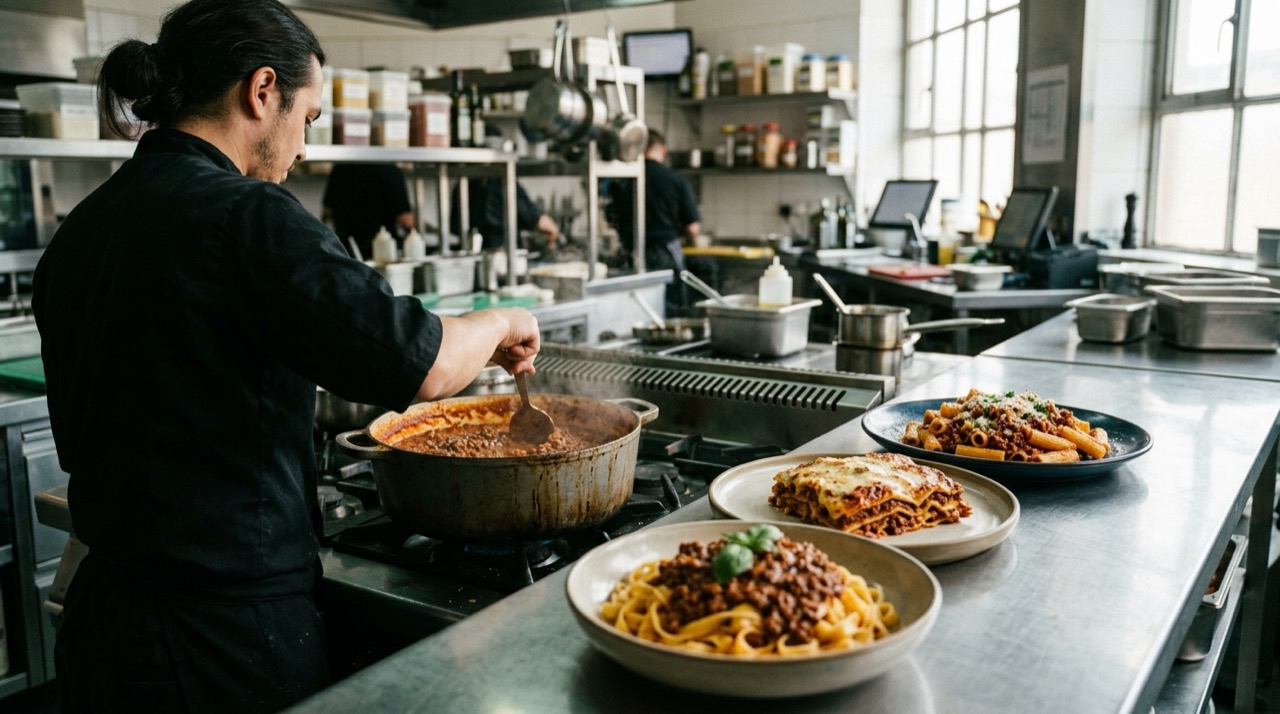
Imagine you make a large batch of bolognese sauce and prorate it across the dishes that use it. Before the meat price increase, your batch costing looks like this:
| Ingredient | Quantity | Purchase price | Cost |
|---|---|---|---|
| Minced beef | 2,000 g | €8.00/kg | €16.00 |
| Crushed tomatoes | 2,000 g | €1.10/kg | €2.20 |
| Onion | 500 g | €0.90/kg | €0.45 |
| Carrot | 300 g | €1.00/kg | €0.30 |
| Olive oil | 80 ml | €6.25/l | €0.50 |
| Red wine | 100 ml | €3.50/l | €0.35 |
| Garlic, salt, and spices (flat rate) | — | — | €0.20 |
| Total batch cost | €20.00 |
The yield after cooking and evaporation is 4.0 kg (4,000 g). So the cost of the bolognese is €20.00 / 4 kg = €5.00/kg, or €0.005/g.
Now comes the dreaded increase: your meat supplier tells you that minced beef is going from €8.00/kg to €10.00/kg. A 25% increase all at once. Only that line in the costing changes. The cost of the meat goes from €16.00 to €20.00, and the total batch cost rises from €20.00 to €24.00. The bolognese now costs €24.00 / 4 kg = €6.00/kg (€0.006/g).
That single change propagates in cascade to the three dishes that use the bolognese. Look at what happens:
| Dish | Bolognese sauce | Cost before | Cost after | Food cost before | Food cost after |
|---|---|---|---|---|---|
| Spaghetti bolognese | 150 g | €1.30 | €1.45 | 26.0% | 29.0% |
| Lasagna bolognese | 250 g | €2.40 | €2.65 | 30.0% | 33.1% |
| Cannelloni bolognese | 200 g | €2.05 | €2.25 | 27.3% | 30.0% |
The spaghetti goes from a 26.0% food cost to 29.0% based on a selling price (excl. VAT) of €5.00. Bad news, but still manageable. The cannelloni rises from 27.3% to exactly 30.0% (selling price excl. VAT €7.50), entering the danger zone. But the one that really sets off the alarm is the lasagna: with a selling price excl. VAT of €8.00, it shoots up to a 33.1% food cost. If you had a target maximum of 30%, this dish has just blown past it.
In a dynamic recipe costing, that alert fires automatically: the lasagna bolognese lights up in red, and you see it instantly. In a static Excel, to detect this problem you’d have to manually open all three spec sheets, recalculate the bolognese batch by hand, update the quantities in each dish, and recalculate the percentages. And you probably wouldn’t do it until the day you sit down for quarterly accounts and discover you’ve been losing money on the lasagna for three months.
Advantages of working with dynamic recipe costing
I’ve spent over twenty years in kitchens of all sizes, and I know that the main enemy of a hospitality professional isn’t the competition: it’s time. The time you don’t have to update Excel, the time you waste crunching numbers instead of being on the floor or in the kitchen, the time it takes you to realize a dish is no longer profitable.
The first big advantage of dynamic recipe costing is speed of reaction. You detect a cost increase the very moment you enter the new purchase price, not after it’s been eating away at your margin for weeks. If minced beef goes up on a Monday, that same Monday you’re seeing the impact on every dish and can make immediate decisions.
The second advantage is strategic: you negotiate with suppliers armed with real arguments. When you know exactly how much impact each price increase has on your bottom line, you can decide whether to absorb it, look for an alternative, or pass part of it on to the selling price. You stop being a passive recipient of prices and become an active manager of your margin.
The third is that you can reprice in time. Before food cost eats up your profit, you adjust the selling price with real data, not gut feelings. And finally, you stop living in an accounting fiction. The numbers you see are the real numbers — not an old photo telling you how you were, but a mirror showing you how you are.
If you’re still getting started with this costing stuff and need how to cost a recipe step by step, I recommend starting there. And if you’ve already got the theory down but are stuck in Excel, take a look at this Miselup vs Excel comparison before you keep reading.
In Miselup, recipe costing is dynamic by nature. It’s not a patch or an add-on feature: the system is built from the ground up so that every ingredient has a master record with its purchase price, and that price propagates automatically to every preparation where it appears. You create a sauce, a dough, or a syrup once, and when it’s time to update an ingredient’s price, you change it in one single place. The cost of every recipe, including nested sub-recipes, recalculates without you lifting another finger. One piece of data, automatic recalculation, food cost always up to date. No macros, no formulas that break, no hidden tabs that no one remembers to update.
If you’re thinking this sounds like what you’ve been trying to tame for years with a recipe costing Excel template, I completely understand. But a template, no matter how well-made, doesn’t update itself. And when you have dozens of dishes and intermediate preparations, keeping it up to date becomes a full-time administrative job.
ChefBusiness · Real profitabilityMaximize your restaurant without losing moneyCost control and food marketing. Book your ChefBusiness consulting now.Get the consulting →Frequently asked questions
What’s the difference between static and dynamic recipe costing?
A static costing is a snapshot: you calculate the cost with the prices at that moment, and that data doesn’t change until you manually touch it. A dynamic costing is connected to purchase prices and recalculates automatically when any of those prices change, propagating the change to every recipe and sub-recipe that uses that ingredient. One ages, the other stays current.
Do I need software to have dynamic recipe costing?
Strictly speaking, a very advanced Excel can simulate some dynamism with complex formulas and linked tables, but the reality is that maintaining it becomes unfeasible. Software designed specifically for recipe costing, like Miselup, automates the entire process and eliminates the risk of human error. You can see how it works at Miselup’s recipe costing.
Can you do dynamic recipe costing in Excel?
You can try with VLOOKUP, pivot tables, and external references to a price sheet. It will work for a while if you have few recipes and no intermediate preparations. The problem comes as soon as you introduce sauces, doughs, or stocks that are used in several dishes: maintaining the consistency of nested formulas and preventing them from breaking when you insert rows requires upkeep that very few hospitality professionals can manage. Technically possible; operationally, not practical.
How often is a dynamic recipe costing updated?
Every time you or your team updates a purchase price for the relevant ingredient. There’s no fixed frequency: the update is instantaneous the moment you record the new price. It could be once a month when you review delivery notes, or the very instant your supplier communicates the increase.
Is dynamic recipe costing useful for pastry and baking?
Absolutely. In pastry and baking, the nesting of preparations is even more intense than in cooking: a crème pâtissière goes into a thousand preparations, a base puff pastry dough unfolds into dozens of items, a ganache changes cost if the price of chocolate goes up. Dynamic recipe costing really shines where there are many sub-recipes, because a single price update propagates through the entire tree of preparations.
Is it worth paying for a recipe costing tool?
If you have one or two recipes and don’t depend on this for a living, maybe not. If you run a hospitality business with tight margins, every cent of cost counts. Tools like Miselup cost a fraction of what you lose in margin when you work with outdated costs. Take a look at Miselup’s pricing and do the test: compare the subscription price with the margin you lose on a single dish over a month without updating the cost. Usually, the decision makes itself.