✨ Early Bird 40% off your first 3 months with code · 40% off · 3 months · EARLYBIRD
Burger restaurants

Burger restaurant recipe costing: calculate the real food cost of your burger

Cost out the full menu, extras and delivery with real figures: the house burger costs €2.71 in edible product, leaves a 27.1% food cost and a gross margin of €7.22 before commissions.

Plans from €19/month No lock-in: cancel anytime Your recipe book in an afternoon

Spec sheet · dynamic

House Double Smash Burger

10 units
Food cost 27.1%
  • Ground beef 80/20 1,600 g €12.80
  • Artisan brioche bun 10 ea €4.50
  • Sliced cheddar 400 g €3.60
  • Smoked bacon 300 g €2.85
  • Sweet onion 600 g €0.72
  • Pickles 200 g €0.70
  • House sauce 300 g €1.35
  • Clarified butter 60 g €0.54
  • Greaseproof paper and basket 10 ea €0.70

Cost / unit: €2.78

€27.76
See it inside

The tools behind your kitchen

Explore the catalog, recipe costing, HACCP controls and traceability in Miselup.

  • Your kitchen at a glance

    A dashboard with your activity, costs and alerts in one screen.

  • Ingredient catalogue

    1,200+ ingredients with cost, units and allergens.

  • Ingredient sheet

    Price per unit, allergens, conversions and supplier.

  • Sub-recipes

    Nested sub-recipes that recost themselves when a price changes.

  • Final dishes

    Your menu dishes and drinks, ready to be costed.

  • Food-cost to the cent

    Cost, waste and margin of the dish in real time.

  • Export to professional PDF

    Technical sheet and food-cost ready to print or send.

  • Techniques

    Your library of techniques, with photos and steps.

  • Equipment & tableware

    Your kitchen's tools and equipment inventory.

  • Controls in the portal

    Configured controls, reading status and access to the form. Documentary records needing attachments are entered in management.

  • Measurement and corrective action

    Product core-temperature recording and corrective action for deviations; this recording type is available in Mise Pro HACCP.
The why

Recipe costing in burger restaurants

In a burger restaurant, profit is decided before you fire up the grill: in the cost sheet of every burger. The recipe costing for the House Double Smash Burger starts with 125 g of served meat, but with a 22% yield loss you need to buy 160 g of 80/20 ground beef at €8.00/kg. That calculation, applied to each ingredient, leaves a product cost of €2.71 and a food cost of 27.1% on a menu price of €11.00 incl. VAT. Yield loss is not an opinion: it's the difference between what you pay and what you serve.

The margin doesn't end with the product: the dine-in basket, the greaseproof paper, the fries in the menu, and the delivery commission decide whether a burger restaurant wins or loses. Dine-in, the gross margin is €7.22 per unit; on delivery, the 30% commission on the VAT-exclusive base leaves it at €3.79. This hub explains how to cost the patty, the bun, the sauces, the extras, the combo, and the delivery channel, with real figures.

Why Miselup

Miselup, built for burger restaurants

Calculate burger food cost and menu prices with Miselup. Work through a costing example and review the margin of each recipe.

Full combo and menu

Cost out the burger with fries, drink and sauce, not just the patty. The real cost of the menu determines the price and margin of each ticket.

Controlled extras and modifiers

Extra bacon or double cheese has its own cost. Cost them out and you'll know how much each modification adds to the burger's final gross margin.

Packaging as consumable

Add packaging as a consumable: the in-house basket costs €0.07 and delivery packaging €0.50. The burger goes from €2.71 to €2.78, with food cost measured only on the edible product.

Step by step

How to cost a burger step by step

1

Set the served weight and apply the yield loss

The cost sheet uses 125 g net of 80/20 ground beef; with a 22% yield loss that's 160 g of purchase at €8.00/kg, €1.28. The two 80 g raw smashes are those 160 g; the griddle leaves them at 125 g. If you cost the served weight as the purchase weight, the food cost comes out low and you lose money on every burger.

2

Cost the bun and the house sauces

The artisan brioche bun comes in at €0.45 per unit and the clarified butter at €9.00/kg. The house sauce is valued at €4.50/kg, the sweet onion at €1.20/kg, and the pickle at €3.50/kg. These are preparations with their own cost: don't mix them with the meat cost or treat them as free.

3

Price the extras and modifiers

An extra smash is 62.5 g net; with the 22% yield loss you buy 80 g and it costs €0.64. Extra bacon €0.29, extra cheddar €0.36, and gluten-free bun €0.60. Charging €1.50 ex VAT leaves the food cost at 42.7%; to sustain the 27.1% you need to ask €2.40 ex VAT, €2.64 on the menu. Giving away 10 a day is €6.40, €192 a month.

4

Cost the side and the full menu

Fresh potatoes lose 30-35% between peeling and trimming. In the menu, the burger at €2.71 plus fries with oil and salt at €0.60 and a drink at €0.40 add up to €3.71 of product; with the basket at €0.07, the total cost is €3.78. At €13.90 incl. VAT, the combo's food cost is 29.4% and the margin is €8.86. The customer pays €2.90 more for a side that costs €1.00.

5

Compare the dine-in margin with the delivery margin

Dine-in, the burger at €11.00 incl. VAT leaves €10.00 ex VAT: food cost 27.1% and margin €7.22. On delivery, the 30% commission on €10.00 leaves €7.00; with packaging at €0.50, the margin is €3.79, €3.43 less. At 50 daily orders, €171.50 a day. To match the €7.22 you would need a price incl. VAT of €16.39, 49% more.

Before costing the menu, get the waste right: the patty's cook loss is not the same as trimming waste, and mixing them up throws off every gram weight.

Free calculator

Calculate a dish's food cost

Enter the ingredient cost and the menu price: you'll see your food cost, the margin and whether you're in the target range (25-35%).

Food cost

—

Price before VAT

—

Gross margin per dish

—

Typical target range: 25-35% depending on the business.

Want the full version? Open the calculator

Worked example

Worked example: cost sheet for the House Double Smash Burger

The table is the cost sheet for a single burger: the quantity column is the net served weight, and the yield loss inflates it to the purchase weight, which is what you pay.

Ingredient Quantity Waste Cost
Ground beef 80/20 125 g 22% €1.28
Artisan brioche bun 1 ea 0% €0.45
Sliced cheddar 40 g 0% €0.36
Smoked bacon 22.5 g 25% €0.29
Sweet onion 42 g 30% €0.07
Pickles 20 g 0% €0.07
House sauce 30 g 0% €0.14
Clarified butter 6 g 0% €0.05
Greaseproof paper and serving basket 1 ea 0% €0.07

Total cost

€2.78

Food cost

27.1%

Suggested price

€11.00 (VAT incl.)

Margin

€7.22 per unit

The 27.1% food cost is calculated only on the edible product (€2.71). Including the basket at €0.07 would raise it to 27.8% and make recipes incomparable; the gross margin of €7.22 does deduct it, because it's a real cost.

27.1%

Food cost of the House Double Smash Burger on the product

Miselup reference cost sheet

28-35%

Burger food cost: target range for the sector (real example: 31.3%)

Frideli

30% ex VAT

Standard delivery commission in Spain (VAT deductible), plus €39-50/month fee

Loomis Pay

12-22%

Typical EBITDA margin of a burger restaurant in Spain on sales

ChefBusiness

In pictures

The craft, up close

Burger restaurants

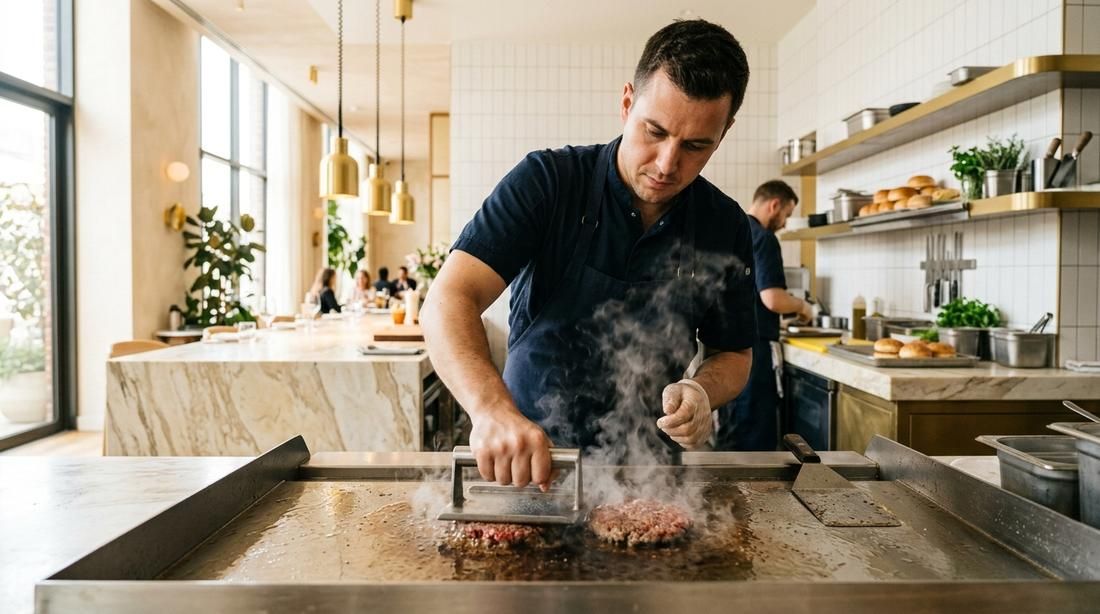
The griddle, where a fifth of the weight goes
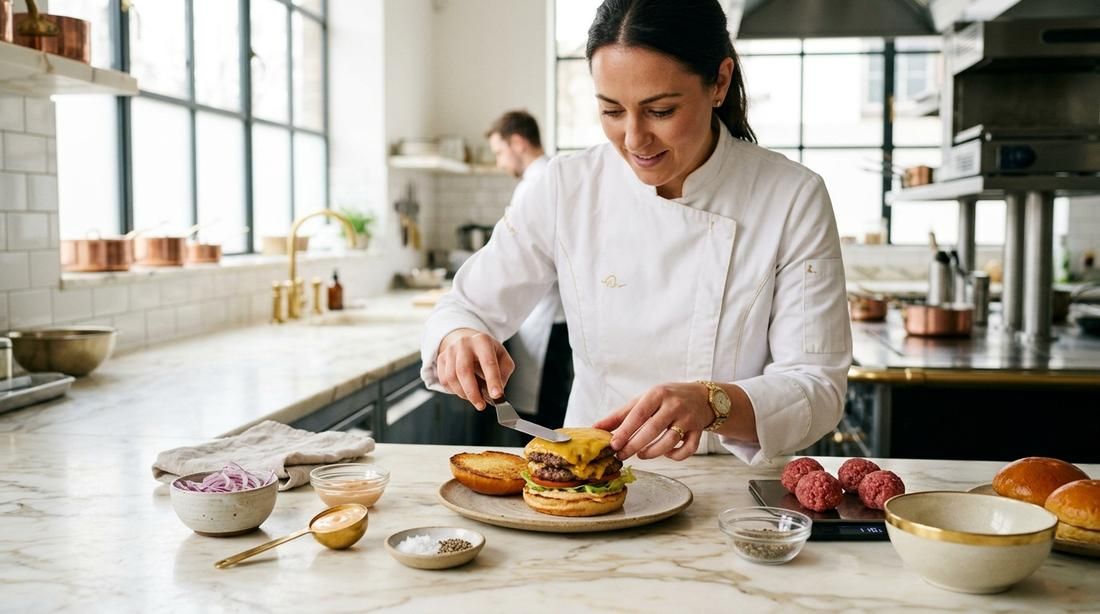
The build, gram by gram
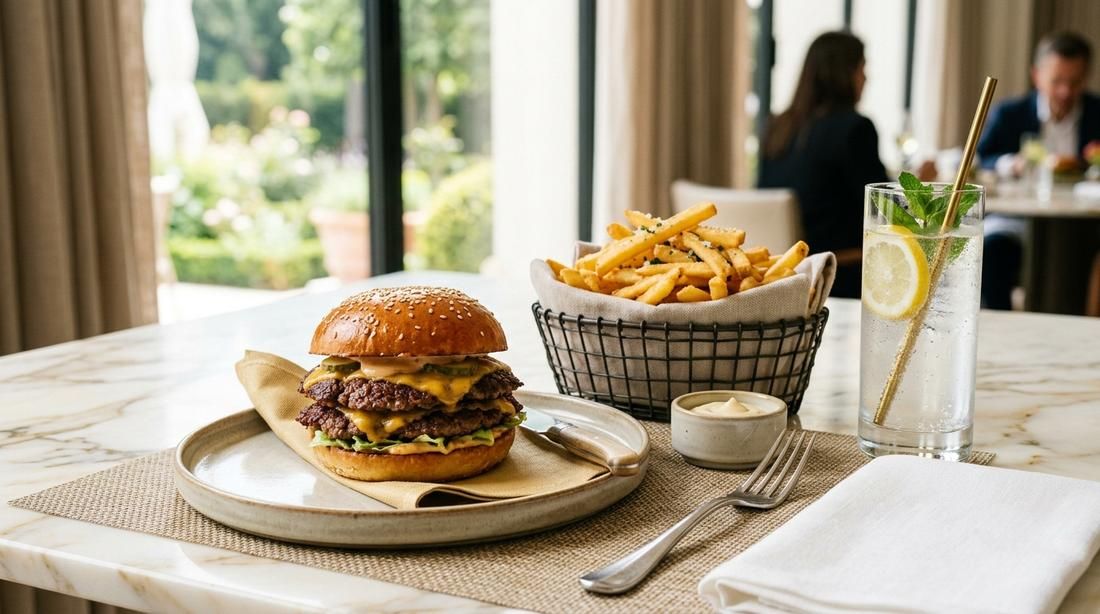
The whole combo, costed
Avoid these

Common mistakes when costing a burger recipe

Costing the served weight as the purchased weight

Costing the 125 g that end up on the plate instead of the 160 g you buy leaves the ground beef at €1.00 instead of €1.28. That is €0.28 less per burger: across 100 burgers, €28 disappears from the margin.

Giving away or underpricing add-ons

An extra smash patty costs €0.64; at €1.50 ex VAT it runs to a 42.7% food cost. Giving away 10 a day costs €6.40 a day, €192 a month. To hold the house 27.1%, you would need to charge €2.40 ex VAT.

Costing only the burger and not the meal

If you only look at the burger, the meal seems expensive: the customer pays €2.90 more for fries and a drink that cost €1.00. The full combo has a 29.4% food cost and leaves €8.86 of margin, more than the €7.22 of the burger alone.

Using the dine-in price for delivery

With the same menu price of €11.00, the 30% commission leaves net revenue of €7.00, and packaging rises to €0.50. The margin falls from €7.22 to €3.79, €3.43 less per order; at 50 orders a day, that is €171.50 a day.

The niche in depth

Types of recipe costing in a burger restaurant

Each product line in a burger restaurant needs its own cost sheet, because the edible-product cost, the consumable, and the target food cost all vary.

House smash burger · soon

This is the business's benchmark: ground beef €1.28, bun €0.45, cheese €0.36, bacon €0.29, onion €0.07, pickle €0.07, sauce €0.14, and butter €0.05 add up to €2.71 of edible product. With the consumable, €2.78; at €11.00 incl. VAT it leaves a 27.1% food cost and a €7.22 margin.

Premium or dry-aged beef burger · soon

With beef at €14.00/kg, artisan bread at €0.80, and aged cheese at €0.60, the edible product comes to about €4.14. At a menu price of €15.90 incl. VAT (€14.45 ex VAT), the food cost sits at 28.6%, within the sector's healthy range.

Meal or combo · soon

Burger €2.71, fries €0.60, and drink €0.40 add up to €3.71 of edible product, or €3.78 with the consumable. At a menu price of €13.90 incl. VAT, the food cost is 29.4% and the margin is €8.86, above the stand-alone sale.

Chicken or plant-based burger · soon

These are lower-cost lines: between €1.80 and €2.20 of edible product per unit, with a menu price of €10–12 incl. VAT. Chicken loses 15–20% on the griddle, less than beef, so its yield loss needs to be measured separately.

Delivery with sealed packaging · soon

The edible product is still €2.71, but the sealed packaging costs €0.50 instead of the €0.07 for a dine-in basket. With a 30% commission, net revenue is €7.00 and the channel food cost rises to 38.7%, leaving a €3.79 margin.

Professionals

What the pros who cook with numbers say

Chefs, pastry chefs, bartenders, baristas and chocolatiers who swapped spreadsheets and notebooks for Miselup.

Carlos Mendoza

Carlos Mendoza

Owner · La Mesa Restaurant

“Every recipe change used to be a mess. With Miselup, if I bump the sirloin by 20 g, I see the real cost instantly. It's amazing—I no longer lose margin without noticing. Now costing is quick and safe, no calculator needed.”

Diego Valdés

Diego Valdés

Head Bartender · Nébula Bar

“My team sees the production sheet without any cost breakdown. That way they measure every cocktail precisely—no more over- or under-pouring. The recipe stays clear, and the numbers stay for my eyes only.”

Mateo Herrera

Mateo Herrera

Owner · Café Origen

“Swap whole milk for oat milk and Miselup updates allergens on the menu automatically. Every new season with sandwiches and pastries used to be a nightmare. Now my digital menu is always up to date and my celiac customers are grateful.”

Carlos Mendoza

Carlos Mendoza

Owner · La Mesa Restaurant

“Every recipe change used to be a mess. With Miselup, if I bump the sirloin by 20 g, I see the real cost instantly. It's amazing—I no longer lose margin without noticing. Now costing is quick and safe, no calculator needed.”

Diego Valdés

Diego Valdés

Head Bartender · Nébula Bar

“My team sees the production sheet without any cost breakdown. That way they measure every cocktail precisely—no more over- or under-pouring. The recipe stays clear, and the numbers stay for my eyes only.”

Mateo Herrera

Mateo Herrera

Owner · Café Origen

“Swap whole milk for oat milk and Miselup updates allergens on the menu automatically. Every new season with sandwiches and pastries used to be a nightmare. Now my digital menu is always up to date and my celiac customers are grateful.”

Carlos Mendoza

Carlos Mendoza

Owner · La Mesa Restaurant

“Every recipe change used to be a mess. With Miselup, if I bump the sirloin by 20 g, I see the real cost instantly. It's amazing—I no longer lose margin without noticing. Now costing is quick and safe, no calculator needed.”

Diego Valdés

Diego Valdés

Head Bartender · Nébula Bar

“My team sees the production sheet without any cost breakdown. That way they measure every cocktail precisely—no more over- or under-pouring. The recipe stays clear, and the numbers stay for my eyes only.”

Mateo Herrera

Mateo Herrera

Owner · Café Origen

“Swap whole milk for oat milk and Miselup updates allergens on the menu automatically. Every new season with sandwiches and pastries used to be a nightmare. Now my digital menu is always up to date and my celiac customers are grateful.”

Lucía Ramírez

Lucía Ramírez

Pastry Chef · Dulce Masa Bakery

“I always jot down recipes in my test notebook. I snap a photo with Miselup, and the AI turns that page into a technical sheet with exact ingredients and weights. It's magic—saves me hours of copying data and eliminates errors completely.”

Ana Solís

Ana Solís

Catering Director · Sol y Sombra Events

“For each wedding menu, I instantly see if the proposal is green or red. The margin traffic light tells me if I'm over cost before sending the quote. I negotiate with data, not blind. And I sleep easy once every event is locked in.”

Isabel Vega

Isabel Vega

Artisan Chocolatier · Bombones Amargo

“For a big order of 300 boxes, I enter the base recipe for 10 chocolates and Miselup scales everything: grams, time, cost. No neurotic math. From small workshop to large order, the scaling is spot on and I don't waste a single gram of cocoa.”

Lucía Ramírez

Lucía Ramírez

Pastry Chef · Dulce Masa Bakery

“I always jot down recipes in my test notebook. I snap a photo with Miselup, and the AI turns that page into a technical sheet with exact ingredients and weights. It's magic—saves me hours of copying data and eliminates errors completely.”

Ana Solís

Ana Solís

Catering Director · Sol y Sombra Events

“For each wedding menu, I instantly see if the proposal is green or red. The margin traffic light tells me if I'm over cost before sending the quote. I negotiate with data, not blind. And I sleep easy once every event is locked in.”

Isabel Vega

Isabel Vega

Artisan Chocolatier · Bombones Amargo

“For a big order of 300 boxes, I enter the base recipe for 10 chocolates and Miselup scales everything: grams, time, cost. No neurotic math. From small workshop to large order, the scaling is spot on and I don't waste a single gram of cocoa.”

Lucía Ramírez

Lucía Ramírez

Pastry Chef · Dulce Masa Bakery

“I always jot down recipes in my test notebook. I snap a photo with Miselup, and the AI turns that page into a technical sheet with exact ingredients and weights. It's magic—saves me hours of copying data and eliminates errors completely.”

Ana Solís

Ana Solís

Catering Director · Sol y Sombra Events

“For each wedding menu, I instantly see if the proposal is green or red. The margin traffic light tells me if I'm over cost before sending the quote. I negotiate with data, not blind. And I sleep easy once every event is locked in.”

Isabel Vega

Isabel Vega

Artisan Chocolatier · Bombones Amargo

“For a big order of 300 boxes, I enter the base recipe for 10 chocolates and Miselup scales everything: grams, time, cost. No neurotic math. From small workshop to large order, the scaling is spot on and I don't waste a single gram of cocoa.”

From production costing to HACCP records

Support full cooking of minced-meat patties and separate raw-meat handling from buns, sauces, assembly and delivery handover.

FAQ

Frequently asked questions

Burger restaurants

How much does a burger cost to make, and what should you sell it for?
The House Double Smash Burger has an edible-product cost of €2.71, or €2.78 including the dine-in consumable. At a menu price of €11.00 incl. VAT (€10.00 ex VAT), the product food cost lands at 27.1% and the gross margin at €7.22 per burger. That margin is what keeps the business viable before fixed costs.
What is the ideal food cost for a burger restaurant?
The healthy range for the sector is between 28% and 35%; Frideli, for example, cites 31.3%. Miselup's benchmark burger comes in below that, at 27.1%, because the cost sheet is tight: ground beef €1.28, bun €0.45, cheese €0.36, bacon €0.29, onion €0.07, pickle €0.07, sauce €0.14, and butter €0.05 add up to €2.71. That cushion lets you absorb supplier price increases or yield loss without eating into the margin.
How much cook loss does a burger patty have?
Between 20% and 25%. In-house, two raw 80 g smash patties come down to 125 g served, a 22% yield loss. The classic mistake is costing the 125 g as if that were the purchased weight: it comes out to €1.00 instead of €1.28. That €0.28 per burger, across 100 burgers, is €28 — the cost of ten full burgers at €2.78.
How do you price a burger meal with fries and a drink?
The meal adds up to burger €2.71, fries €0.60, and drink €0.40: €3.71 of edible product, or €3.78 with the consumable. At a menu price of €13.90 incl. VAT (€12.64 ex VAT), the food cost is 29.4% and the margin is €8.86. Compared with the burger on its own, the customer pays €2.90 more for a side that costs €1.00.
How should you charge for burger add-ons?
An extra smash patty costs €0.64. If you charge €1.50 ex VAT, its food cost jumps to 42.7%, well above the house 27.1%. To hold that 27.1%, you would need to charge €2.40 ex VAT, which is €2.64 on the menu. And if you give away 10 extra smash patties a day, that is €6.40 a day: €192 a month.
How much does delivery change a burger's margin?
With a 30% commission on the VAT-exclusive base, the net revenue on the €10.00 ex VAT burger is €7.00. Sealed packaging costs €0.50 instead of €0.07, so the total cost is €3.21 and the channel food cost is 38.7%. The margin drops to €3.79 versus €7.22 dine-in. To recover it you would need a menu price of €16.39 incl. VAT, 49% more; that is why delivery pricing is set somewhere in between.
John Guerrero
About the author

John Guerrero

Gastronomy consultant · Founder of ChefBusiness and Miselup

15+ years advising restaurants, bakeries and hospitality businesses across Spain and Latam. Creator of ChefBusiness, AI Chef Pro and Miselup: the digital mise en place his clients use to control food cost to the cent.

Ready to stop losing money on every plate?

Set up your recipe book in an afternoon. From €19 a month, every figure published and no lock-in: cancel whenever you like.