Allergen Control Plan for Restaurants: Step by Step
Allergen control plan for restaurants: ingredient checks, cross-contact prevention, staff training, customer information and records. Worked example.

An allergen control plan for restaurants documents how the kitchen identifies allergens in each dish, checks ingredients and suppliers, prevents cross-contact and informs customers. It assigns responsibilities, covers staff training and keeps records for review when recipes or processes change. This guide explains how to organise those elements with a worked example.
Last week I walked into a kitchen that smelled of a proper stew. The team was running at full speed, the sauces were on point, and the pass was humming. In the cold prep area, a cook was finishing some canapés with a fermented cashew cream that was pure show-stopper. The problem wasn’t in what you could see: it was in the immersion blender he had just used, which—without going through the dishwasher—was then set down on the dessert table. In that three-second gesture, an allergen risk had just been created that no diner could have anticipated. That day I didn’t fine anyone, but we did stop the kitchen for half an hour to reconstruct the traceability of the tree nut. Because when it comes to allergens, the difference between a flawless service and a hospital emergency fits on the edge of a spoon.
I’ve been auditing professional kitchens for over fifteen years—restaurants, pastry workshops, industrial caterers, and central kitchens for institutions—and if there’s one thing I’ve learned, it’s that an allergen control plan for hospitality is not a paperwork exercise to keep the inspector happy. It’s the document that proves your kitchen knows exactly what it serves and can protect the person sitting at your table. And yes, it’s also the paper you’ll be asked for if something goes wrong.
What is an allergen control plan (and why will you be asked for it)?
An allergen control plan is the set of procedures, records, and preventive measures that a hospitality establishment implements to identify, manage, and communicate the presence of allergenic substances in the food it prepares and serves. Put more simply: it’s the system that lets you know which allergens are in each dish, prevent them from turning up where they shouldn’t, and ensure the customer receives truthful information before deciding what to eat.
The legal obligation is not new, although for years many kitchens dismissed it with a laminated poster by the entrance. Regulation (EU) 1169/2011 on the provision of food information to consumers established the obligation to declare allergens both in packaged and non-packaged foods. In Spain, the Spanish Royal Decree 126/2015 developed that obligation for foods presented without packaging—which includes practically everything that comes out of a professional kitchen—and made it clear that allergen information must be available, accessible, and above all, truthful.
In practice, this means that having a list of allergens hanging on the wall is not enough. The authorities expect you to be able to demonstrate that you’ve done your homework: that you have evaluated each dish, trained your team, controlled what comes in through the loading dock, and kept records that prove all of the above. When a health inspector asks for your allergen control plan, they are not looking for a generic document downloaded from the internet: they are checking that your kitchen has real control over what it serves.
The 14 mandatory declaration allergens
European legislation establishes a list of fourteen substances or products that must be declared mandatorily because they are responsible for the vast majority of food allergic reactions. Knowing them is the first step, but the real craft lies in knowing where they hide inside a professional kitchen. I’ve seen too many times how a cook assured that a dish “doesn’t contain anything weird” while emulsifying a sauce with butter without declaring the dairy.
| Allergen | Where it hides (real kitchen examples) |
|---|---|
| Gluten (wheat, rye, barley, oats, spelt, kamut) | Breading flour, soy sauce, industrial broths, thickeners like cornstarch if contaminated, sausages, surimi, pâtés, stock cubes. |
| Crustaceans | Prawns, langoustines, crab. Also in fish fumets and shellfish broths, sauces like American sauce, Thai curry pastes, prepared soups. |
| Eggs | Egg white for clarifying broths, egg in breadings and batters, fresh pasta, sauces like mayonnaise, hollandaise or béarnaise, pastries, ice cream, egg substitutes that contain egg. |
| Fish | Anchovies in sauces (Caesar sauce, Worcestershire), fish broth in rice dishes and soups, surimi, gelatins, marine omega-3. |
| Peanuts | Peanut oil for frying, satay sauces, curries, nut creams that may contain traces, desserts with praline, peanut butter in pastry. |
| Soy | Soy sauce, miso, tofu, soy lecithin in chocolates and industrial pastries, textured vegetable protein, oriental broths. |
| Dairy (milk and derivatives) | Butter in sauces and sautéed dishes, cream in creams and purées, grated cheese in gratins, whey in industrial breads, caseinates in sausages. |
| Tree nuts (almonds, hazelnuts, walnuts, cashews, pecans, Brazil nuts, pistachios, macadamia nuts) | Pralines in pastry, nut creams, nut oils for dressings, gluten-free flours containing almond, nougats, pestos. |
| Celery | Celery stalks in stir-fries and base broths, celery salt in cocktails, stock cubes, prepared vegetable mixes for mirepoix, cured sausages. |
| Mustard | Vinaigrette sauces, industrial mayonnaises, pickles, barbecue sauces, curry powder, prepared meat dishes. |
| Sesame | Sesame seeds on breads and hamburgers, tahini in hummus and oriental sauces, sesame oil in stir-fries, gomasio. |
| Sulphites (above 10 mg/kg or 10 mg/l, expressed as SO₂) | Wine and wine vinegar, dried fruits, shellfish treated to preserve colour, frozen pre-fried potatoes, bottled sauces. |
| Lupins | Lupin flour in gluten-free breads, savoury snacks, coffee substitutes, vegan products that mimic dairy. |
| Molluscs | Mussels, clams, squid, octopus, oysters. Also in shellfish broths, Asian fish sauces, brothy rice dishes. |
The 7 elements of the plan
An allergen control plan that can withstand a real audit is built on seven pillars. They are not theory: I’ve seen them work in kitchens of all sizes, and I’ve also seen them fail spectacularly when one is missing.
1. Risk assessment per dish
This is the starting point. It means sitting down with the specification sheet for each preparation and analysing, ingredient by ingredient, which allergens it contains directly and which may appear through cross-contamination in your kitchen. It’s not enough to think “this dish doesn’t contain nuts”: you have to check whether the flour you use may contain traces, whether the frying oil has touched breadings with egg, or whether the base broth contains celery. This assessment is documented in writing and updated every time a recipe or supplier changes.
2. Supplier and label control
Your allergen plan begins before the raw material comes through the door. You need up-to-date technical sheets from all your suppliers, stating the allergens present and any possible cross-contamination at source. Checking labels on every product when it arrives is not a quirk: it’s the only way to detect formulation changes that the supplier doesn’t always communicate. I’ve seen more than one scare with a flour that suddenly started containing traces of soy without warning.
3. Separate storage
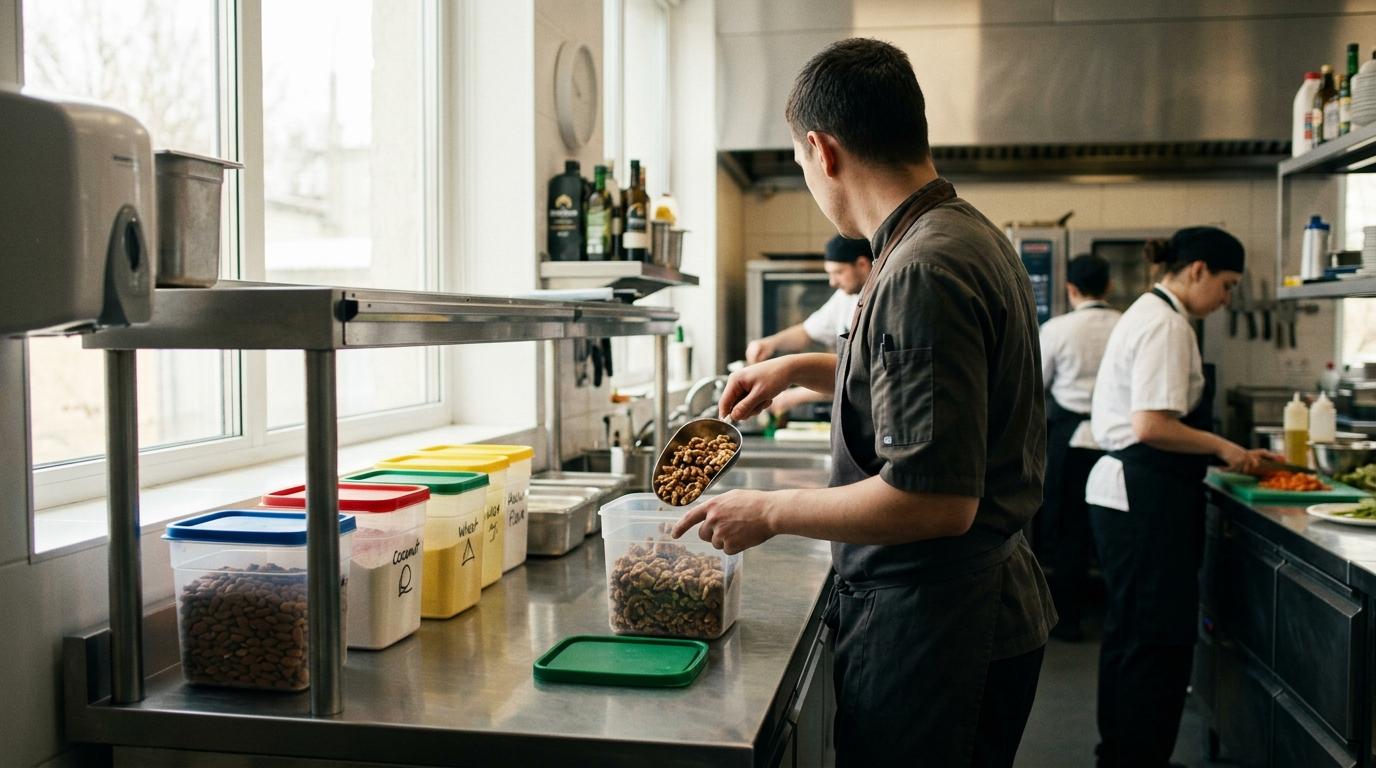
In the pantry and cold rooms, allergens must be identified and stored in a way that prevents any accidental contact. Products containing gluten, tree nuts, or powdered dairy are kept in airtight, labelled containers, preferably on shelves below allergen-free products to avoid spills. Alternative gluten-free flours deserve their own space and exclusive dosing utensils.
4. Prevention of cross-contamination in production
This is the point where most kitchens fail. Cross-contamination occurs when an allergen passes from one food or surface to another that should not contain it. The most common routes are hands and gloves not changed, shared utensils (blenders, cutting boards, knives), frying oils, grills and griddles, and kitchen cloths. Prevention involves establishing clear procedures: cleaning and disinfection between preparations, utensils used exclusively for major allergens, separate frying protocols, and above all, a production organisation that prepares allergen-free dishes first and leaves those containing allergens for last.
5. Menu and customer information
Allergen information must be available to the customer before they make their purchasing decision. This can be done through an allergen menu, an icon system on the regular menu, a QR code linking to detailed information, or a combination of several formats. The important thing is that the information is complete, up-to-date, and that the front-of-house staff know how to interpret it. A waiter who answers “I think it doesn’t contain” without checking the documentation is an unnecessary risk. Our complete allergen guide for menus walks through how to build that documentation step by step.
6. Staff training
Having the best documented plan is useless if the team doesn’t know how to apply it. Training must be practical and periodic: what allergens are, how to read a label, what cross-contamination is, how to handle a query from an allergic customer, and what to do if an adverse reaction is suspected. In kitchens with high staff turnover, this training must be given during onboarding and refreshed at least once a year.
7. Records and review
The plan materialises in records: the allergen assessment per dish, supplier technical sheets, staff training logs, cleaning records, and incident reports if any failure occurs. These documents must be organised and accessible. Moreover, the plan is not static: every change in menu, supplier, or process must trigger a review. An internal audit every six months is a recommended practice that allows you to detect deviations before the inspector does.

Worked example: the pumpkin cream that wasn’t safe
Let me give you a real case I encountered in a catering kitchen a couple of seasons ago. In the allergen assessment per dish, the pumpkin cream appeared free of the fourteen mandatory declaration allergens. The declared ingredients were pumpkin, onion, potato, olive oil, salt, and pepper. On paper, impeccable.
During the process audit, I observed that the immersion blender used to purée the cream was the same one the pastry team used to whip up a hazelnut and toasted almond praline. The cleaning procedure between uses consisted of a quick rinse with hot water and a cloth. When I swabbed for surface control, the result was positive for tree nut protein.
What went wrong here? The risk assessment per dish had been done looking only at the recipe ingredients, without considering the actual processes in the kitchen. The cross-contamination didn’t come from the raw material, but from the shared use of a poorly sanitised utensil.
The corrective measure was immediate: a blender was assigned for exclusive use on nut-free preparations, identified with a colour code, and the cleaning protocol was reinforced with complete disassembly of the head between uses. In the allergen assessment record, the pumpkin cream was changed to “may contain traces of tree nuts” until three consecutive surface analyses came back negative. From that point on, the declaration returned to “allergen-free”, but with an asterisk referring to the cross-contamination control record, available for any query.
This example illustrates why the allergen control plan cannot be a desk document: it has to be built with boots on the ground inside the kitchen.
When the allergen spreadsheet falls short
Most kitchens I work with start exactly where you probably are now: with an Excel template or a folder of sheets where they jot down ingredients and allergens. It’s a valid starting point and, if well managed, does its job for a while. The problem arises when the menu grows, suppliers change, or the team turns over: keeping that information updated manually becomes a titanic task, and the risk of error skyrockets.
The qualitative leap comes when allergens stop being a separate list and become part of the specification sheet for each recipe. If your recipe costing software links each ingredient with its corresponding allergens, any change in a recipe is automatically reflected in the dish’s allergen declaration and on the menu. No one has to chase someone to update an Excel file: the system inherits the information and keeps it consistent across all documents.
At Miselup, kitchen spec sheets are the heart of this system: each ingredient carries its associated allergens from the moment it is entered, and that information automatically flows to the allergen control module and integrates with the HACCP software using recorded data. What used to require whole afternoons of manual review is now kept updated in real time, freeing the team to focus on what really matters: cooking safely.
Follow the HACCP setup guide to configure your manual and controls. Connect this procedure with temperature records and, for off-site service, HACCP for catering. Miselup calculates allergens from recorded ingredients and nested preparations; it does not check supplier declarations or cross-contact.
See the actual routes in the bakery HACCP plan, covering fillings and decorations; the ice cream shop plan, covering cones and scoops; and the sushi plan, covering fish, sauces and assembly. For children’s special diets and site handover, use the school-kitchen plan. This guide develops allergen review and communication; those pages organise each business’s wider plan.
ChefBusiness · Real profitabilityMaximize your restaurant without losing moneyCost control and food marketing. Book your ChefBusiness consulting now.Get the consulting →Frequently asked questions
What are the 14 mandatory declaration allergens?
The fourteen allergens established by European regulations are: cereals containing gluten, crustaceans, eggs, fish, peanuts, soy, milk and dairy products, tree nuts, celery, mustard, sesame seeds, sulphites (above 10 mg/kg or 10 mg/l, expressed as SO₂), lupins, and molluscs. This list covers the substances responsible for the majority of food allergic reactions in Europe, and their declaration is mandatory both in packaged foods and in those served unpackaged in hospitality.
Is it mandatory to have a written allergen control plan?
Yes. The regulations require that allergen information be available and verifiable, and the only way to demonstrate that risks have been assessed and control measures implemented is through written documentation. A verbal plan or one based on the cook’s informal knowledge will not withstand an inspection, nor, more seriously, a claim following an allergic incident.
What are the consequences of not correctly informing about allergens?
Beyond the obvious moral responsibility and the risk to the customer’s health, non-compliance with food information regulations can lead to administrative sanctions. The amount depends on the applicable regional regulations and the classification of the infringement, which can range from minor to very serious depending on the risk generated and whether there was a repeat offence. In any case, the reputational cost of an allergic incident is usually much more painful than any financial penalty.
How can I avoid cross-contamination in a small kitchen?
Lack of space is not an excuse, but it does force you to be more meticulous. The keys are: establish a production order that starts with allergen-free dishes, have utensils exclusively for the most frequent allergens (identified by colours or marks), be extremely thorough with cleaning and disinfection between preparations, and store allergenic ingredients in airtight containers physically separated from the rest. In very small kitchens, sometimes the solution is to set aside a clean work area only for allergen-free preparations during a specific shift.
What is the allergen menu and can it be digital?
The allergen menu is the document that informs the customer about the presence of the fourteen allergens in each of the dishes on the food offering. It can be presented in physical format, such as a separate menu or integrated into the main menu using icons, or in digital format, for example via a QR code linking to an updated web page. The regulations allow digital format as long as the information is easily accessible to the customer at the time of consultation.
How often should the allergen control plan be reviewed?
The plan must be reviewed every time a change occurs that could affect allergen information: modification of a recipe, change of supplier, introduction of a new ingredient, or detection of an incident. At a minimum, it is recommended to conduct a full review every six months, or at least once a year, although the ideal frequency depends on the volume of activity and menu rotation. The review must be documented in writing.