HACCP plan for food trucks: prep base to service window
By Miselup team · Updated:
A HACCP plan for food trucks identifies hazards in the mobile unit and explains how to control them from the prep base to the service window. It covers loading, travel, on-board preparation, water, storage and return, with monitoring and a response to failures that can prevent safe service.
A food truck’s working conditions change before the first order is taken. Refrigeration may use a different power source on the road, the pitch may offer unfamiliar water connections, and the person handling payments may also assemble food. A mobile food safety plan needs to describe that operating day as well as the menu.
This example covers a truck loading from a prep base and cooking or finishing food at a pitch. Adapt the flow if everything is prepared on board. Mise Pro HACCP helps organise the manual and records; assess local permits, mobile-unit requirements and the safety of each operating arrangement yourself.
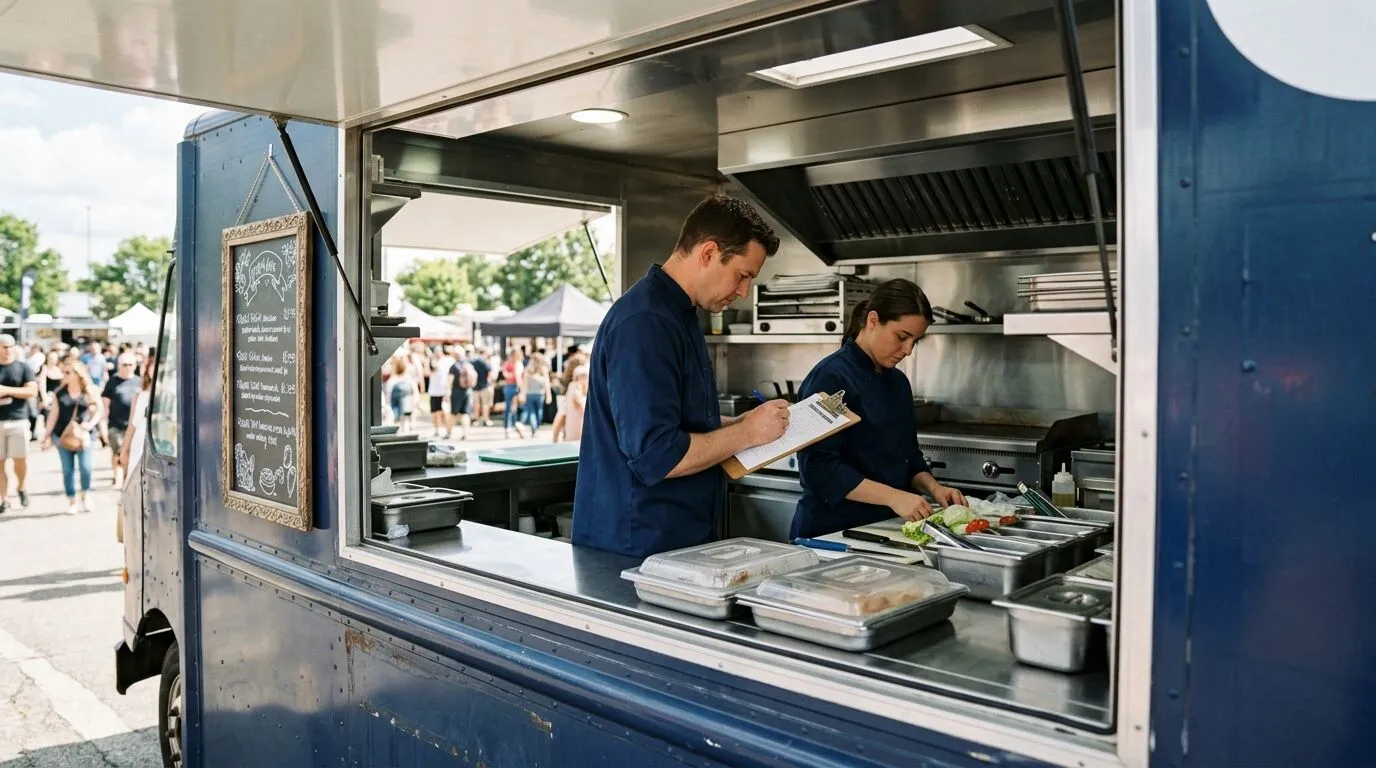
The journey and the pitch are part of food preparation
A food truck must maintain controls while its power supply, pitch and sales pace change. Follow the complete base-to-window route and establish which tasks must stop when water or refrigeration fails.
A prep base or commissary can make production easier, but introduces a handover. Identify which food leaves the base, how it is protected and temperature-controlled, and what the truck operator checks on arrival. A working refrigerator once parked does not establish what happened during the journey.
Check the pitch before committing to service: potable water, handwashing, wastewater arrangements, reliable power and protection from the surroundings. Set a practical stop-and-protect procedure for any failure that makes safe handling impossible. The ability to sell at a venue does not prove that the venue can support your operating procedure.
Match the menu to the mobile unit’s capacity. A single worktop, griddle and refrigerator may not support raw poultry preparation, cold assembly and allergy orders at the same time. Change the sequence, reduce the menu or prepare suitable components at the base if necessary. More records cannot compensate for an unworkable layout.
A food flow to confirm in your operation
- 1.Receive and prepare at the base, if used
- 2.Identify and load
- 3.Transport
- 4.Unload and assess the pitch
- 5.Prepare or cook on board
- 6.Assemble and serve
- 7.Decide leftovers, return and clean
Food safety hazards in food trucks
Loading and cramped assembly space can bring raw chicken, ready-to-eat salad and shared utensils together while travel changes storage conditions. Include water quality, tank-cleaning chemicals, loose fittings and allergen cross-contact at the window in the assessment.
Biological
Refrigeration stops during travel; raw chicken shares the assembly area with ready-to-eat salad; payment handling interrupts hygienic food preparation.
How to control it: Establish loading, unloading and holding controls. Separate raw and ready-to-eat tasks and organise payment roles or hand hygiene. Maintain potable water and stop affected handling if the necessary facilities fail.
Chemical
Fuel or cleaning chemicals are stored with food; cleaning residues remain in a water tank or hose; takeaway packaging is unsuitable for its intended use.
How to control it: Separate chemicals and fuel from food and utensils. Use suitable food-contact tanks, connections and packaging. Follow cleaning and rinsing instructions rather than assuming one chemical dose suits every mobile system.
Physical
Vibration loosens fittings; dust, insects or packaging fragments reach open assembly at the service window.
How to control it: Check fittings and utensils after travel, protect exposed food and remove outer packaging away from assembly. Inspect the pitch before opening and apply the breakage procedure when needed.
Allergens
Bread, sauces and coatings share tongs, griddle space or frying oil; an event-day ingredient substitution changes the declared composition.
How to control it: Verify specifications and the allergen matrix before departure. Assess cross-contact within the available space and communicate the preparation you can actually provide. Use your country’s allergen declaration rules rather than assuming one international list.
Prep-base and on-board processes: what applies and when
The chicken-cooked-to-order example uses on-board cooking, with no cooling or reheating because previously cooked meals are not loaded. Add egg preparation or anisakis control only when the menu requires it, and thawing when frozen ingredients are used. Determine CCPs through the truck and prep base’s hazard analysis rather than Miselup’s six available process workflows.
Cooking on board
The truck cooks meat, fillings or other foods needing a defined treatment.
Criterion: Operator criterion: justify the food’s temperature/time treatment against the process and local requirements.
Recording in Miselup: Record lot, portion, food-core temperature and holding time; the griddle setting is not the food measurement.
Cooling at the prep base, where used
Use this when cooked fillings are cooled at the base before loading; the raw-chicken cook-to-order example does not use it.
Criterion: Operator criterion: established endpoints and cooling window supported by evidence and local requirements.
Recording in Miselup: Record cooling start and finish with observations. The available equipment must actually suit the load.
Reheating prepared fillings
Use this for cooked chilled fillings reheated on board; cooking the example’s raw chicken is a different route.
Criterion: Operator criterion: declare treatment and process window. Preventing a second reheating is a Miselup product restriction, not a statement of your country’s law.
Recording in Miselup: Record removal from refrigeration, the finishing check and leftovers disposition.
Egg preparations on the menu
Use this for egg dishes or sauces prepared by the operator; a purchased finished sauce does not itself establish an egg-preparation process.
Criterion: Operator criterion: assess the recipe, intended consumers and local egg requirements. Check whether the available workflow supports your method.
Recording in Miselup: Record the selected treatment or egg-product route and applicable storage follow-up.
Anisakis only where relevant
Raw or lightly treated fish introduces this parasite hazard.
Criterion: Operator criterion: substantiate treatment or exemption under local requirements. Omit this process where the menu and hazard analysis do not call for it.
Recording in Miselup: Link the chosen freezing or thermal treatment to the identified portion.
Thawing before the rush
Use this for frozen ingredients thawed at the base or on board; omit it for the example’s chicken received chilled.
Criterion: Operator criterion: define the method, conditions and window using an appropriate basis. A queue is not a reason to improvise thawing.
Recording in Miselup: Record start, finish, route and contamination prevention with portion cold-cycle identity.
Example food truck HACCP plan: chicken sandwiches at a pitch
The truck loads chilled raw chicken, ready-to-eat salad and sauce from its base, then cooks to order at the pitch. This route does not use cooling or reheating; add those stages if you carry cooked fillings instead. Decide which controls are CCPs through the operation’s hazard analysis; not every row is a CCP.
On smaller screens, scroll the table horizontally to read every control.
| Stage | Hazard | Control measure | Limit / criterion | Monitoring | Record in Miselup |
|---|---|---|---|---|---|
| Receive at the base | Unacceptable ingredients or unidentified lots. | Check suppliers, condition, identification, specifications and relevant temperatures. | Operator acceptance criteria suited to each ingredient and local requirements. | Check at receiving and record the acceptance decision. | Receiving check linked to the matching purchase-order obligation where available. |
| Prepare and load | Raw chicken contaminates salad or sauce. | Separate closed, identified containers and clean handling areas. | Operator separation procedure and cleaning-product instructions. | Check closure, identification and sanitation before loading. | Cleaning/disinfection and container sanitising. |
| Travel to the pitch | Temperature control is interrupted on the road. | Use a suitable holding arrangement and assess departure and arrival conditions. | Operator food-specific transport conditions and window, consistent with local requirements. | Check food at loading and unloading and evaluate journey incidents. | Transport loading and unloading linked to the lot and preserved criterion. |
| Set up water and handwashing | Inadequate water or facilities prevent hygienic handling. | Check potable supply, connections, handwashing and wastewater arrangements; stop affected handling on failure. | Operator opening conditions under local mobile-unit rules. Water test parameters alone do not establish a complete safe supply. | Check before opening and after relevant incidents; take tests required by the procedure. | Water parameters at the defined sampling point and cleaning records; retain other opening evidence separately. |
| Store on board | Power failure or repeated door opening affects the food. | Separate foods, avoid overloading and prepare an alternative holding arrangement. | Operator food-storage and equipment criteria with justified shelf life. | Food and equipment checks at the defined frequency and after relevant disruptions. | Cooler temperature and product-storage checks as distinct records. |
| Cook chicken to order | Insufficient treatment at the food core. | Apply the established method for portion size and griddle load. | Operator temperature/time combination supported by evidence and local requirements. | Core and holding-time observations under the procedure, including busy periods. | Cooking check with identified lot and portion. |
| Assemble an allergy order | Shared bread, sauce or tools introduce an undeclared allergen. | Use verified ingredients and an assessed preparation route; answer accurately at the window. | Local declaration requirements and operator cross-contact controls. | Confirm the actual ingredients and preparation before accepting and handing over the order. | Allergen control and verified matrix. |
| Serve at the pitch | Environmental contamination or uncontrolled waiting food. | Protect assembly and organise replenishment for the demand. | Operator exposure and service procedure under local rules; no universal ambient holding time. | Perform the defined service checks and act on incidents. | Destination service record under declared activity. |
| Close and return | Leftovers lose their identity or are mixed with fresh stock; tanks and surfaces remain dirty. | Decide and identify each food’s disposition; clean the unit, utensils and containers. | Operator disposition procedure using the food’s history. Returning to base does not reset shelf life. | Review food decisions, unfinished processes and sanitation before the next pitch. | Applicable product-storage checks and cleaning/disinfection. |
Retention samples are not a universal requirement for every truck or festival. Check whether your country or service contract requires them. When appropriate, Miselup supports sample origin and destination records; moving a sample does not restart its retention deadline.
How to measure and record temperatures: the measurement method
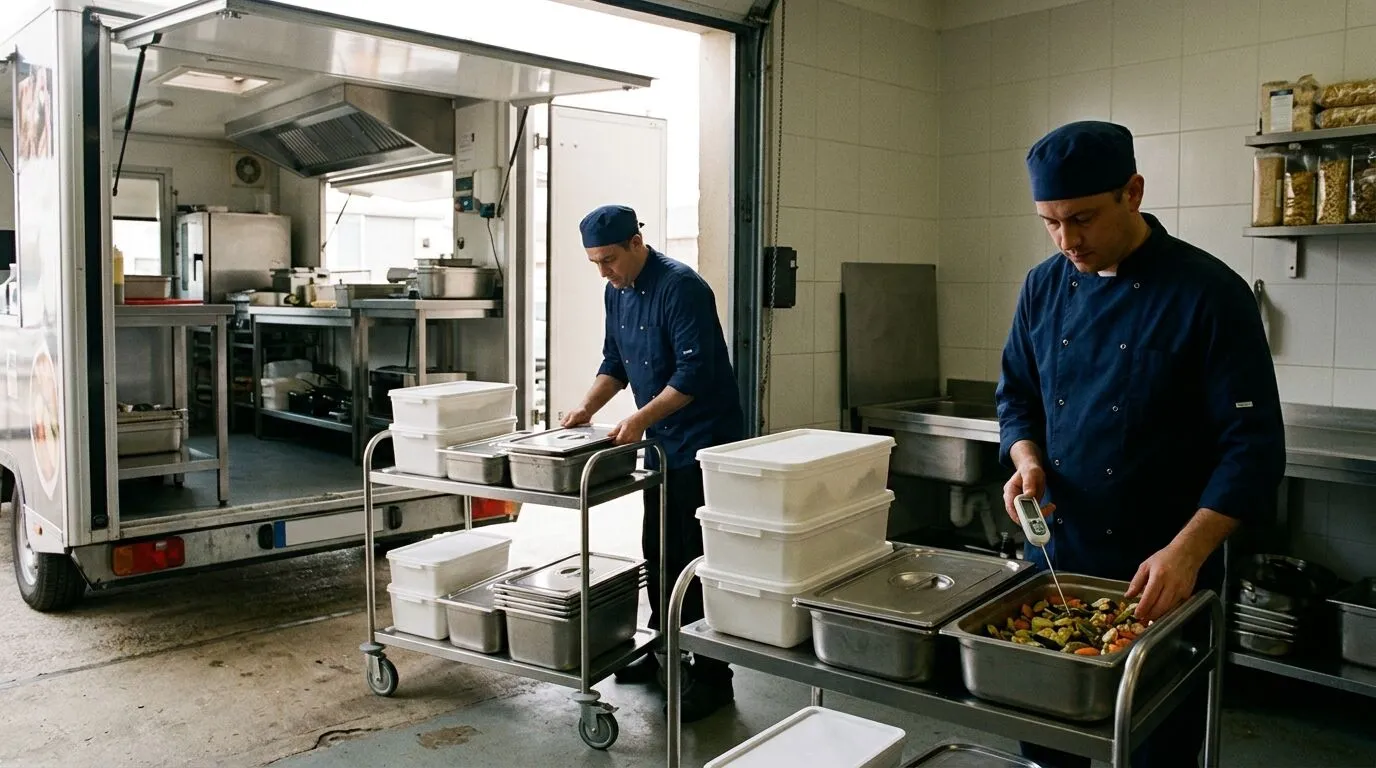
Record a journey from the prep base through return
Link the transport record to the lot and complete unloading before offering chicken and salad at the window. Then record the water, storage and service checks specified by your plan, and review each leftover lot’s disposition before returning it to stock.
Hand over from the prep base to the truck
Declare transport activity and record loading and unloading with the identified lot and required observations. The dashboard and portal keep both acts linked. A receipt or produced lot can generate a recording obligation when an applicable control exists, but dispatch still requires an activity declaration.
Check water, refrigeration and assembly before opening
Authorised team members can record assigned water, cleaning, cooler and food-storage checks through the portal. Use the food observation to assess chicken or salad and the equipment observation to check the cooler; document your response when its power arrangement changes.
Keep the lot identifiable through the queue
Record chicken cooking by lot and portion, and destination service under the declared activity. If the truck supplies a contracted catering service requiring retention samples, use the origin-to-destination sample record. Selling at a festival alone does not establish that requirement.
Close the journey and prepare the next pitch
Review unfinished transport, missing checks and lot dispositions in the period report. Prepare a way to retain observations if connectivity fails, because offline capture is not offered. Periodic emails help review incidents but do not act as instant refrigeration alarms.
The Miselup HACCP software hub explains the scope of Mise Pro and Mise Pro HACCP and how the manual, records, processes, verification, notifications, team portal and reports work.
Common gaps to address before an inspection
Gaps tend to occur at handovers: loading is recorded without arrival, refrigeration changes power source, or leftovers return without their history. Check that handwashing and the separation between payments and food assembly remain workable during the queue.
-
The food flow ends at the commissary door
Loading, the journey and return are missing. Confirm the process on the truck and at a real pitch, including the handover.
-
Travel refrigeration is assumed
A parked cooler reading cannot reconstruct the journey. Establish a viable supply, monitoring method and response to a power interruption.
-
Water is checked only after it runs out
The hygiene procedure fails when facilities fail. Define opening checks and when affected handling must stop.
-
Payments and food assembly have no hygiene boundary
Busy service encourages shortcuts. Allocate roles or a practical hand-hygiene sequence before orders begin.
-
An allergy order uses the ordinary shared station
Removing sauce does not undo earlier cross-contact. Assess the preparation you can provide and tell the guest before accepting the order.
-
Leftovers return without a history
A closed container does not establish temperature control or shelf life. Preserve identification and have the responsible person decide disposition.
Daily HACCP checklist for food trucks
Before leaving, check food, containers and the refrigeration arrangement for travel; on arrival, finish unloading and assess water and power before opening. During sales, follow the planned monitoring, then decide each lot’s disposition at closing without resetting its shelf life on return to base.
-
At the base: review food and specifications
Confirm ingredients, allergen information, lot identification and storage conditions for everything leaving.
-
Before loading: prepare holding and containers
Check sanitation, separation, equipment and its power arrangement during travel; record loading.
-
On arrival: finish the transport record
Assess food conditions and document unloading and incidents before making food available for service.
-
Before opening: check water and power
Confirm potable supply, handwashing, wastewater, refrigeration and the contingency arrangement.
-
Set up: protect and separate
Check fittings, surroundings, waste arrangements and the assembly station; separate raw and ready-to-eat work.
-
Prepare for the rush: allocate roles
Decide who handles payments, food assembly and allergy questions.
-
During sales: measure and respond
Perform the scheduled checks and processes. Protect food and stop affected operations when a failure prevents hazard control.
-
After service: decide leftovers
Do not mix leftovers into new stock or reset shelf life on return.
-
Before the next pitch
Complete sanitation and review open processes, missing checks and the documented handover.
Frequently asked questions: HACCP for food trucks
A short mobile menu may simplify the plan, but travel and outdoor service still introduce hazards. These answers help define the base and truck’s scope, prepare contingencies and choose records for each journey under your country’s requirements.
Does a sandwich-only food truck need a HACCP plan?
Does the prep base’s plan automatically cover the truck?
What transport records can the team complete?
What should the plan say about water or power failure?
Can I record checks offline at a festival?
Must every food truck keep retention samples?
Can unsold food always go back into stock?
Which Miselup plan supports mobile food service?
Related guides and businesses
This page covers a mobile unit selling at a service window and its connection with a prep base; the catering guide covers a contracted event with setup and destination service. The temperature guide explains measurements and log design, while this page organises the full departure-to-return route.
- Off-site catering guide
Explore transport and destination service; its legal figures concern Spain and require local review elsewhere.
- Temperature logging guide
Distinguish equipment and food readings; adapt illustrative figures to your jurisdiction.
- Allergen control in shared spaces
Review supplier information, cross-contact and the declaration rules for your country.
- HACCP for restaurants
Develop the prep base’s batch-production and kitchen handover procedures.
Prepare the food safety system for your next pitch
Define the food route and your response to water, power or refrigeration failure. Use Mise Pro HACCP to organise the manual and records, and prepare team access before departure.