HACCP plan for restaurants: example and daily checklist
By Miselup team · Updated:
A HACCP plan for restaurants identifies menu hazards and sets out how to control them from receiving to service. It defines monitoring, corrective action and verification for each food route, including dishes cooked to order and batches prepared for a later shift.
A restaurant can run several food safety workflows behind one menu. A steak goes from the grill to the guest, a soup is chilled for tomorrow, and a cold garnish receives no further heat treatment. A restaurant HACCP plan needs to follow each route rather than treat the kitchen as one cooking step.
Use this example to connect your hazard analysis with the checks your team actually performs. Mise Pro HACCP keeps the manual and typed record book together. You still assess the hazards, establish suitable criteria and check the rules that apply in your country.
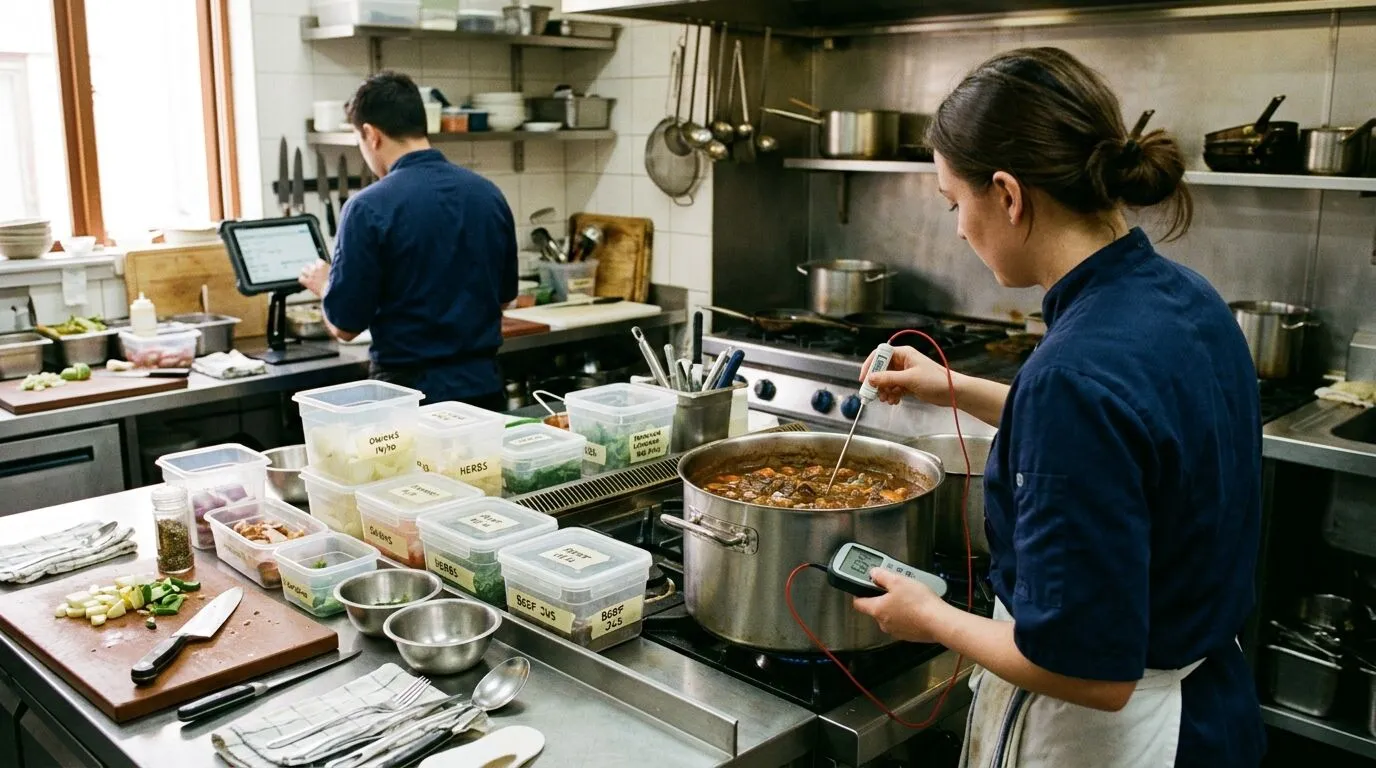
One menu can hide several different risk pathways
A restaurant plan needs to separate food cooked for immediate service from batches cooled for tomorrow. It must also connect supplier substitutions and finishing ingredients with the allergen information given to guests by front-of-house.
Separate food cooked to order from food prepared, cooled and reheated later. The same sauce may enter either route depending on how the station works. Map the actual batch size, equipment capacity and handover between prep and service before deciding which steps need critical control.
Ready-to-eat food needs protection after its last effective treatment. A salad handled beside raw poultry or a cooked garnish put back into an unclean container can introduce a hazard that another cooking record will never address. Hygiene practices and separation remain part of the system even where they are not CCPs.
Front-of-house needs the recipe that was served, including substitutions and finishing touches. A changed stock, a different bread roll or a dairy garnish can invalidate yesterday’s allergen answer. Build a clear route from supplier information to kitchen decisions and the person taking the order.
A food flow to confirm in your operation
- 1.Receiving
- 2.Storage and separation
- 3.Preparation
- 4.Cooking or cold assembly
- 5.Cooling and storage where used
- 6.Reheating where used
- 7.Holding, pass and service
Food safety hazards in restaurants
Raw poultry, ready-to-eat garnishes and cooked batches can share staff and space while needing different controls. Assess cleaning residues, damaged equipment and allergen cross-contact alongside microbial hazards before choosing measures for each menu route.
Biological
Raw poultry contaminates salad ingredients; a deep container of soup cools unevenly; a sauce sits at the pass outside its defined control conditions.
How to control it: Separate raw and ready-to-eat work, establish cleaning between tasks and validate each temperature/time procedure. Monitor food where the criterion concerns the food; a cooler display measures a different thing.
Chemical
Cleaning chemical residue remains in a container; a reused container is unsuitable for hot or acidic food.
How to control it: Use cleaning products according to their instructions and document the procedure. Store chemicals away from ingredients and confirm food-contact materials are suitable for the intended use.
Physical
Fish bones remain in a plated portion; damaged blender parts or broken glass enter food after preparation.
How to control it: Define portion inspection, equipment checks and a breakage procedure. Isolate exposed food and have the responsible person assess its disposal before restarting the station.
Allergens
A stock substitution adds an undeclared allergen; a shared fryer or finishing spoon creates cross-contact even though the recipe itself has not changed.
How to control it: Use the allergen declaration requirements of your country, review supplier specifications and check the actual recipe. Assess shared equipment and give front-of-house an accurate answer about what the kitchen can control.
Menu processes and decisions about CCPs
Cooking, cooling and reheating may form the batch-production route; egg preparation, anisakis control and thawing depend on the menu and ingredients. A cook-to-order kitchen does not normally need cooling and reheating for those dishes, and a menu without fish does not need the anisakis workflow. Determine CCPs through the establishment’s hazard analysis rather than the available Miselup forms.
Cooking to order and in batches
Steaks cooked to order and batches of soup use different loads and methods; assess each recipe’s heat treatment.
Criterion: Operator criterion: a justified temperature/time combination appropriate to the food and your country’s requirements.
Recording in Miselup: Record the soup batch or steak portion, its core temperature and holding time; the grill setting does not substitute for a food observation.
Cooling food for a later service
Soups or sauces are kept for a later shift; omit this stage for dishes served immediately after cooking.
Criterion: Operator criterion: justified cooling endpoints and process window. Establish evidence that the method works for your containers, loads and equipment.
Recording in Miselup: Identify the soup lot and record cooling start and finish; review the unfinished process at handover or record reasoned abandonment in the dashboard.
Reheating previously chilled food
Yesterday’s soup returns from chilled storage to hot service; cold garnishes and freshly cooked dishes do not use this route.
Criterion: Operator criterion: declare the target, holding time and window allowed by your procedure and local rules. Miselup prevents a second reheating as a product restriction.
Recording in Miselup: Link the soup’s removal from refrigeration with its finishing check and the disposition of food left after that service.
Egg dishes and sauces
The kitchen prepares egg dishes, desserts or sauces requiring a defined route; omit this workflow when no such preparation takes place.
Criterion: Operator criterion: assess intended consumers, immediate service or storage and your country’s egg requirements. Available routes do not support every equivalent heat-treatment combination.
Recording in Miselup: Record the selected route and applicable treatment or storage follow-up.
Fish requiring parasite control
Raw or lightly treated fish appears on the menu and introduces an anisakis hazard; a menu without fish does not use this workflow.
Criterion: Operator criterion: substantiate the treatment and any exemption against your country’s requirements. A supplier’s marketing term is not treatment evidence.
Recording in Miselup: Link the chosen freezing or thermal route to the portion and preserve cold-cycle identity.
Thawing before preparation
Frozen meat, fish or preparations are readied before the shift; a kitchen using no frozen ingredients normally omits this workflow.
Criterion: Operator criterion: justify the route, conditions and window. Follow local rules and product instructions; do not assume a universal thawing temperature or duration.
Recording in Miselup: Record start and finish, route, contamination prevention and cold-cycle continuity.
Example restaurant HACCP plan: soup prepared for tomorrow
This example follows a cooked soup into chilled storage, reheating and service, with a ready-to-eat garnish handled separately. It is a working structure, not an approved plan. Classify CCPs through your own hazard analysis; receiving and hygiene controls are not automatically CCPs.
On smaller screens, scroll the table horizontally to read every control.
| Stage | Hazard | Control measure | Limit / criterion | Monitoring | Record in Miselup |
|---|---|---|---|---|---|
| Receive ingredients | Unsafe ingredients or interrupted temperature control. | Check supplier, lot identification, condition and relevant food temperatures. | Operator acceptance criteria for the food, consistent with your country’s requirements. | Check at receiving as specified; isolate or reject food that fails acceptance. | Receiving check linked to the detected purchase-order obligation where available. |
| Prepare soup and cold garnish | Raw ingredients contaminate ready-to-eat garnish. | Separate work and clean utensils and surfaces between tasks. | Operator hygiene procedure and cleaning-product instructions. | Check the station before switching to ready-to-eat work. | Cleaning and disinfection, including contact time in minutes. |
| Cook the soup | Survival of pathogens through inadequate treatment. | Apply the established heat treatment and assess the core. | Operator temperature/time combination with supporting evidence. | Measure and record the defined temperature and holding time for the batch. | Cooking check with lot and portion. |
| Cool for storage | Microbial growth during slow cooling. | Use a cooling method established for the load and container depth. | Operator endpoints and cooling window, checked against local rules. | Record the start and finish; follow the corrective procedure on deviation. | Cooling process with linked start and finish. |
| Store the chilled batch | Growth during storage or use beyond the justified shelf life. | Identify the lot and storage conditions; keep equipment and food checks distinct. | Operator storage limit and shelf life with an appropriate basis. | Food and cooler checks at the declared frequency; review batch identification. | Lot-storage check and cooler temperature check. |
| Reheat for service | Insufficient treatment before hot service. | Use the established reheating procedure and decide the fate of leftovers. | Operator temperature/time target and window. No second reheating in the product workflow. | Record removal from refrigeration, core treatment and finish. | Reheating process and declared leftovers disposition. |
| Hold and serve | Growth while soup waits at the pass. | Maintain the defined conditions and replenish identifiable batches. | Operator holding criteria and exposure procedure under local requirements. | Check food as required; check holding equipment separately. | Product storage and hot-holding equipment controls. |
| Serve an allergy order | An undeclared ingredient or garnish cross-contact. | Confirm the actual recipe, preparation route and front-of-house message. | Accurate declarations under local rules and the operator’s assessed cross-contact controls. | Kitchen and front-of-house confirmation before serving. | Allergen control and verified matrix. |
Assign a responsible person, corrective action and verification method to each control. Miselup stores the observation; it does not decide whether unsafe food can be recovered. Declare thermal and service activity: a production order is not evidence of a completed heat treatment.
How to measure and record temperatures: the measurement method
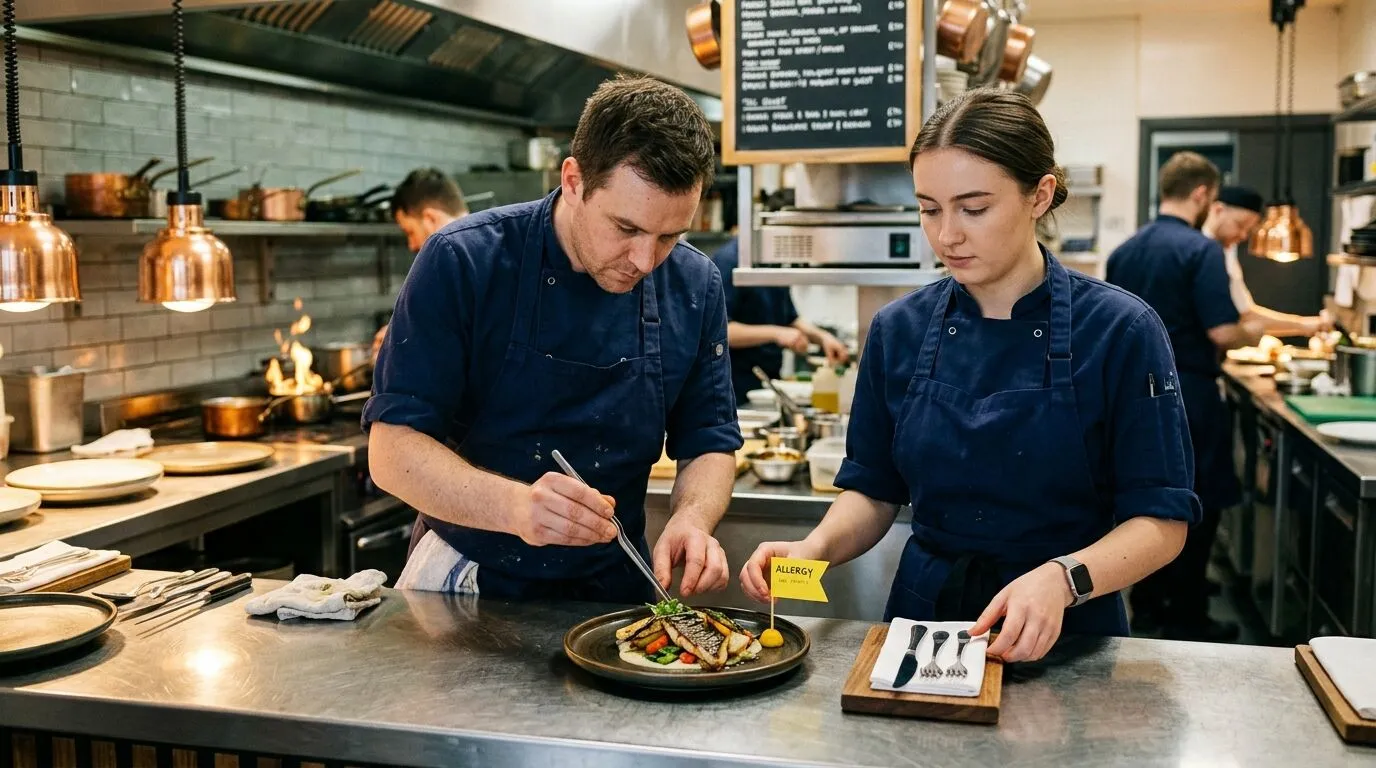
Record batch production and shift handovers with Miselup
Link tomorrow’s soup batch to its cooling, storage and reheating records, and leave unfinished processes visible for the next shift. For a dish cooked to order, record its treatment and check the actual garnish and allergen information with front-of-house.
Follow today’s soup into tomorrow’s service
Declare thermal activity for the lot, record cooling start and finish, then open and complete reheating when the batch leaves refrigeration. The next shift can review unfinished processes in the dashboard. Creating a production lot does not establish that any treatment has been completed.
Check received ingredients and stored batches
With an applicable plan control, a food purchase-order receipt or produced lot can generate a recording obligation. Measure and link the relevant check: an open obligation does not establish the condition of delivered poultry or a newly chilled soup batch.
Connect substitutions with the allergy order
Review ingredient and recipe composition and record the verified allergen matrix when stock, bread or a finishing sauce changes. Authorised staff can use the portal to record the check at the pass. Communication between the kitchen and front-of-house remains part of the restaurant’s procedure.
Review the batch history between services
Use probe verification and traceability-test records to review measurements and reconstruct a soup lot’s route. Review deviations and email history during handover, then check the period report for completed processes, corrective actions and missing observations.
The Miselup HACCP software hub explains the scope of Mise Pro and Mise Pro HACCP and how the manual, records, processes, verification, notifications, team portal and reports work.
Common gaps to address before an inspection
Gaps often occur between preparation shifts and service: the log records cooking but loses the batch’s later history. Check food measurements, unfinished processes and whether front-of-house is using the specification actually prepared in the kitchen.
-
A generic flow stops at cooking
It misses cooling, storage and reheating for tomorrow’s soup. Walk through every route used by the menu, including cold dishes and garnishes.
-
Cooler readings stand in for food checks
A newly stored deep container may still be warm. Keep air and food-core observations separate and choose each for its intended control.
-
Allergen answers follow the old specification
The team substituted stock or bread without reviewing the guest information. Make supplier changes part of the kitchen-to-service handover.
-
Started processes disappear at handover
A cooling start does not show successful cooling. Review unfinished processes and record completion or reasoned abandonment in the dashboard.
-
Perfect logs have no observed times
Do not recreate measurements from memory. Keep observation and recording times distinct and identify permitted deferred entries.
-
Corrective action only mentions the equipment
Turning down a thermostat does not establish whether the soup is safe. Record protection of the food, the responsible person’s decision and the follow-up check.
Daily HACCP checklist for restaurants
Before service, review prepared lots and unfinished work handed over by the previous shift, then confirm ingredient substitutions with front-of-house. During production, complete the scheduled checks and hand over unresolved incidents; use your plan’s frequencies rather than treating this sequence as a universal rule.
-
Opening: review the handover
Identify prepared lots, shelf lives, unfinished processes and unresolved deviations.
-
Prepare instruments and equipment
Have verified probes available and perform the scheduled equipment checks.
-
Receiving: assess and record
Check ingredients and link the observation to the matching open receiving obligation.
-
Preparation: separate the routes
Protect ready-to-eat food and check the cleaning sequence before switching tasks.
-
Pre-service: update the allergen conversation
Tell front-of-house about substitutions, garnishes and the assessed limits of cross-contact control.
-
Production: finish the processes
Take the required observations and complete cooling and reheating records with corrective actions where needed.
-
Service: monitor holding
Check food and equipment according to the plan and keep replenished batches identifiable.
-
Closing: decide food disposition
Handle leftovers under the relevant procedure, clean the station and hand over gaps and unfinished work.
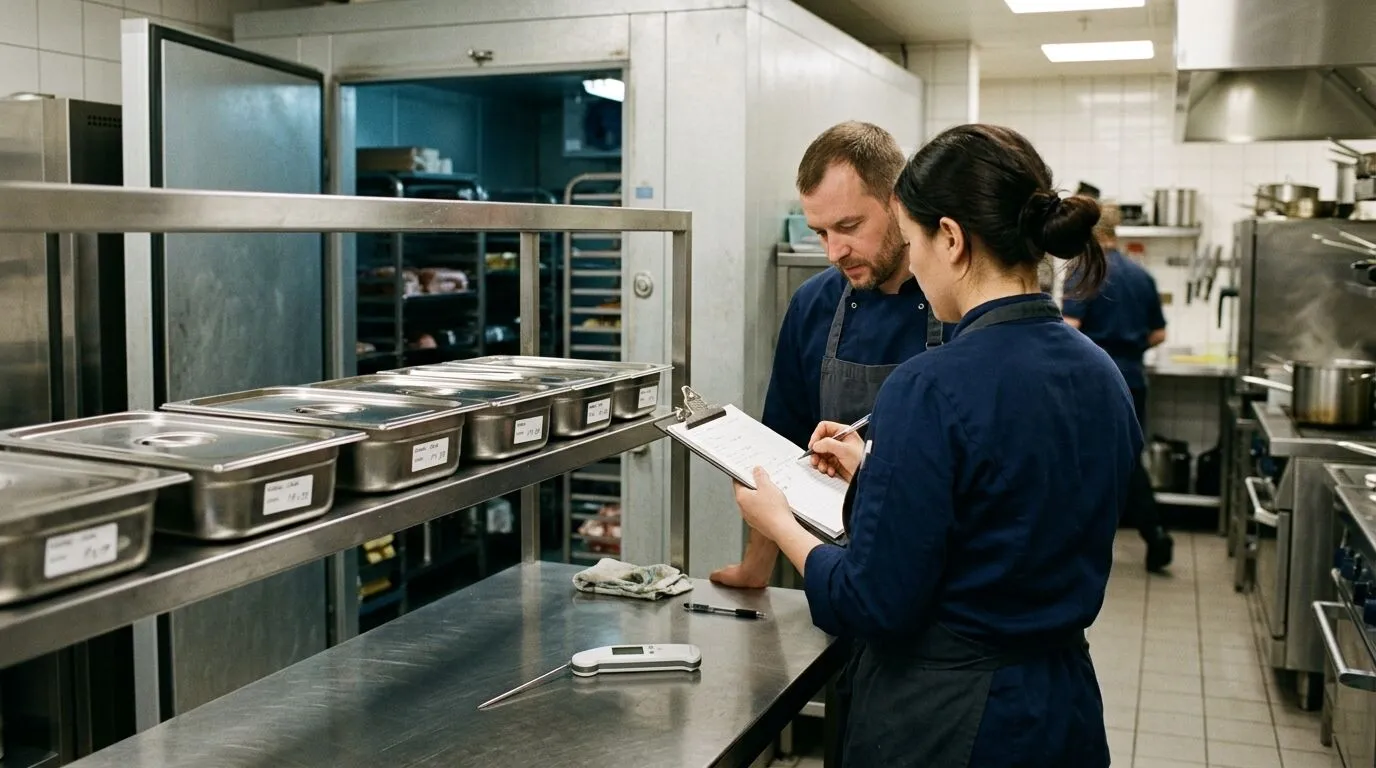
Frequently asked questions: HACCP for restaurants
The menu and food routes determine a restaurant’s controls more directly than its size. These answers help adapt the example to batch preparation, cooking to order and your country’s documentation requirements.
Does every restaurant need the same HACCP paperwork?
Can cook-to-order and batch preparation share a plan?
Where do I get restaurant CCP limits?
Is this example a ready-to-use restaurant HACCP template?
What changes when raw fish is added to the menu?
Does Miselup determine whether a meal is allergen-free?
Does a purchase receipt automatically complete the HACCP check?
What can I prepare for a restaurant inspection?
Related guides and businesses
This page follows the restaurant’s complete food routes and kitchen-to-service handover; the temperature guide focuses on measurements and log design. For food supplied and served at a contracted off-site event, use the catering guide to assess transport, setup and destination service.
- HACCP for contracted catering events
Assess the off-site route when the restaurant supplies and serves a contracted event.
- Temperature logging guide
Explore log design; its numerical examples are jurisdiction-specific, not universal limits.
- Allergen control in restaurant kitchens
Develop the procedure; check the declaration list required in your country.
- HACCP for food trucks
Review the extra steps when food and service move into a mobile unit.
Make your restaurant’s HACCP part of the shift
Prepare your menu workflows, criteria and responsible people. Use Mise Pro HACCP to organise the manual, processes and records around the way your kitchen works.