HACCP for Catering: Building the Plan When Your Critical Points Travel
Why catering differs, catering CCPs table (transport, regeneration), step-by-step plan, 200-guest banquet example, and FAQ.

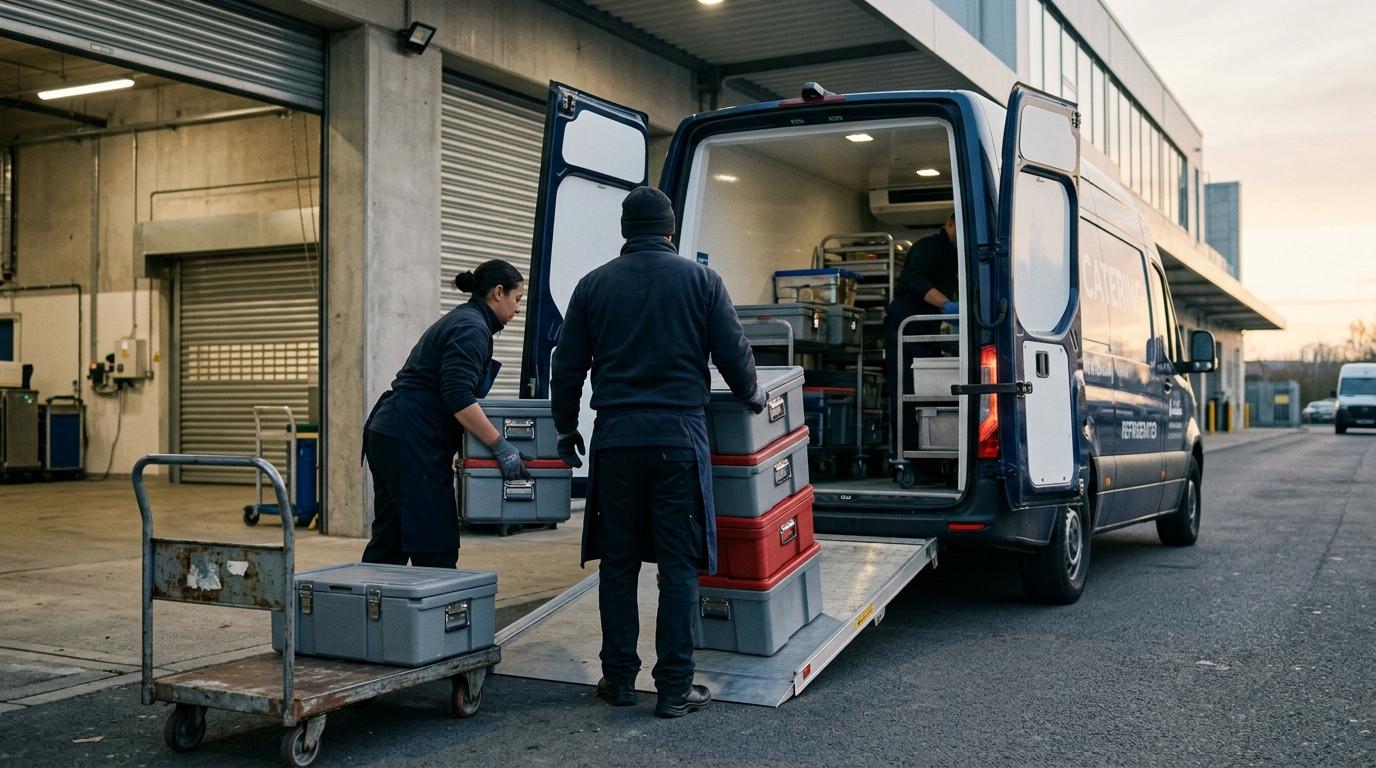
I remember an audit I did a few years ago for a catering service that was serving a wedding for 250 guests. The central kitchen was impeccable: up-to-date spec sheets, documented blast chillers, trained staff. Everything seemed under control until I asked to see the refrigerated van that had just arrived at the garden where the event was being held. The interior thermometer read 12 °C. The containers with fish and meats had been inside for over an hour. That day, the van—a link many see as mere logistics—became the weakest point in their entire food safety system. And that’s the reality of HACCP in catering: the critical points travel, and your self-control plan must travel with them, batch by batch and event by event.
Why HACCP for Catering Is Different
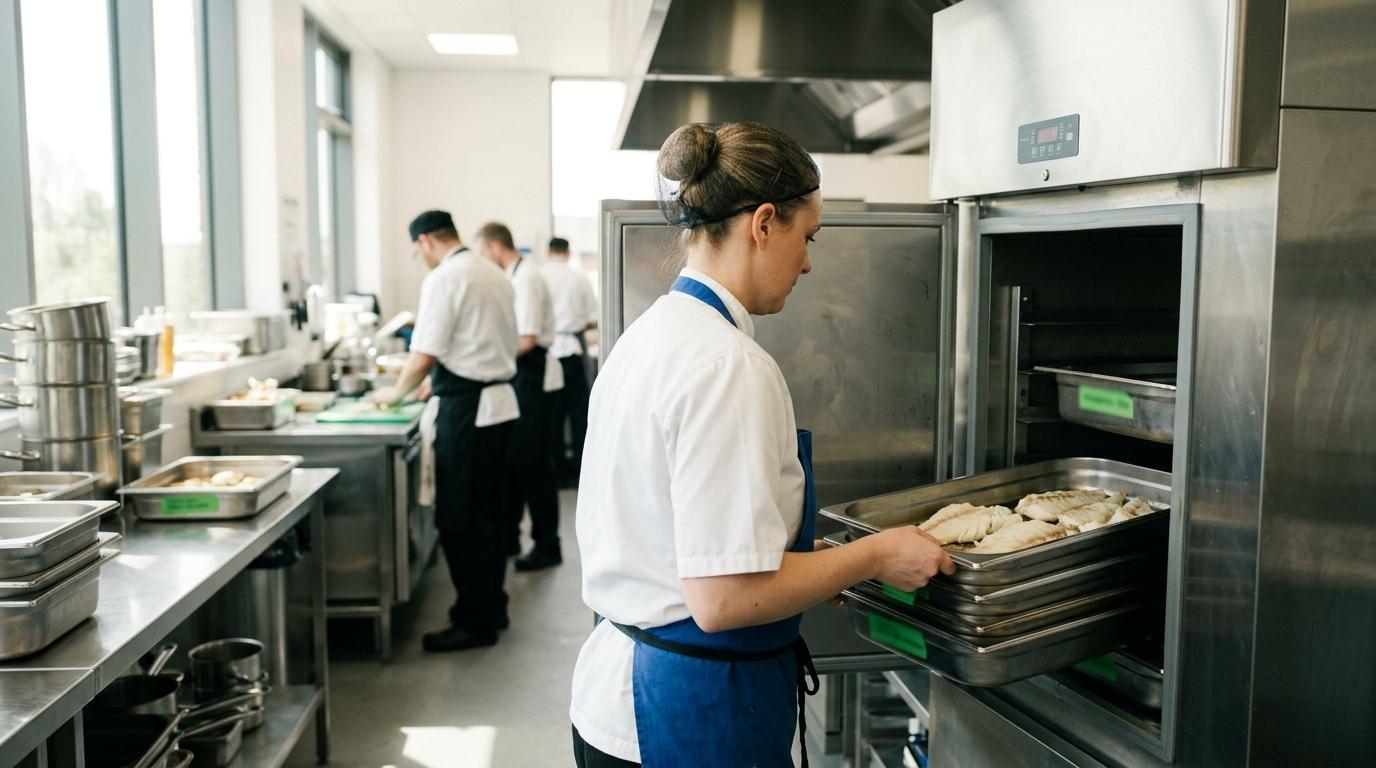
In a fixed kitchen, processes repeat in the same space. Storage, cooking, and service temperatures are controlled within an environment you master. But catering adds a variable that changes everything: food leaves your workshop, is cooled, transported, regenerated, and served in a place where you don’t have your kitchen. A catering HACCP plan cannot be limited to what happens within your four walls; it must follow the product all the way to the last diner.
Regulation (EC) 852/2004, which lays down general hygiene rules for foodstuffs, already makes it clear that the operator’s responsibility extends along the entire chain, from production to the final consumer. For prepared meals in Spain, Miselup’s catalog includes Royal Decree 1086/2020, article 30, as amended by Royal Decree 1021/2022. It’s not enough to have an adapted restaurant HACCP: you need a specific HACCP catering plan that addresses the risks of every move, every temperature change, and every setup in a banquet hall, garden, or office.
When I audit a catering company, the first thing I check is whether their self-control plan acknowledges this difference. Many operators copy their restaurant scheme and add a couple of transport logs. That’s a mistake. Food safety at events depends on performing the hazard analysis on the actual process: cold or hot production, blast chilling, intermediate storage, refrigerated or hot transport, regeneration at destination, hot-holding on the buffet line, and extended service. Each stage introduces hazards that don’t exist in a fixed kitchen.
Typical Critical Control Points in Catering
This table is an illustrative procedure reference, not a universal list of CCPs or a complete copy of the catalog. Classification depends on the establishment’s hazard analysis. Spanish legal figures apply only to ES plans; elsewhere Miselup uses Codex and operator criteria without certifying local legal compliance. Example check frequencies and stricter internal margins must be declared in the plan.
Over the years, I have identified a set of critical control points (CCPs) that recur in almost all catering services, regardless of the event type. I summarize them in this table with the critical limits I use as a prudent reference in my audits:
| CCP | Hazard | Critical Limit | Monitoring |
|---|---|---|---|
| Rapid cooling after cooking (blast chilling) | Survival and growth of bacteria (e.g., Clostridium perfringens) | Reduce from 60 °C (140 °F) to 10 °C (50 °F) in less than 2 hours (ideally in 90 minutes) | Temperature measurement at the center of the product at start and end of blast chilling; time recording |
| Cold storage in the workshop | Growth of psychrotrophic microorganisms and pathogens | Product temperature ≤ 4 °C (39 °F); chamber at ≤ 3 °C (37 °F) as safety margin | Continuous monitoring with probe or product thermometer; daily equipment verification |
| Transport (cold chain, insulated containers) | Cold chain break, cross-contamination from condensation or contact | Spain: refrigerated according to shelf life (≤4 °C if >24 h, ≤8 °C if <24 h); hot ≥63 °C. A 65 °C margin is an operator criterion | Temperature reading at workshop exit and at event arrival; calibration of vehicle thermometers |
| Regeneration at destination | Pathogen survival if insufficient temperature is reached | Spain: core ≥74 °C for ≥15 s, within ≤1 h of removal from refrigeration (RD 1086/2020, art. 30.7) | Measurement with probe thermometer on several pieces of the batch; regeneration time recording |
| Holding on the buffet line (cold and hot) | Bacterial growth due to prolonged exposure at risk temperatures | Cold: applicable product criterion; hot ≥63 °C in Spain, or a stricter operator margin | Check every hour with instant-read thermometer; frequent tray replacement |
| Service and exposure times | Environmental contamination and microbial growth due to time outside controlled temperature | Time and corrective action defined and justified in the plan; 2 h is not a universal legal limit | Record of start and end time of service; training of service staff |
These limits are not made up; they are prudent references aligned with the sector’s good hygiene practice guides and with what health inspectors expect to see when they visit an event. The key is that monitoring is real, not a paper filled out at the end of the day.
AI Chef Pro · AI for chefs55+ AI tools for your kitchen55+ AI tools to create recipes and menus and optimize your costs.Take a look →The Plan, Step by Step
Building a solid HACCP catering plan is no more complicated than a restaurant one, but it does require ordering the stages differently. Let me tell you how I structure it when I advise a catering company, step by step.
Team and scope. The first thing is to define the HACCP team: quality manager, head chef, operations manager, and, if applicable, the person in charge of event setup. The plan’s scope must cover all types of service you provide: banquets, coffee breaks, cocktails, themed buffets, transported meals for companies, etc. Each has a different flow diagram because the hazards are not the same if you serve a cold canapé assembled on-site or if you regenerate a hot dish for 300 people.
Flow diagram by service type. Draw the food’s journey for each mode. For example, in a banquet with a central kitchen, the typical flow is: raw material receiving → storage → cold/hot preparation → cooking → blast chilling → cold storage → refrigerated transport → regeneration at destination → hot-holding → service. In a coffee break with cold pastry products, the flow may skip cooking and regeneration, but adds contamination risks during assembly. This diagram is the backbone of the plan.
Hazard analysis by stage. For each stage of the diagram, identify biological, chemical, and physical hazards. In catering food transport, for example, the main biological hazard is bacterial growth due to cold chain break; the chemical one is migration of substances from unsuitable packaging; the physical one is foreign bodies from poor stowage. Don’t forget the specific hazards of the event venue: provisional kitchens, lack of running water, outdoor dust, etc.
Limits and monitoring. For each CCP, establish critical limits like those in the table above and define how you will monitor them: what instrument, who does it, how often, and where it is recorded. In catering, transport monitoring is especially delicate. I recommend placing data loggers in insulated containers that record temperature throughout the journey, not just at departure and arrival. That way you can prove there were no peaks.
Corrective actions. Define what to do if a critical limit is exceeded. If the fish arrives at the event at 8 °C (46 °F) instead of ≤ 4 °C (39 °F), is it discarded? Can it be recovered with immediate regeneration? The decision must be documented and based on a risk assessment. In my audits, I insist that corrective actions be recorded on the same event report, signed by the person in charge.
Verification and records. The plan must include periodic verification activities: thermometer calibration, internal audits, microbiological analysis of surfaces and finished products. And, of course, the daily records that demonstrate the system is working: temperature logs from blast chillers, cold rooms, vehicles, regeneration, and buffet; cleaning and disinfection records; batch and event traceability sheets.
Worked Example: A Banquet for 200 Guests
To make it clear, here’s a real case I often use in training sessions. Imagine a catering company serving a gala dinner for 200 people. The main course is oven-baked hake fillet with a side. The hake is cooked in the workshop the day before the event.
The process begins with cooking, reaching 72 °C (162 °F) at the center. Immediately after, the hake is placed in the blast chiller. In less than 90 minutes, the temperature drops from 60 °C (140 °F) to 8 °C (46 °F). Each tray is labeled with the batch, production date, and expiry date (consume within 48 hours). The trays go into a cold storage room at 2 °C (36 °F), where they are stored until the next day.
On the morning of the event, they are loaded into insulated containers with cold packs. Before closing the vehicle, the product temperature is recorded: 3 °C (37 °F). The vehicle thermometer reads 4 °C (39 °F). Upon arrival at the hall, two hours later, the temperature is measured again: 4 °C (39 °F) in the product. Everything within limits.
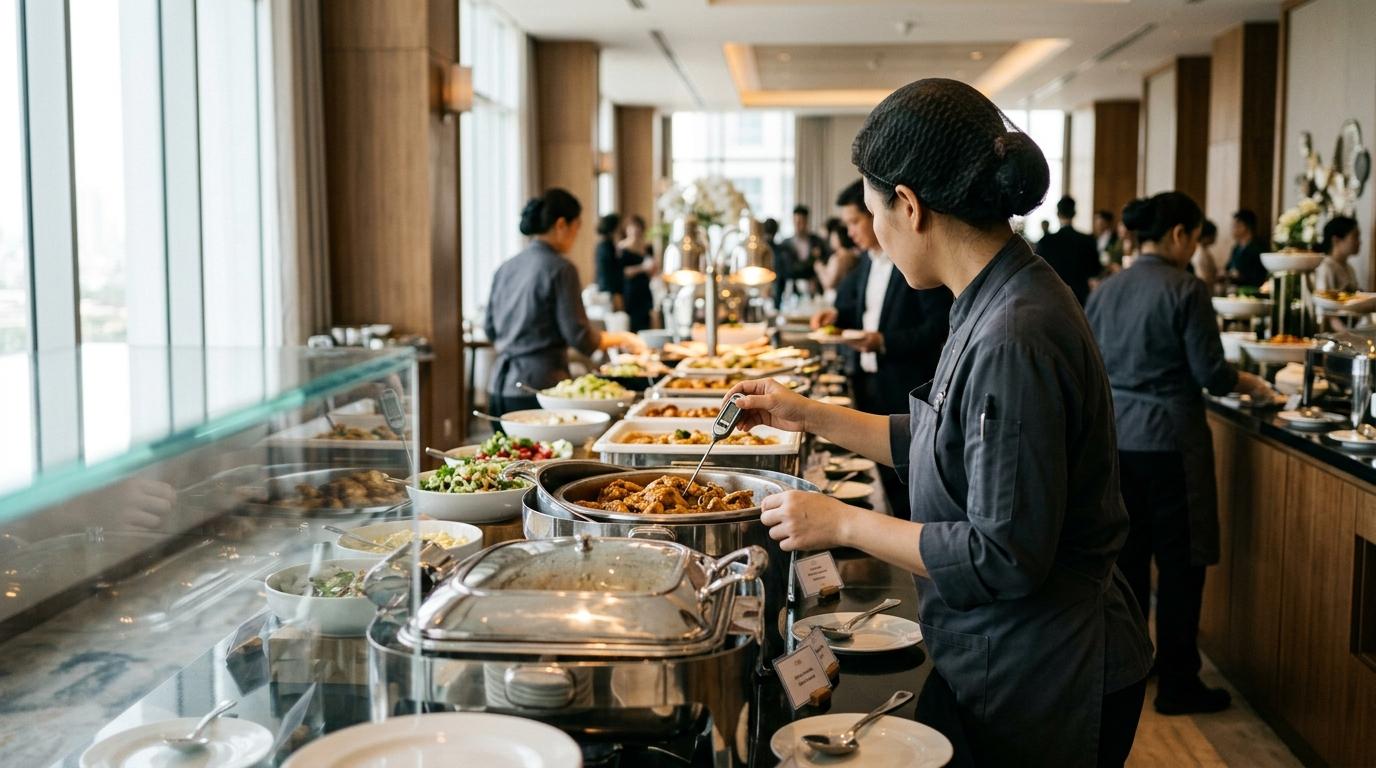
In this fictional example, the plan uses a stricter 75 °C margin. The ES reheating criterion is core ≥74 °C for ≥15 s, within ≤1 h of removal from refrigeration; record the times as well as the temperature. At the event, trays go into reheating ovens. Three random pieces are checked with a probe thermometer: 76 °C (169 °F), 75 °C (167 °F), 77 °C (171 °F). The dish is kept on hot tables at 68 °C (154 °F) until service. During the buffet, an assistant measures the temperature every hour and records the values. Service lasts 1 hour and 45 minutes, within this example’s declared two-hour maximum, not a universal rule.
Every link has a record: blast chilling, cold storage, transport departure and arrival, regeneration, and hot-holding on the buffet. All those papers are stapled to the event report, along with the traceability sheet linking the hake batch to the supplier, receipt date, and number of guests served. If an inspector asks for that data tomorrow, you have it in a single dossier.
One Dossier per Event, No Binders
I’ve seen hundreds of catering companies that run this system in ring binders, event by event. And it works, I won’t say otherwise. When you do two or three services a week, the paperwork is manageable. The problem comes when you grow: ten events in a weekend, teams spread out, several vehicles, temporary staff who don’t know the plan. That’s when paper records start to fail: sheets get lost, a temperature is forgotten, batches get mixed up.
The qualitative leap is to anchor records digitally to the batch and the event. So you know who measured, when, and where, without relying on anyone’s memory. And, above all, so that in the event of an inspection or a health alert, you can retrieve the history of any batch in seconds, not hours digging through filing cabinets.
At Miselup, we have developed a HACCP software designed precisely for this reality: spec sheets linked to recipe costing, temperature records signed from a mobile device, batch traceability that travels with the event. If you want the full detail of the cold-chain log, the HACCP temperature log guide covers the sheet and its typical mistakes. And since cost control is as critical as safety in catering, in the guide to recipe costing for catering and events I walk through how to calculate margins per service without losing sight of waste or spec sheets. In the end, HACCP and recipe costing are two sides of the same coin: you control what you serve and how much it costs, with the same database.
To prepare your plan in the app, follow the HACCP setup guide. Develop the kitchen procedures with the allergen control guide. Mise Pro HACCP supports complete transport workflows from loading to unloading and retention samples from origin to destination, in both the dashboard and team portal. The final act stays linked to the start, lot and linked obligation; the sample’s destination does not restart its retention deadline. An older open process can use the normal finish workflow when the necessary data is present, with its food family declared at finish if missing. See the criteria and scope on the HACCP product page.
The team also sees open receiving and lot-storage obligations for authorised controls and selects them when recording. Only the final act covers the obligation; starting a two-act process leaves it in progress. Automatic detection remains limited to food purchase-order receipts and storage per produced food lot: dispatches, services and thermal operations require activity declarations. Cleaning and disinfection contact times are recorded in minutes; older records without a unit print with a warning, without assuming they mean minutes.
This article covers catering as a contracted event, including preparation, transport, setup and service for the client. For sales from a mobile unit, the HACCP plan for food trucks focuses on the prep base, vehicle and service window; for an event supplied by a working restaurant kitchen, also review the HACCP plan for restaurants.
For regular meals supplied to children or another institution, use the HACCP plan for school kitchens, focusing on special diets, vulnerable consumers, applicable samples and site handover. For a bakery supplying the event, the bakery and pastry HACCP plan follows fillings, assembly and display; this guide keeps its focus on contracted-event logistics.
Timlup · Team on trackDaily checklists & tasks for your restoKeep your team on point with recurring tasks. Meet Timlup and simplify operations.Meet Timlup →Frequently Asked Questions
Does a catering company need its own HACCP plan even if the production kitchen already has one?
Yes, absolutely. The production kitchen may have its own self-control plan, but catering adds critical stages—transport, regeneration, service at external locations—that are not covered by the kitchen’s plan. The catering HACCP plan must cover the entire journey of the food to the final consumer, and be specific to each type of event.
At what temperature should prepared food be transported?
In Spain, the catalog applies the storage criteria in RD 1086/2020, article 30: hot ≥63 °C; chilled ≤4 °C with shelf life over 24 h, or ≤8 °C if under 24 h. At exactly 24 h, the product applies ≤4 °C. The plan may set a stricter margin. Outside Spain, review local law and declare the criterion under Codex.
How long can food be exposed on a buffet?
It depends on the food, temperature control and the establishment’s justified procedure. A two-hour room-temperature maximum does not suit every food or country. Declare times, temperatures and corrective actions in the plan and monitor service accordingly.
What is blast chilling and why is it important?
Blast chilling is the rapid cooling of cooked food to reduce its temperature from 60 °C (140 °F) to 10 °C (50 °F) in less than 2 hours. It is a key CCP because it prevents bacteria that survive cooking from multiplying in the danger zone (between 5 °C and 65 °C / 41 °F and 149 °F). In catering, where food is cooked a day ahead, improper blast chilling can compromise the safety of an entire batch.
What records will an inspection request from a catering company?
A health inspector will ask for, at a minimum: temperature logs for blast chilling, cold rooms, transport, regeneration, and buffet hot-holding; cleaning and disinfection records for vehicles and equipment; batch traceability (raw material intake and event output); and documented corrective actions. Everything must be dated, signed, and linked to the specific event.
How is batch traceability managed at events?
Each batch of prepared product is labeled with a unique code that links it to the raw materials received, the production date, and the event it is destined for. During service, it is recorded which batches were served to which guests (at least by table or group). A digital system simplifies this management, allowing barcode scanning and retrieval of the traceability tree backward and forward in seconds.