HACCP plan template and a complete restaurant example
A HACCP plan is a document that identifies food safety hazards in a business and explains how they are controlled. It includes the team, product, intended use, confirmed process flow, hazard analysis, critical control points, limits, monitoring, corrective actions, validation, verification and records. This template follows the twelve steps and seven principles of Codex.
Free, no account needed. Printing includes only the blank template.
This English example uses Codex Alimentarius CXC 1-1969, revision 2020, the basis declared by Miselup. All example limits and frequencies are illustrative operator criteria: confirm your local requirements and validate controls for your kitchen. Codex provides the method; it does not supply universal cooking or cooling temperatures for every dish.
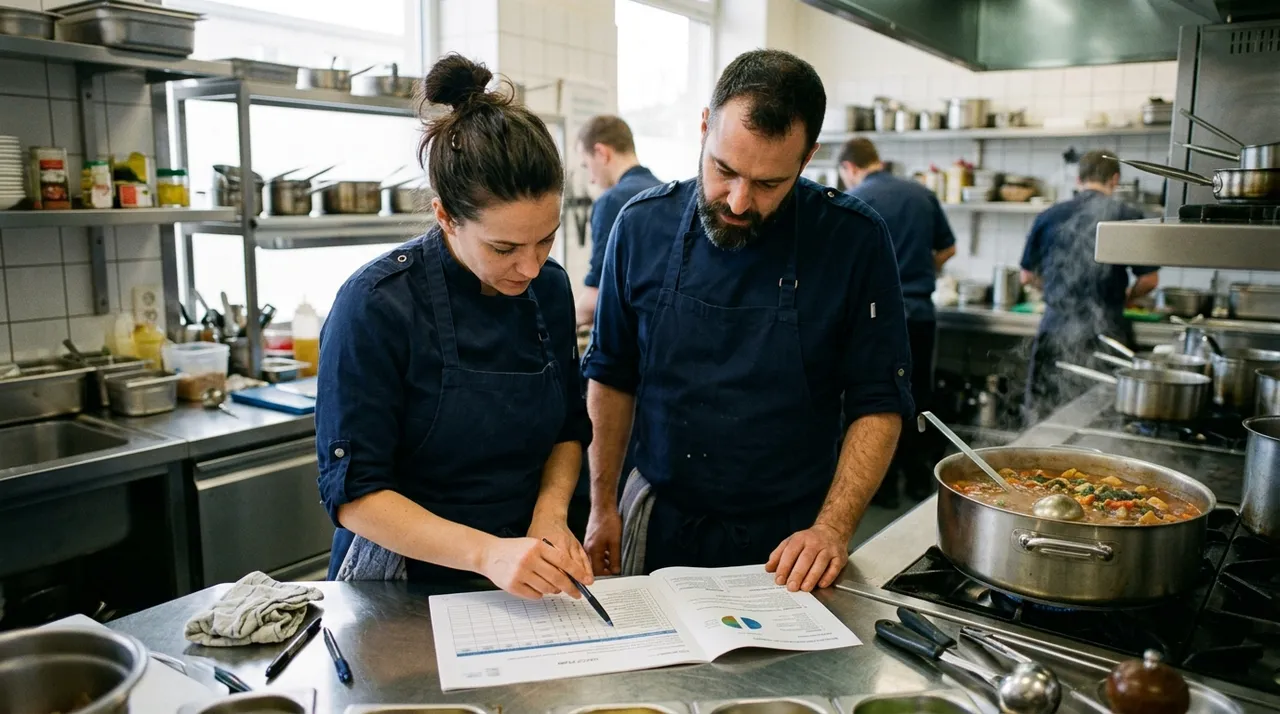
HACCP plan template: 12 Codex steps and 7 principles
The first five steps prepare the analysis. Steps 6 to 12 correspond, in order, to the seven principles. This structure follows CXC 1-1969, revision 2020, the product’s declared basis; it is not presented as the latest Codex revision. Application sequence: FAO.
Principle 6 is to establish verification procedures. Step 11 also documents validation of control measures before implementation, with evidence kept separate from routine system verification.
Start with prerequisite programmes: suppliers and receiving, water, cleaning and disinfection, pest control, maintenance, personal hygiene and training, traceability and allergens. Assess which hazards those programmes control and which need a CCP. A temperature check is not automatically a CCP; record why the control is essential at that stage.
| Step / principle | What to fill in | Brief example |
|---|---|---|
| 1. HACCP team and scopePreliminary step | Names, roles, competence, lead and deputy; site, activities and processes covered. Identify who writes, reviews and approves the plan. | Laura, head chef, leads; Marcos, sous-chef, deputises; Elena, business manager, approves. Scope: cooked meals prepared and served at the restaurant. |
| 2. Product descriptionPreliminary step | Ingredients, allergens, relevant properties, processing, packaging, storage and justified shelf life. Group products only when their hazards and controls are comparable. | Beef stew with potato, carrot and stock containing celery; cooked, chilled in covered food-grade trays and reheated for the following service. |
| 3. Intended usePreliminary step | Serving and consumption, intended consumers and vulnerable groups. Include reasonably foreseeable misuse. | Served hot to the general public on site; not supplied to vulnerable-group institutions. Reheated leftovers are discarded under this example’s operator procedure. |
| 4. Process flow diagramPreliminary step | Every stage in sequence, inputs, waits, returns, storage and leftover disposal. Include outsourced stages within the scope. | Receiving → raw storage → preparation → cooking → rapid chilling → chilled storage → reheating → hot holding → service and disposal. |
| 5. On-site confirmation of flowPreliminary step | Walk the process during actual work; record the person, date, shifts observed and corrections. Check that the diagram matches practice. | Laura observes production and service, notices the tray-filling wait and adds that step to the diagram before approval. |
| 6. Conduct a hazard analysisPrinciple 1 | For each stage, list biological, chemical and physical hazards, including allergens; origin, likelihood, severity, significance, control and reasons for inclusion or exclusion. | Slow cooling may allow Clostridium perfringens to grow; treat it as significant and control it through rapid chilling and core-temperature checks. |
| 7. Determine critical control points (CCPs)Principle 2 | Explain where control of a significant hazard is essential. Record the decision method and answers, including hazards managed through prerequisites. | Chilling is a CCP: reheating cannot be assumed to undo every instance of growth or toxin formation caused by an inadequate cooling cycle. |
| 8. Establish critical limitsPrinciple 3 | Parameter, unit, limit, scope and source for each CCP; justification for each limit. Separate legal requirements, operator limits and working targets. | Cooling: record the validated curve for this recipe, tray depth and load, with endpoints and deadlines based on applicable local requirements and supporting evidence. |
| 9. Establish a system to monitor CCPsPrinciple 4 | What, how, where, when and by whom; instrument, representative sampling and record. Monitoring must detect a deviation in time to act. | Marcos probes representative trays in each load and records the lot, starting and finishing readings and times; the equipment display is not a core measurement. |
| 10. Establish corrective actionsPrinciple 5 | Actions for the process and the food, who decides disposition, how control is restored and recurrence prevented. Keep the incident and decision. | Hold a failed cooling lot, prevent service, document its disposition and investigate loading or equipment before continuing. |
| 11. Establish verification proceduresPrinciple 6 | Record review, observation, instrument checks and results; assign people, frequencies and review triggers. Also document control-measure validation before implementation, with evidence kept separate from routine verification. | Laura reviews cycles each day; Elena reviews incidents weekly. Separate files document process validation and probe checks. |
| 12. Establish documentation and recordsPrinciple 7 | Version, approval, review date, procedures, forms, records and evidence; access, retention and change control. Blank forms do not demonstrate execution. | Manual edition A, recipe specification, hazard analysis, CCP table, lot logs and dated verification reports identifying the author and criterion used. |
HACCP plan example: cooked, chilled and reheated beef stew
Fictional worked example: The Table restaurant prepares beef stew with potato, carrot and stock containing celery, chills it and reheats it for the next day’s service. The figures below make the example readable; they are illustrative operator criteria, not validated instructions for an actual kitchen or limits attributed to a national regulator.
- Team and scope
- Laura leads production and monitoring; Marcos deputises; Elena approves and reviews incidents. Scope includes receiving, preparation and on-site service. Transport, freezing, egg processing and fish are excluded because they are not used for this recipe.
- Product and shelf life
- Beef, potato, carrot, oil, water and stock containing celery. Covered food-grade trays identified by lot. Intended service the following day; the illustrative operator procedure sets a maximum shelf life of 48 hours from cooking and core storage ≤4 °C. Both need supporting evidence and a local-requirement check before adoption.
- Intended use
- Served hot to the general public at the restaurant. Celery is communicated to customers and cross-contact is controlled; this recipe is not offered as celery-free. The example’s operator procedure discards reheated food not consumed and prohibits another reheating cycle.
- Confirmed flow
- Receiving → raw storage → preparation → cooking → portioning and rapid chilling → chilled storage → reheating → hot holding → service and disposal. Laura confirms the route during production and service on 6 October 2026 and adds tray portioning; Elena approves example edition A.
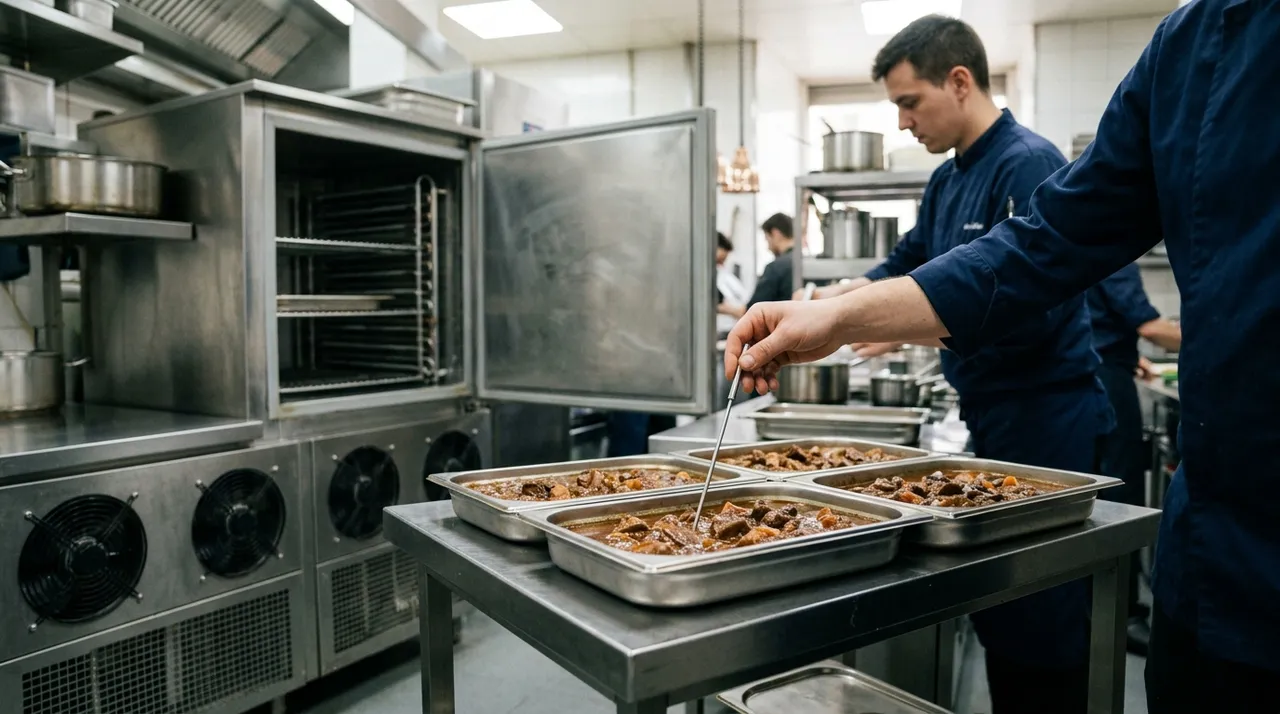
Restaurant hazard analysis
B = biological; C = chemical; P = physical; A = allergen (shown separately for clarity). The qualitative assessment explains significance and control decisions for this example.
| Stage | Hazard and origin | Assessment | Measure | Control and rationale |
|---|---|---|---|---|
| Receiving | B: pathogens in raw beef; A: undeclared celery in stock. | Significant: contamination enters the process and information may be incorrect. | Approved supplier, integrity, product-specific receiving criteria, lot and allergen specification. | Receiving prerequisite; pathogens are controlled at cooking. Celery is managed through specifications and service communication. |
| Raw storage | B: growth or cross-contamination of ready-to-eat food from raw meat. | Significant if cold storage or separation fails. | Storage appropriate to each ingredient, covered containers and raw-food separation. | Storage prerequisite; no single cooked-meal temperature is assigned to every raw ingredient. |
| Preparation | B: cross-contamination; C: cleaning residues; P: utensil fragments. | Significant if hygiene, rinsing or equipment integrity fails. | Separate tasks, follow cleaning-product instructions and check utensils. | Prerequisites with checks before work; remove damaged utensils and affected food. |
| Preparation and service | A: celery in stock and cross-contact with other allergens. | Significant: heat does not remove the allergen hazard. | Updated recipe specification, ingredient checks, clean utensils and service information. | Allergen prerequisite with change and order checks; cooking does not establish allergen absence. |
| Cooking | B: survival of pathogens from raw beef. | Significant because of severity; an effective treatment is needed. | Heat treatment validated for the recipe, load and equipment. | CCP-1: pathogen reduction; the numerical operator example needs validation before use. |
| Portioning and chilling | B: spore germination and growth, including C. perfringens. | Significant when cooling a mass of stew. | Prompt tray portioning and rapid chilling with core measurements. | CCP-2: control growth; do not rely on reheating to repair a failed cooling cycle. |
| Chilled stew | B: growth and recontamination after cooking. | Significant throughout the intended shelf life. | Covered, labelled product; core temperature and shelf-life control. | CCP-3 for cold storage, prerequisites for hygiene. Air and product temperatures are different measurements. |
| Reheating | B: survival through insufficient or uneven heating. | Significant before consumption. | Reheat and check the core, holding time and time out of refrigeration. | CCP-4: final heat control; it does not justify releasing an improperly stored lot. |
| Holding and service | B: growth or recontamination before the dish reaches the customer. | Significant during the hot-holding wait. | Core-temperature control and clean serving utensils. | CCP-5 for temperature; prerequisites for service hygiene. |
| Reheated leftovers | B: repeated exposure during another cycle. | Significant if reheated food is stored or heated again. | Separate, identify and discard unconsumed reheated food. | Operator disposal procedure linked to CCP-4; confirm applicable local requirements. |
CCPs, limits, monitoring and corrective actions
The CCPs are decisions for this example, not a mandatory list for every kitchen. Every numerical limit below is an illustrative operator criterion. Confirm your local requirements and validate the recipe, load, equipment and shelf life before using the plan.
| Stage | Hazard | Measure | Critical limit and source | Monitoring | Corrective action | Verification | Record |
|---|---|---|---|---|---|---|---|
| CCP-1 · Cooking | Pathogen survival. | Heat treatment of stew. | Illustrative operator criterion: core ≥75 °C for ≥30 seconds; validation file V-01 must support this recipe, load and equipment. Confirm your local requirements. | Marcos, every load: representative core and time at temperature; identify lot and probe. | Do not release; continue only under the validated procedure, remeasure, or hold and document disposal. | Laura reviews each load and V-01; probe checks follow V-03. | R-01: lot, core, holding time, clock time, author, criterion and incident. |
| CCP-2 · Rapid chilling | Growth of spore-formers. | Rapid cooling after portioning. | Operator criterion: a validated time–temperature cooling curve for this stew, tray depth and load, followed by the declared chilled-storage limit. Define endpoints and deadlines in V-02 from applicable local requirements and supporting evidence before use; confirm your local requirements. | Marcos, every load: core and clock time at each declared cooling endpoint and at entry to chilled storage; representative trays. | Hold the lot if a limit fails or evidence is missing; prevent service, document disposition and investigate loading or equipment. | Laura reviews every cycle; V-02 supports loading, V-03 supports probe checks. | R-02: lot, tray, endpoint readings and times, cooling intervals, author and corrective action. |
| CCP-3 · Chilled storage | Growth during shelf life. | Chill covered stew. | Illustrative operator criteria: core ≤4 °C and shelf life ≤48 hours from cooking. Support both with evidence; confirm your local requirements. | Marcos after chilling and before reheating; Laura at opening and closing. Representative product reading; operator frequency. | Hold the lot and assess exposure and shelf life. Move it if appropriate; cooling it again does not alone justify release. | Laura reviews daily; Elena reviews incidents and shelf-life evidence. | R-03: lot, core, time, author, use-by time and disposition. |
| CCP-4 · Reheating | Insufficient heating. | Uniform heat treatment. | Illustrative operator criterion: core ≥75 °C for ≥30 seconds, within ≤1 hour out of refrigeration. Validate in V-01 and confirm your local requirements. | Marcos, every cycle: removal time, core, time at temperature and finishing time. | Do not serve. Complete only within the procedure and deadline; otherwise hold and document disposal. Discard unconsumed reheated food under the operator procedure. | Laura reviews each cycle and disposal; V-01/V-03 support method and instrument. | R-04: lot and portion, removal time, core, holding time, finish, leftovers and author. |
| CCP-5 · Hot holding | Growth before consumption. | Keep hot until service. | Illustrative operator criterion: core ≥65 °C; equipment setpoint established separately. Validate holding conditions and confirm your local requirements. | Marcos at service start and each replenishment; Laura before closing. Core measurement; frequency set for this example’s service. | Remove the affected tray from service; decide disposition under the exposure procedure. Do not start another reheating cycle. | Laura reviews readings and observes service daily; Elena reviews recurring causes weekly. | R-05: lot, tray, clock time, core, author, exposure, corrective action and disposition. |
- Validate before implementation
- V-01 must contain evidence for the cooking and reheating treatments; V-02 must cover the chilling curve, tray configuration and load. Shelf life also needs supporting evidence. This example supplies no actual validation study: replace its illustrative criteria with justified controls checked against local requirements before operating.
- Verify during operation
- Laura reviews R-01 to R-05 daily and observes measurements; Elena reviews incidents weekly. V-03 defines probe checks, tolerance and frequency based on the instrument and risk. These are example operator frequencies, not universal legal minimums. Each verification records the date, person, result and follow-up.
- Documents and review
- Example edition A, approved by Elena on 6 October 2026. The operator schedules review before the next menu change and after incidents or changes in supplier, recipe, equipment or process. Keep a lot-linked archive of hazards, CCPs, V-01/V-02/V-03, monitoring and corrective actions; justify retention in the document-control procedure.
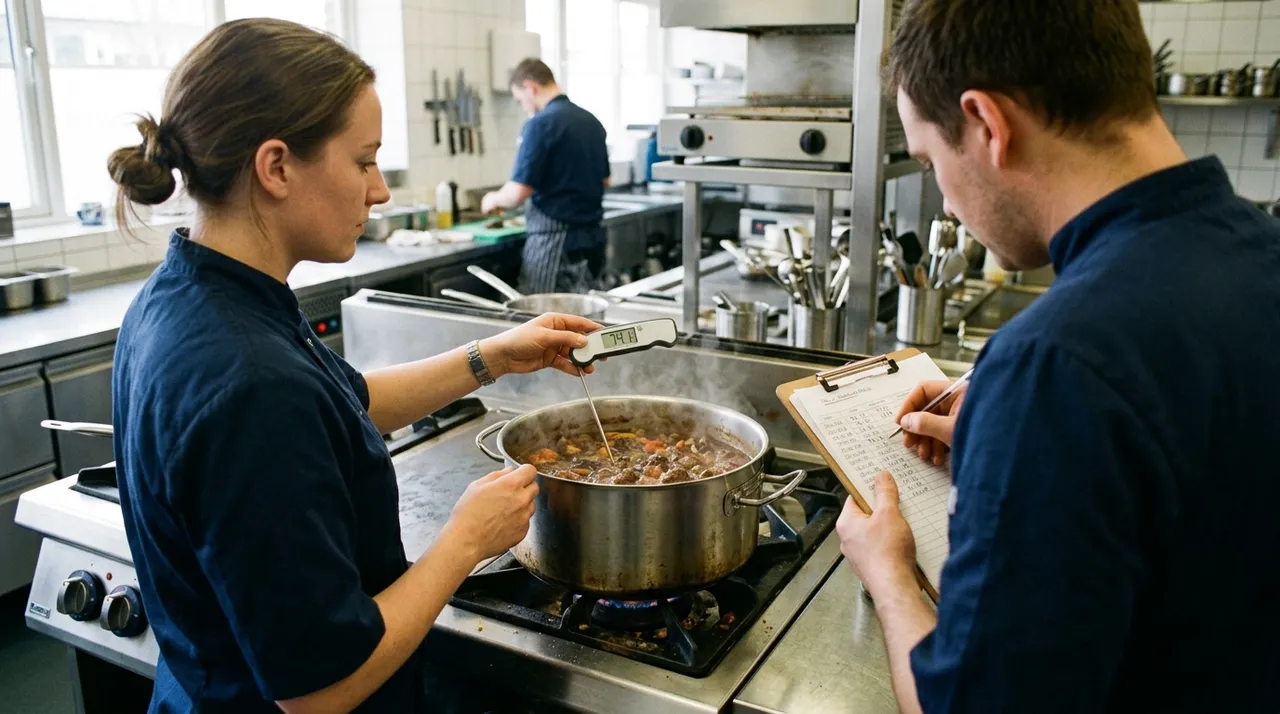
Download the blank HACCP plan template
The print layout includes business identity, space for the twelve steps and blank hazard and CCP tables. Choose “Save as PDF” in your browser; you can turn off browser headers and footers. The HTML download contains the same document and can be opened in Word to edit its tables.
Preview the blank template before printing
Blank HACCP plan template
Miselup · 2026-10-06 · Codex CXC 1-1969 (2020)
Complete for the business: confirm local requirements, justify limits, validate controls and approve the plan before use. This form does not establish that controls were performed.
| Business and address | |
|---|---|
| Country and applicable requirements | |
| Product / family | |
| Edition and date | |
| Prepared / reviewed / approved by | |
| Prerequisites and references | |
| Next review and record retention |
The 12 plan steps
1. HACCP team and scope · Preliminary step
Names, roles, competence, lead and deputy; site, activities and processes covered. Identify who writes, reviews and approves the plan.
2. Product description · Preliminary step
Ingredients, allergens, relevant properties, processing, packaging, storage and justified shelf life. Group products only when their hazards and controls are comparable.
3. Intended use · Preliminary step
Serving and consumption, intended consumers and vulnerable groups. Include reasonably foreseeable misuse.
4. Process flow diagram · Preliminary step
Every stage in sequence, inputs, waits, returns, storage and leftover disposal. Include outsourced stages within the scope.
5. On-site confirmation of flow · Preliminary step
Walk the process during actual work; record the person, date, shifts observed and corrections. Check that the diagram matches practice.
6. Conduct a hazard analysis · Principle 1
For each stage, list biological, chemical and physical hazards, including allergens; origin, likelihood, severity, significance, control and reasons for inclusion or exclusion.
7. Determine critical control points (CCPs) · Principle 2
Explain where control of a significant hazard is essential. Record the decision method and answers, including hazards managed through prerequisites.
8. Establish critical limits · Principle 3
Parameter, unit, limit, scope and source for each CCP; justification for each limit. Separate legal requirements, operator limits and working targets.
9. Establish a system to monitor CCPs · Principle 4
What, how, where, when and by whom; instrument, representative sampling and record. Monitoring must detect a deviation in time to act.
10. Establish corrective actions · Principle 5
Actions for the process and the food, who decides disposition, how control is restored and recurrence prevented. Keep the incident and decision.
11. Establish verification procedures · Principle 6
Record review, observation, instrument checks and results; assign people, frequencies and review triggers. Also document control-measure validation before implementation, with evidence kept separate from routine verification.
12. Establish documentation and records · Principle 7
Version, approval, review date, procedures, forms, records and evidence; access, retention and change control. Blank forms do not demonstrate execution.
| Stage | Hazard / origin | Likelihood / severity | Significance and reason | Measure / responsible person | Prerequisite or CCP and rationale |
|---|---|---|---|---|---|
| Stage / CCP | Hazard | Measure | Limit / unit / source | Monitoring / person / frequency | Corrective action / disposition | Validation / verification | Record |
|---|---|---|---|---|---|---|---|
Reference template and example: https://miselup.pro/en/appcc/haccp-plan-template/
From the paper plan to Miselup’s C-10 manual and record book
- Prepare the draft with the site, activity and responsible people. In Spain, review the applicable Spanish legal catalog; in every other country, declare hazards, criteria, frequencies and process windows under Codex.
- Assess hazards: adopt or exclude with reasons, explain significance and link them to control points. Complete the team, scope, intended use, flow and on-site confirmation; document limits, monitoring, corrective actions and verification.
- Review the C-10 manual and outstanding items. Approval seals the exact review with the person, date and edition; signing does not fill missing documentation. The report separates the sealed manual, operational changes and period records.
- Configure the processes your kitchen uses. Miselup records cooking, chilling and reheating, plus egg preparation, anisakis treatment and thawing; two-act processes require a finish or abandonment. The record book keeps measurements, authors, times, gaps, incidents and reasoned voids.
The template is not imported automatically. It helps prepare decisions and transfer them into the plan. Miselup documents the system; local legislative suitability requires the operator’s review. The full suite belongs to the Mise Pro HACCP plan.
Template sources, date and scope
Editorial authorship: Miselup. Updated 6 October 2026. This fictional example explains the method and requires business-specific adaptation and evidence. The product’s reference is Codex CXC 1-1969, revision 2020; consult the official index for published editions.
HACCP plan template and example FAQs
What should a HACCP plan template include?
A HACCP plan template should include the team, product, intended use, process flow and on-site confirmation, hazard analysis, CCPs, critical limits, monitoring, corrective actions, validation, verification and records. Identify responsibilities, sources and document versions. Prerequisite programmes and evidence of actual controls complete the system; downloading a template only prepares its documentation.
How do the 12 HACCP steps relate to the 7 principles?
The twelve HACCP steps organise plan development. The first five establish the team, describe the food and its use, and confirm the actual process. The remaining seven apply the principles, from hazard analysis through record keeping. Validation establishes whether controls can work; verification checks their continued implementation and effectiveness during operation.
Can I use this HACCP plan example for any restaurant?
This restaurant HACCP plan example explains how hazards, controls and records connect for a cooked, chilled and reheated stew. Adapt it to your recipes, equipment, loads, staff and customers. CCP decisions, shelf life, limits and monitoring frequencies need assessment and supporting evidence for your business. Confirm your local requirements before adopting controls.
Does Codex prescribe the temperatures in this example?
Codex provides the HACCP method and calls for validated controls and critical limits; it does not prescribe one temperature schedule for every restaurant dish. The English example’s numerical limits are illustrative operator criteria. They need validation for the actual food and process, and a check against applicable local requirements before use.
Is this HACCP plan template suitable for the US or UK?
The Codex structure can help organise a HACCP plan for a US or UK business, but this template does not establish compliance with national or local rules. Confirm your local requirements for the activity, product and jurisdiction. In Miselup, countries outside Spain use Codex and operator criteria, without Spanish limits becoming local law.
How do I download a blank HACCP plan as PDF or edit it in Word?
Select “Print / save as PDF” to print only the blank HACCP template, including the twelve steps and hazard and CCP tables. Your browser can save that printout as PDF. You can also download the tables as HTML, open them in Word and edit them. No account or external conversion service is required.
What is the difference between a HACCP manual and a record book?
A HACCP manual states the hazards, controls, limits, responsibilities and procedures the business has adopted. A record book shows what happened: measurements, times, authors, incidents and corrective actions. Miselup’s report separates the sealed manual, operational changes and period records, and displays outstanding documentation. A signed manual does not remove those outstanding items.
How often should a HACCP plan be reviewed and verified?
Set HACCP verification frequencies according to risk, activity and the documented procedures. Review the plan when recipes, equipment, suppliers, intended consumers or processes change, and after relevant failures. The example’s daily and weekly reviews are operator decisions, not universal legal intervals. Keep the reviewer, date, findings and resulting actions in the records.
What should I do when a critical limit is missed?
When a HACCP critical limit is missed, stop releasing affected food, identify the lot and follow the documented corrective procedure. Record the actual readings, exposure, responsible person and food disposition. Restore process control and investigate the cause. A later satisfactory temperature alone does not prove that an earlier unsafe exposure has been resolved.
How do I transfer this HACCP plan into Miselup?
With the Mise Pro HACCP plan, prepare a draft, assess hazards, link them to controls and complete the team, scope, intended use, flow and on-site confirmation. Declare missing criteria and procedures, review the C-10 manual and sign the reviewed edition. Then record processes and consult the record book, including outstanding documentation and gaps.