HACCP for ice cream shops: production, display and service plan
By Miselup team · Updated:
A HACCP plan for an ice cream shop identifies hazards in mixes, additions, storage and service and explains their controls. It describes in-house production or purchased finished ice cream, with monitoring, corrective action and verification along each product route.
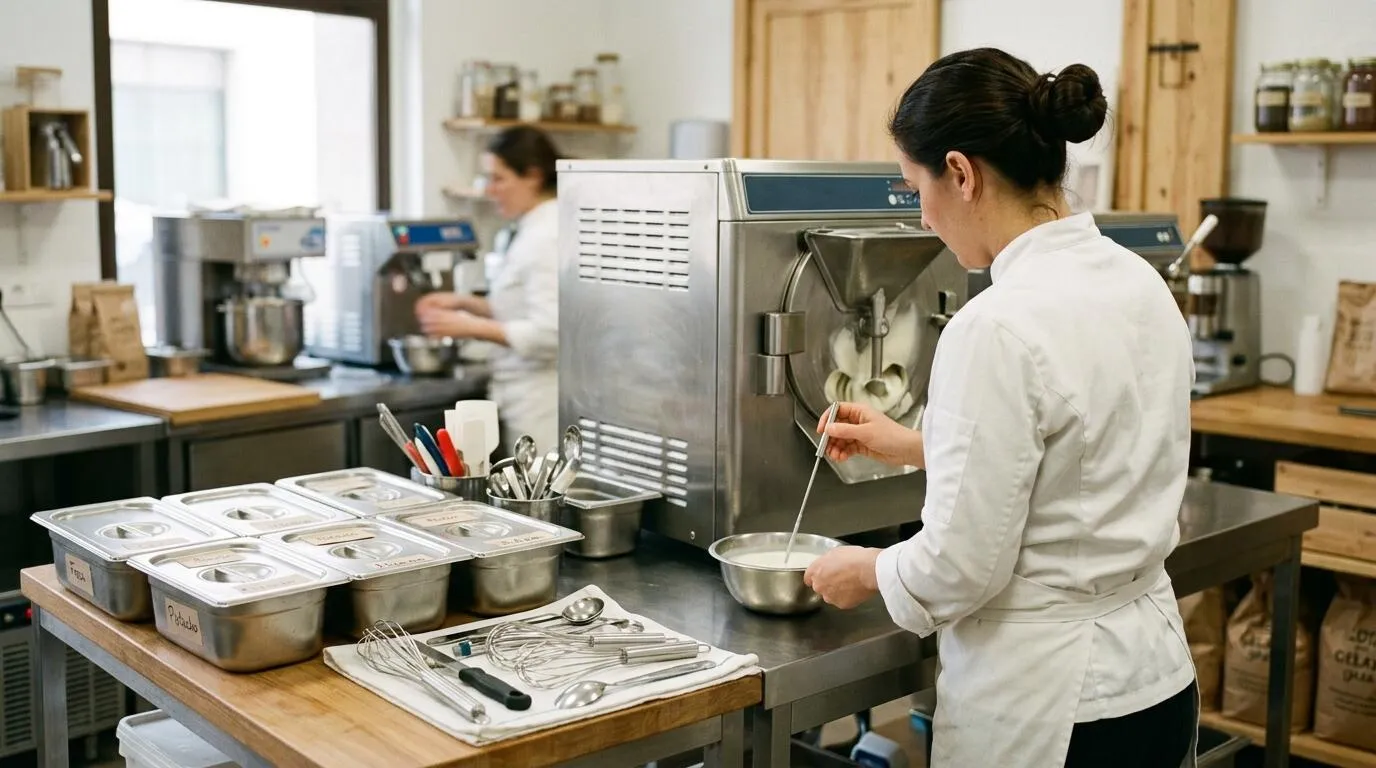
A mix is treated, aged and churned, then receives sauce or nuts and moves to the display. At the counter, scoops, rinse water, cones and tubs create shared handling routes while each replenishment needs to retain its identity.
This example starts with a dairy mix made on site using an operator-declared treatment. If you only receive finished ice cream, remove stages you do not perform; Mise Pro HACCP helps organise checks without assuming every shop pasteurises mixes.

Mix production and scooping have different hazards
The plan distinguishes making mixes, receiving treated bases and selling finished ice cream. It also follows inclusions and scoops after treatment through to the cone or cup supplied.
Separate in-house mixes, purchased treated bases and finished ice cream. Receiving a treated base does not establish treatment of a new mix after ingredients are added; support the actual recipe, equipment and production procedure.
After treatment, describe cooling, ageing, churning and addition of inclusions. Cleaning pipes, seals and removable parts and protecting the mix matter alongside thermal observations because contamination may be introduced after the final effective treatment.
A scoop and its water container can connect flavours and tubs. Define a hygienic system for use, cleaning and renewal that staff can execute, including allergy requests and the destination of ice cream with altered cold-chain history; returning it to cold storage cannot erase exposure.
A food flow to confirm in your operation
- 1.Receive dairy, bases and inclusions
- 2.Store and review opened ingredients
- 3.Prepare identified mix
- 4.Apply declared treatment where used
- 5.Cool and age under the procedure
- 6.Churn and add inclusions hygienically
- 7.Conserve tubs in frozen display
- 8.Serve, clean utensils and decide leftovers
Food safety hazards in ice cream shops
Mixes and additions can become contaminated before or after the declared treatment. Assess machine-cleaning residues, damaged parts and allergens shared through tubs, cones and utensils as well.
Biological
Insufficient treatment, mix contamination after treatment or contaminated scoop water.
How to control it: Support treatment and the subsequent route and define utensil cleaning, protection and renewal.
Chemical
Detergent or disinfectant residues in circuits, seals and tubs.
How to control it: Follow dismantling, dosing, contact and rinsing instructions and check equipment before use.
Physical
Seal, spatula or inclusion-package fragments reaching the mix.
How to control it: Inspect parts and tools, control package opening and remove food exposed to breakage.
Allergens
Milk, egg, nuts or cone wheat omitted from information; scoops and water carrying allergens between flavours.
How to control it: Review bases and inclusions, establish service utensils and cleaning and explain actual options for allergy requests.
Ice cream processes: mix treatment, ageing and churning
The operator supports and declares mix pasteurisation without copying a generic cooking number. Cooling, egg and thawing forms cover only actual branches; ageing and churning need their own procedures rather than a promised specialist form.
Declared treatment of an in-house mix
The shop applies heat treatment to its mix; omit it for received finished ice cream.
Criterion: Operator-supported treatment for the actual composition, equipment and process, with local requirements checked. This page prescribes no universal pasteurisation pairing.
Codex Alimentarius · General Principles of Food Hygiene, CXC 1-1969
Recording in Miselup: Support the procedure and declare activity appropriate to the configured thermal control. A cooking record can retain observations but does not automatically validate pasteurisation.
Cooling after mix treatment
Treated mix is cooled before ageing; distinguish this from churning.
Criterion: Support the mix's cooling and storage conditions and check local requirements before configuring criteria. Ageing does not start a new shelf life.
Codex Alimentarius · General Principles of Food Hygiene, CXC 1-1969
Recording in Miselup: If the plan configures cooling, record its acts and mix identity and retain the ageing procedure separately. Churning cannot establish earlier cooling.
Optional reheated food in another range
Only previously cooked and cooled food served hot uses this branch; the example's ice cream does not.
Criterion: Support reheating and service of that food under local rules. Miselup restricts repeated reheating as a product rule; this is not a pasteurisation criterion for ice cream.
Codex Alimentarius · General Principles of Food Hygiene, CXC 1-1969
Recording in Miselup: Do not open reheating when softening a tub. Declare the separate route for stored cooked food and record removal from cold storage and completed treatment.
Egg-containing mix or inclusion
Egg appears in the recipe; an egg-free sorbet does not use this process merely because equipment is shared.
Criterion: Check ingredient suitability, treatment and local egg requirements for the actual preparation. Review storage and shelf life without substituting a generic pasteuriser setting.
Codex Alimentarius · General Principles of Food Hygiene, CXC 1-1969
Recording in Miselup: Identify ingredient and actual preparation route and review egg handling separately from later inclusion in the mix. Document supported treatment or suitable egg-product use.
Raw fish in a separate range, only if prepared
Only if the establishment prepares additional products containing susceptible raw fish; this does not apply to the example's ice cream.
Criterion: Support parasite control for the actual fish and check your local requirements. Keeping ice cream frozen cannot establish treatment of another product.
Codex Alimentarius · General Principles of Food Hygiene, CXC 1-1969
Recording in Miselup: Assess that fish separately and keep its treatment evidence. This route does not apply to dairy mix, sorbet or nuts.
Ingredients thawed before preparation
An ingredient is thawed before inclusion; service softening is not a validated thawing route.
Criterion: Support thawing and cold-chain controls under local requirements. Miselup restricts refreezing without documented transformation; hardening ice cream again does not demonstrate that transformation.
Codex Alimentarius · General Principles of Food Hygiene, CXC 1-1969
Recording in Miselup: Identify portion, method and destination before use. Protect a partially thawed tub and document the responsible person's decision rather than silently returning it to storage.
Example plan: in-house dairy mix and tub service
The shop treats its mix, cools, ages and churns it before frozen display. Pasteurisation procedures and supported criteria belong to the operator; the example does not replace them with generic figures.
On smaller screens, scroll the table horizontally to read every control.
| Stage | Hazard | Control measure | Limit / criterion | Monitoring | Record in Miselup |
|---|---|---|---|---|---|
| Receive dairy base and inclusions | Unsuitable ingredients or altered cold chain. | Check supplier, batch, integrity and instructions. | Ingredient-specific acceptance criteria under local requirements. | Inspect delivery and separate rejected goods. | Ingredient receiving with an available obligation. |
| Prepare the mix | Contamination from tools or opened ingredients. | Use clean equipment and retain ingredient and mix identity. | Shop preparation and cleaning procedure. | Check opening histories, bench, tubs and tools. | Preparation cleaning and disinfection. |
| Apply declared treatment | Insufficient heat treatment. | Apply the mix's supported procedure and review its execution. | Operator treatment and process conditions; no universal pasteurisation number or automatic app validation. | Record required observations and retain procedure evidence. | Thermal capture if the configured cooking control covers the observations; separate procedure evidence. |
| Cool and age the mix | Growth or contamination after treatment. | Control cooling, storage and mix protection. | Supported mix and ageing criteria without a universal duration. | Complete cooling and review conservation during ageing. | Cooling where configured and food conservation; no specialist ageing form. |
| Churn and add inclusions | Machine contamination or unexpected allergen. | Check dismantling, clean assembly and inclusion composition. | Equipment instructions and actual recipe; churning establishes no kill step. | Inspect seals, parts and additions at planned changes. | Cleaning and verified matrix, with churning in the procedure. |
| Keep tubs in frozen display | Lost cold conditions or tub identity. | Separate tubs and maintain supported product conditions. | Product-specific conservation and supplier instructions, distinct from equipment readings. | Check food, display and replenishments under the plan. | Ice cream conservation and display checks. |
| Serve with scoops and cones | Contaminated utensil water and allergen cross-contact. | Execute the defined scoop, cleaning and water-renewal system. | Service procedure and actual ice cream, cone and topping composition. | Review utensils and confirm allergy requests. | Water, cleaning and allergen checks. |
| Close and decide destinations | Unjustified refreezing or dirt retained in equipment. | Isolate tubs with altered history and dismantle equipment as instructed. | Documented food decision; freezing again provides no automatic recovery. | Review incidents, destinations and final cleaning. | Food conservation with action taken and equipment cleaning. |
Pasteurisation, ageing and churning are not specialist Miselup form names. Keep the operator's procedures and evidence and use available captures only when they represent actual observations; record disposition of tubs with altered cold-chain conditions.
How to measure and record temperatures: the measurement method
Organising mix, tubs and service with Miselup
Identify the mix and checks following it to display. Handover also reviews utensils, changed inclusions and tubs with incidents.
The mix before churning
Declare the thermal processes configured by the plan and complete observations linked to the lot. Keep pasteurisation and ageing procedures as supporting documentation; starting or finishing a capture cannot validate the procedure by itself.
Each tub in the display
Record food and equipment separately and preserve identity during replenishment. With an applicable conservation control configured in the HACCP plan, a produced lot can generate a required obligation; staff measure, link the observation and decide the destination after loss of control.
A change of flavour and scoop
Review recipes, inclusions, cones and toppings and record the verified allergen matrix. Include water and cleaning checks for service; the app neither detects traces nor automatically checks the water used with scoops.
The Miselup HACCP software hub explains the scope of Mise Pro and Mise Pro HACCP and how the manual, records, processes, verification, notifications, team portal and reports work.
Common gaps to address before an inspection
A cold display establishes neither correct mix treatment nor a clean scoop. Review production evidence, equipment dismantling, tub identity and responses to lost cold-chain conditions.
-
Every base is assumed to cover the finished mix
Added ingredients change composition and route. Review evidence for the actual mix made.
-
Ageing resets the date
Resting does not start another history. Preserve batch, times and conditions from preparation.
-
Freezing is treated as a kill step
Churning and display cannot replace treatment or subsequent hygiene.
-
Scoops sit in water without a procedure
They can connect contamination and flavours. Define use, cleaning and renewal and check execution.
-
Cones and toppings disappear from allergen information
The guest receives more than ice cream. Review composition and tools for the complete serving.
-
A softened tub returns without a decision
Recovered texture does not establish safety. Isolate, assess history and record disposition.
Daily HACCP checklist for ice cream shops
Opening checks include tubs, display, utensils and the water system used for service. During production and sale, complete declared processes and review additions, allergy requests and closing destinations.
-
Review tubs and handover
Identify batches, previous conditions and unresolved decisions before opening.
-
Ready displays and equipment
Check scheduled controls, probes and clean assembly of parts and seals.
-
Accept ingredients
Review bases, dairy and inclusions with opening and storage instructions.
-
Declare mix and treatment
Identify recipe and lot and apply the appropriate supported procedure.
-
Complete cooling and ageing
Record available acts and retain ageing evidence under the plan.
-
Churn and replenish with identity
Review equipment and additions and avoid mixing tubs with different histories.
-
Control service and allergy requests
Execute the scoop and water system and confirm ice cream, cone and topping.
-
Close, clean and decide destinations
Manage affected tubs, dismantle equipment and hand over incidents and open processes.

Frequently asked questions: HACCP for ice cream shops
Ice cream questions depend on whether the shop makes mixes or receives ready-to-sell products. These answers separate treatment, ageing, churning and service without universal numbers or safety guarantees from freezing.
Does buying finished ice cream change the HACCP plan?
What pasteurisation temperature should my mix use?
Are ageing and churning the same control?
Can scoops stay in water throughout service?
Which allergens matter beyond the ice cream flavour?
Can I refreeze a tub that has softened?
Does Miselup provide specialist ageing and churning forms?
Does a frozen display automatically log the ice cream?
Related guides and businesses
This page follows the ice cream shop's operations; the temperature guide develops measurement and record design. For a shared pastry workshop, review the other route's fillings, assembly and allergens too.
- HACCP temperature logging
Define observations and distinguish food, process and equipment.
- Allergen control planning
Develop flavour, cone, topping and utensil procedures.
- Bakery and pastry HACCP plan
Review fillings and assembly in a shared pastry workshop.
Connect the mix plan with display and service
Define what you produce and how each flavour is stored and served. Mise Pro HACCP helps organise the ice cream shop's procedures, checks and records.